2 Kings 19: 1-7
1 When King Hezekiah heard it, he tore his clothes, covered himself with sackcloth, and went into the house of the LORD. 2 And he sent Eliakim, who was in charge of the palace, and Shebna the secretary, and the senior priests, covered with sackcloth, to the prophet Isaiah son of Amoz. 3 They said to him, “Thus says Hezekiah: This day is a day of distress, of rebuke, and of disgrace; children have come to the birth, and there is no strength to bring them forth. 4 It may be that the LORD your God heard all the words of the Rabshakeh, whom his master the king of Assyria has sent to mock the living God, and will rebuke the words that the LORD your God has heard; therefore lift up your prayer for the remnant that is left.” 5 When the servants of King Hezekiah came to Isaiah, 6 Isaiah said to them, “Say to your master: Thus says the LORD: Do not be afraid because of the words that you have heard, with which the servants of the king of Assyria have reviled me. 7 I myself will put a spirit in him so that he shall hear a rumor and return to his own land; I will cause him to fall by the sword in his own land.”
The narration of 2 Kings 19 speaks in unison with Isaiah 37 as the prophetic voice brings a note of hope into this critical moment in the life of Jerusalem. The threats of Rabshakeh, and by extension King Sennacherib of Assyria, are now relayed to King Hezekiah and then to the LORD the God of Israel. The hope of the land now rests in the hope the prophet’s intercession with living God will cause this God to act on behalf of the city. King Hezekiah, a king who did right in the sight of the LORD as his ancestor David had done, and the Prophet Isaiah stand with the LORD the God of Israel against the arrayed forces of the empire of Assyria that call from beyond the walls of the city.
The perspective of the narrator of 2 Kings is that the LORD the God of Israel is trustworthy and that the fall from the nation of Israel’s pinnacle under David and Solomon to the reality at the time of Hezekiah where Samaria has been captured and Jerusalem stands under threat was precipitated by the unfaithfulness of the kings and people. Yet, Hezekiah is a king who has shown faithfulness to God’s vision for the people and has been aligned with the prophet Isaiah. In contrast to the bold and idolatrous voice of Rabshakeh and Sennacherib, here Hezekiah assumes the expected posture of repentance: he tears his clothes and covers himself in sackcloth before the LORD as a sign of distress and repentance. As the prophet Isaiah says:
On that day the Lord God of hosts
called for weeping and mourning,
for baldness and putting on sackcloth, Isaiah 22:12[1]
Now the king assumes this posture of weeping and mourning on this day of distress. The king utilizes the image of a woman who comes to the point of childbirth where the child is in the birth canal and needs the mother to push the child out into the world, but the mother does not have the strength to move the child from this place of extreme pain and danger from both the child and the mother. Hezekiah and Jerusalem are powerless to bring about their own deliverance and can only rely upon the LORD to respond and rescue them.
The king and the prophet relay the mocking words of Rabshakeh and Sennacherib to the LORD in the hope that God will respond and rebuke these arrogant words and actions. Isaiah relays to the servants to Hezekiah God’s response which begins with the reassuring words, “Do not be afraid.” Hezekiah and Isaiah have trusted in God against the overwhelming and mocking might of the Assyrians, and God will not be mocked. God will put a spirit in the king, not unlike the action of the ‘lying spirits’ that Micaiah mentions that deceive King Ahab,[2] which lead him away from Jerusalem and eventually to his death.
2 Kings 19: 8-13
8 The Rabshakeh returned and found the king of Assyria fighting against Libnah, for he had heard that the king had left Lachish. 9 When the king heard concerning King Tirhakah of Cush, “See, he has set out to fight against you,” he sent messengers again to Hezekiah, saying, 10 “Thus shall you speak to King Hezekiah of Judah: Do not let your God on whom you rely deceive you by promising that Jerusalem will not be given into the hand of the king of Assyria. 11 See, you have heard what the kings of Assyria have done to all lands, destroying them utterly. Shall you be delivered? 12 Have the gods of the nations delivered them, the nations that my predecessors destroyed: Gozan, Haran, Rezeph, and the people of Eden who were in Telassar? 13 Where is the king of Hamath, the king of Arpad, the king of the city of Sepharvaim, the king of Hena, or the king of Ivvah?”
14 Hezekiah received the letter from the hand of the messengers and read it; then Hezekiah went up to the house of the LORD and spread it before the LORD. 15 And Hezekiah prayed before the LORD and said, “O LORD the God of Israel, who are enthroned above the cherubim, you are God, you alone, of all the kingdoms of the earth; you have made heaven and earth. 16 Incline your ear, O LORD, and hear; open your eyes, O LORD, and see; hear the words of Sennacherib, which he has sent to mock the living God. 17 Truly, O LORD, the kings of Assyria have laid waste the nations and their lands 18 and have hurled their gods into the fire, though they were no gods but the work of human hands—wood and stone—and so they were destroyed. 19 So now, O LORD our God, save us, I pray you, from his hand, so that all the kingdoms of the earth may know that you, O LORD, are God alone.”
Jerusalem may be the capital of a small kingdom caught between the aggressive Assyrian empire and the movements of Egypt to the south, but the audacity of the Jewish belief is that the God of Israel is the LORD of hosts behind not only the armies of heaven but behind the movement of the armies on the face of the earth. The rumored or real movement of the armies of King Tirhakah of Cush[3] prevent a threat to the Assyrians in Judah that must be addressed and this causes both King Sennacherib to move from Lachish and the emissaries of the king of Assyria to prepare to move in support of their king. Yet, King Sennacherib does not want to allow Jerusalem to believe that it has escaped his judgment, and that any removal of the threat is temporary. The Assyrians have conquered numerous other nations and their gods, and in the eyes of Sennacherib Jerusalem, Hezekiah and the LORD are no different. In a similar way Joseph Stalin is attributed with remarking millennia later about the pope, “How many divisions hath the pope?” In the eyes of the empire of the day might makes their position right.
King Hezekiah of Jerusalem views the world differently; it is the LORD who makes things right. Hezekiah takes these words delivered by the messenger, enters the house of the LORD and spreads these words before the LORD. Hezekiah’s prayer calls on the LORD to hear, see, and respond to the mocking words of King Sennacherib. The Assyrians may have defeated the other nations and their gods, who were really no gods at all, but now they have challenged the creator of the heavens and the earth. King Hezekiah calls on God to save Jerusalem from the hands of the Assyrians and to demonstrate that the LORD the God of Israel is the only true God.
2 Kings 19: 20-34
20 Then Isaiah son of Amoz sent to Hezekiah, saying, “Thus says the LORD, the God of Israel: I have heard your prayer to me about King Sennacherib of Assyria. 21 This is the word that the LORD has spoken concerning him:
She despises you; she scorns you—
virgin daughter Zion;
she tosses her head—behind your back,
daughter Jerusalem.
22 Whom have you mocked and reviled?
Against whom have you raised your voice
and haughtily lifted your eyes?
Against the Holy One of Israel!
23 By your messengers you have mocked the Lord,
and you have said, ‘With my many chariots
I have gone up the heights of the mountains,
to the far recesses of Lebanon;
I felled its tallest cedars,
its choicest cypresses;
I entered its farthest retreat,
its densest forest.
24 I dug wells
and drank foreign waters,
I dried up with the sole of my foot
all the streams of Egypt.’
25 Have you not heard
that I determined it long ago?
I planned from days of old
what now I bring to pass,
that you should make fortified cities
crash into heaps of ruins,
26 while their inhabitants, shorn of strength,
are dismayed and confounded;
they have become like plants of the field
and like tender grass,
like grass on the housetops
that is scorched before the east wind.
27 But I know your sitting
and your going out and your coming in
and your raging against me.
28 Because you have raged against me
and your arrogance has come to my ears,
I will put my hook in your nose
and my bit in your mouth;
I will turn you back on the way
by which you came.
29 “And this shall be the sign for you: This year you shall eat what grows of itself and in the second year what springs from that; then in the third year sow, reap, plant vineyards, and eat their fruit. 30 The surviving remnant of the house of Judah shall again take root downward and bear fruit upward, 31 for from Jerusalem a remnant shall go out and from Mount Zion a band of survivors. The zeal of the LORD of hosts will do this.
32 “Therefore thus says the LORD concerning the king of Assyria: He shall not come into this city, shoot an arrow there, come before it with a shield, or cast up a siege ramp against it. 33 By the way that he came, by the same he shall return; he shall not come into this city, says the LORD. 34 For I will defend this city to save it, for my own sake and for the sake of my servant David.”
The poetic response to King Hezekiah’s prayer and King Sennacherib’s mocking letter is delivered through Isaiah and the instrument of the word of the LORD. Jerusalem, personified as a woman, despises and mocks Sennacherib and Assyria, but ultimately it is not Jerusalem that has been disrespected but the Holy One of Israel. Sennacherib has misunderstood his military successes as his own action, but the poem reveals the truth understood from the biblical perspective: the LORD the God of Israel is the LORD of hosts (or armies). The LORD has allowed Sennacherib and Assyria to enjoy the success they have seen, but now they have bitten the hand that fed them. The mocking words of Sennacherib have provoked a reaction from the LORD and now a hook in the nose and a bit in the mouth symbolically shows the powerful king as an unruly animal brought under control by force. Sennacherib will have his head turned like a horse or mule to direct this recalcitrant tyrant back to Ninevah.
The sign discussing eating what grows from the ground for two years before replanting and sowing not only grain, but vineyards set a period for recovery in the aftermath of Assyria’s invasion. The invasion of a land does not only focus on cities. The agricultural land also is used by the invading army as a source of food and unutilized crops are often destroyed to deny food to the invaded population. Yet, the LORD promises there will be enough to glean from the remnant of the current years crop and the volunteer crop of the following year as the armies return to Assyria and depart not only the region around Jerusalem but the entirety of the productive land of Judea. In the third year there will be the security to plant not only annual crops like wheat and barley but also to plant vineyards and to begin to restore the productivity of the land. The expulsion of the armies of Assyria allows both the people and the land to take root and bear fruit. Both nations and people can recover and grow from the remnant of the people of Judah who are gathered in Jerusalem.
The LORD also indicates that the threat to Jerusalem will end without the activities of a siege: no arrows shot into the city, no shields and siege ramps cast up against the walls of Jerusalem. This indicates the army camped near Jerusalem will depart almost immediately before the work of the siege can begin. The LORD promises here to act both on God’s behalf, for the sake of the honor of the name of the LORD which has been insulted by Sennacherib’s words, but also for the sake of David and his faithful heir Hezekiah.
This moment when the armies of Assyria are turned away at the gates of Jerusalem will encourage a focus on the city of Jerusalem, the temple, and the Davidic line as guarantees of divine protection by the LORD. The emergence of a Zion theology, where temple and city occupy a privileged place before God will have to be deconstructed by later prophets like Jeremiah, but in this moment of a faithful king who appeals to God through the prophet Isaiah and in prayer in the temple God answers the prayer of the faithful one. Nevertheless, as Alex Israel states:
When the Temple was eventually destroyed, kings and commoner alike were astonished. They simply failed to comprehend that Jerusalem could fall. Why? Because the victory against Sennacherib had engendered the belief that Jerusalem was under divine protection, that it was invincible.
Similarly, Jeremiah (ch.7) seeks to persuade the people of Jerusalem to stop believing blindly that the Temple was fundamentally indestructible, that God would never abandon His Temple. (Israel, 2019, p. 303)
Or as Lamentations 4:12 states:
The kings of the earth did not believe, nor did any of the inhabitants of the world, that foe or enemy could enter the gates of Jerusalem.
Yet from the perspective of 2 Kings the faithfulness of the king and the people matter. God did not rescue Samaria from Assyria and from the perspective of 2 Kings that conquest is a judgment upon the kings and people of Samaria and their idolatrous practices. Hezekiah restores the people to proper worship of the LORD, and his faithfulness and prayer change God’s authorization of Assyria’s conquest.
2 Kings 19: 35-37
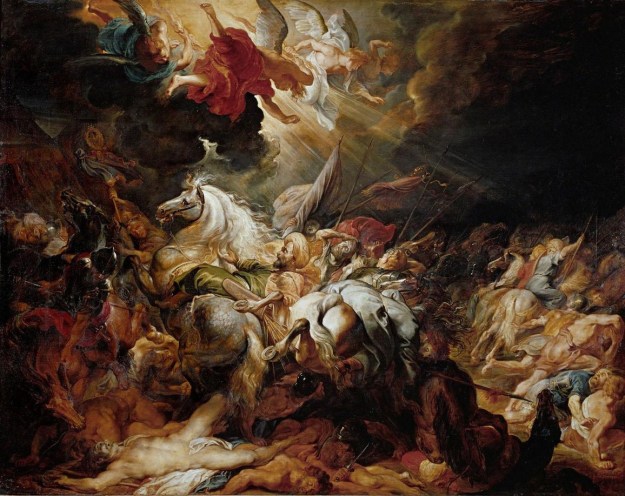
35 That very night the angel of the LORD set out and struck down one hundred eighty-five thousand in the camp of the Assyrians; when morning dawned, they were all dead bodies. 36 Then King Sennacherib of Assyria left, went home, and lived at Nineveh. 37 As he was worshiping in the house of his god Nisroch, his sons Adrammelech and Sharezer killed him with the sword, and they escaped into the land of Ararat. His son Esar-haddon succeeded him.
Many modern readers struggle with the destruction of the one hundred eighty-five thousand soldiers in the camp of Assyria. I remember during Desert Storm Sadaam Hussein claimed that Allah would strike down the American other allied soldiers who were fighting against him in this ‘holy war/Jihad’ and most modern Western observers responded to this language with scorn. Yet, as Walter Brueggemann states, “the bible hangs or falls on its attestation of the divine difference Yahweh makes in real events.” (Brueggemann, 2000, p. 517) The narrator of 2 Kings has already indicated the power of the LORD the God of hosts when the servant of Elisha has his eyes opened to see the LORD’s chariots of fire and horsemen which surround the Arameans attempting to capture the prophet. (2 Kings 6:15-23) The bible is full of imagery of God as the divine warrior or the leader of armies who saves that people. One hundred eighty-five thousand soldiers is a huge number, especially in the ancient world where populations were much smaller, but I think too many modern readers struggle with accepting that God could act like this through the angel of the LORD.
King Sennacherib retires to Ninevah, likely significantly embarrassed by inability to capture Jerusalem and the loss of soldiers. A defeated king is a vulnerable king, and while worshipping in the house of the unknown god, outside of this mention, Nisroch he is killed by two of his sons who flee and one of his other sons ascends the throne. Assyria’s reign as the empire of the day has not ended, indeed Esar-haddon would conquer Egypt, and Assyria remains a threat through the end of Hezkiah’s life (see 2 Kings 20:6) but God promises to continue to protect Jerusalem.
So much of the biblical language of prophecy is poetry, and so I’m going to close this reflection with Lord Byron’s poem “the Destruction of Sennacherib”
The Assyrian came down like the wolf on the fold,
And his cohorts were gleaming in purple and gold;
And the sheen of their spears was like stars on the sea,
When the blue wave rolls nightly on deep Galilee.
Like the leaves of the forest when Summer is green,
That host with their banners at sunset were seen:
Like the leaves of the forest when Autumn hath blown,
That host on the morrow lay withered and strown.
For the Angel of Death spread his wings on the blast,
And breathed in the face of the foe as he passed;
And the eyes of the sleepers waxed deadly and chill,
And their hearts but once heaved, and for ever grew still!
And there lay the steed with his nostril all wide,
But through it there rolled not the breath of his pride;
And the foam of his gasping lay white on the turf,
And cold as the spray of the rock-beating surf.
And there lay the rider distorted and pale,
With the dew on his brow, and the rust on his mail:
And the tents were all silent, the banners alone,
The lances unlifted, the trumpet unblown.
And the widows of Ashur are loud in their wail,
And the idols are broke in the temple of Baal;
And the might of the Gentile, unsmote by the sword,
Hath melted like snow in the glance of the Lord!
From the Poetry Foundation website: The Destruction of Sennacherib | The Poetry Foundation
[1] See also the actions of the King of Ninevah in Jonah 3: 6-8 or the action of the unnamed king of Samaria during the siege of Ben-hadad of Aram in 2 Kings 6:30.
[3] King Tirhakah or Taharqa was one of the Cushite or Nubian Pharoahs that came from further south in Africa. These ‘Cushite’ Pharoahs ruled over Egypt for more than a century.
 Sign of the Rose