Tag Archives: Christ

Psalm 110 A Psalm of Enthronement

Stained Glass window at the Melkite Catholic Annunciation Cathedral in Roslindale, MA depicting Christ the King with the regalia of a Byzantine Emperor

Psalm 110

Of David. A Psalm.
1The LORD says to my lord, “Sit at my right hand until I make your enemies your footstool.”
2The LORD sends out from Zion your mighty scepter. Rule in the midst of your foes.
3Your people will offer themselves willingly on the day you lead your forces on the holy mountains. From the womb of the morning, like dew, your youth will come to you.
4The LORD has sworn and will not change his mind, “You are a priest forever according to the order of Melchizedek.”
5The LORD is at your right hand; he will shatter kings on the day of his wrath.
6He will execute judgment among the nations, filling them with corpses; he will shatter heads over the wide earth.
7He will drink from the stream by the path; therefore he will lift up his head.

Psalm 110 is repeatedly referenced in the New Testament[1] as a way of demonstrating that Jesus is the Messiah and that as the Messiah, he is more important even than David. Yet this psalm so important to early Christians is heard differently by Jewish readers. Within these reflections I’ve tried to hold both Christian and Jewish voices in conversation, and I think that both can help us gain a fuller picture of the scriptures that we share. This enthronement psalm shares similar themes to Psalm 2. Both psalms view this newly anointed lord as the chosen vessel of the LORD the God of Israel. The king may be seated at the right hand[2]

As an enthronement psalm for a Davidic king, these words would likely come from a court prophet or singer to be spoken as God’s words over the new king. The prophet or singer refers to the new king as ‘my lord’ because they serve that king. The capitalization of the letters in the other occurrences of LORD in this psalm indicate that it refers to the divine name, YHWH, and the vowels are pointed around the letters to indicate to the speaker to say ‘Lord’ (or Adonai in Hebrew) instead of the divine name. YHWH speaks through the prophet to the new king and invites the king into this position of honor and promises to fight on the new king’s behalf. Verse three is full of textual difficulties, as Nancy deClaissé- Walford states, the

words appear to be an elevated description of the newly enthroned monarch, obeyed willingly by the people and endowed with strength and stamina—the dew of your childhood—which emanate from the splendor of holiness.” (Nancy deClaisse-Walford, 2014, p. 836)

Although there were both royal and priestly roles in the world of the Davidic kings, the kings of Israel did have priestly functions. Now the king is linked to the ancient figure of Melchizedek who comes from Salem, and who is also a king, and blesses Abraham by God Most High. This King of Salem becomes the priestly model for the King of Jerusalem, likely built on the same spot generations later. This installation of the new king in both a royal and priestly role integrates this new leader into their privileged place in God’s ordering of the world. (Mays, 1994, p. 352)

The ancient world was a violent place, and the Davidic kings were expected to lead the nation to both safety and military victory. Yet, Israel was never to be a military power,[3] and their strength resided in the God who executes judgment among the nations. The language of ‘filling the nations with corpses’ and ‘shattering heads over the wide earth’ continues the elevated description of the power behind the new monarch and the power behind the throne that ultimately controls the fate of the nations. The LORD, the God of Israel, will provide the stream beyond the path of the new king allowing this king to lift up his head in honor and strength.

Christian readers will hear this psalm through the lens of Christ, and ‘sitting at the right hand of the Father’ becomes a way that the church will talk about the honored and powerful position of Jesus for the church and the world. Jesus takes on the role of king for Christians and this led to the persecution of many early followers of Jesus who refused to pay honor to the divinity of Caesar. The book of Hebrews also highlights the way Jesus fulfils the role of the priesthood for Christians.[4] In liturgical churches the final Sunday of the church year is Christ the King Sunday which celebrates the way Jesus is enthroned at the right hand of God, but instead of being a conquering king he was a crucified messiah. Revelation 19: 11-16 is the closest the New Testament gets to the militaristic language of verse five and six of this psalm. The quotation of this psalm by Jesus in his conflicts with the Pharisees in Matthew 22:44 and parallels probably was not viewed as a convincing argument by his opponents and most Jewish leaders, if they utilize this psalm today, would be waiting for a return of a Davidic ruler who can rule from the power of the LORD the God of Israel and bring the nation back to a place of security. As large of a role as this psalm plays in the New Testament, I don’t believe that it plays a similar role in the thought of contemporary Judaism.


[1] Matthew 22:44; Mark 14:62; 16:19; Luke 22:69; Acts 2:34-35; 7:55; Romans 8:34; Ephesians1:20; Colossians 3:1; Hebrews 1:3,13; 8:1; 10:12; 1 Peter 3:22

[2] Being seated at the right hand is a position of honor and power. It is interesting that in Psalm 109 the psalmists asks for an accuser to take this position for the wicked person. The name Benjamin comes from a conjunction of the Hebrew word for son (bin) and right hand (yamin).  

[3] Deuteronomy 17: 14-20 which sets the limits on a king for Israel indicates that the focus is not to be on building a stronger military but instead on a ruler being faithful to the LORD and the covenant.

[4] Particularly Hebrews chapters 5 and 7.
Foundations Course: Session 1 God the Foundation

Greenhouse for Faith Foundations Course: Session 1 (God the Foundation)

The Greenhouse for Faith: What We Grow Here is Meant to be Planted in the World

This is an introduction to a way of thinking about God that is ancient, but it is beautiful. It has brought life and meaning to one of the larger families of faith throughout the world. Yet it is very different from what many churches teach.

These reflections use the image of a greenhouse as a model for thinking about God, our relationship with God and the world God created.

The Foundation: that which everything else builds upon is a way of thinking about God.

This way of thinking focuses in on who God is and what God has already done.

“Let God be God” is a short summary of this way of thinking because we focus on God as the primary actor.

God is the creator, rescuer, and the one who renews this world and our lives.

God loves this world and is active, passionate, and engaged in the world and in our lives.

God also works in ways that may be mysterious, hidden, or unseen by us in our lives.

Questions for reflection:

  • When you think about your relationship with God do you begin with what you believe you need to do or what God has done?
  • Do you think that God is active in the world? In your life?
  • How do you walk through times where God’s working in the world seems hidden from you?
  • What in your life are you thankful for? What is something that is a part of the world that you are thankful for?

Foundations Course: Session 2 Christ-Where God Meets Us

Greenhouse for Faith Foundations Course: Session 2 (Christ)

The Greenhouse for Faith: What We Grow Here is Meant to be Planted in the World

There are four pillars that will be used in this greenhouse: Christ, Word, Faith, and Grace that help us understand the God who is our foundation. These are the classic ‘alones’ or ‘solas’ (Latin for alone) of Lutheran thought.

The first pillar is Christ: We are Jesus people. Jesus is where we come to know primarily what God is like.

The life, ministry, death, and resurrection of Jesus is the key through which we understand everything else about God.

The God who comes down to be among us: the witness of Christmas is of the God who comes to meet us in Jesus. God comes where God can be approached and becomes vulnerable so that we may draw near. We don’t have to ascend to where God is because God approaches us where we are in Jesus.

In Jesus we also come to know the God who suffers for this world and the people God loves. On the cross we find a God who refuses to give up on the world or God’s people. The cross looks like a place where God’s love is absent, but we believe this is where we most clearly understand the depth of God’s love. A love that refuses to give up even when it is rejected and killed.

Questions for reflection:

  • How is Christ’s example of love different from romantic love?
  • How does Christ’s example of love inform romantic relationships?
  • How do you see your own leadership impacted by Christ’s example of love?

Foundations Course Session 3 Word Alone

The Greenhouse for Faith: What We Grow Here is Meant to be Planted in the World

There are four pillars that will be used in this greenhouse: Christ, Word, Faith, and Grace that help us understand the God who is our foundation. We talked in the previous session about how we come to know about God in Christ.

The second pillar is the Word. When we talk about the Word we are primarily talking about three things: the Word of God as Christ, the Word of God as the proclamation of scripture and preaching in the church, and the Word of God as scripture.

  • The Word always goes back to Christ. When we talk about the Word of God we are first and foremost talking about the Word of God as John’s gospel relates it:
    • In the beginning was the Word, and the Word was with God, and the Word was God. John 1:1
    • The Word who was with God, who was in the beginning and who was God is Christ. Christ is active in creation, throughout the life, death and resurrection of Jesus and continues to be active throughout our world.
  • The Word also goes back to scripture and proclamation. The Christ we talk about will also reflect the Christ we come to know through scripture and the preaching of the church.
    • Proclamation: We believe that God is active in the world and in the church, and particularly we believe that when a person from the community or the pastor both read and proclaim about scripture that God is active in that space. It is not that the pastor has the perfect words to say or that they are infallible, instead it is a trust and expectation that God and God’s Spirit are active in that time.
    • Scripture: Luther’s image of scripture being the manger where the Christ child is laid. Scripture is the source of where we come to know about God. We don’t believe that all scripture is equally valued, but instead it is that which presents Christ is the center of scripture. Christ is the key that unlocks everything else.

Reading scripture can be challenging. One of the challenges is the way we often approach scripture: We often go to scripture seeking answers, but scripture wants to give us wisdom. Scripture invites us to learn a way of life, a way of encountering the world, and an invitation to follow the God who we come to know in Christ.

A tool for reading scripture: Law and Gospel. This is one tool in the toolbox of how we approach scripture, but it is a good way to start. Scripture encounters us as Law: that which condemns us, shows us where we have fallen short and need God’s grace and ultimately should drive us back to God and help us reorient our lives on God. Scripture also encounters us as Gospel: that which sets us free, forgives us, renews us, and tells us about what God has done for us.

Questions for reflection:

  • Think of one of the passages from scripture you are familiar with. Identify both the Law and Gospel in that passage and share your thoughts.
  • Think of scripture that is problematic or hard to interpret. How does looking at this scripture through Jesus’s teachings change your interpretation?

Matthew 16: 13-20 Peter’s Confession

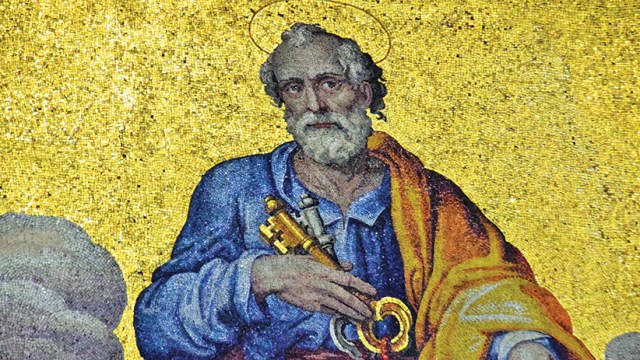
Mosaic of Peter from St. Peter’s Basilica, Vatican city

Matthew 16: 13-20

Parallels Mark 8: 27-30; Luke 9: 18-21

13 Now when Jesus came into the district of Caesarea Philippi, he asked his disciples, “Who do people say that the Son of Man is?” 14 And they said, “Some say John the Baptist, but others Elijah, and still others Jeremiah or one of the prophets.” 15 He said to them, “But who do you say that I am?” 16 Simon Peter answered, “You are the Messiah, the Son of the living God.” 17 And Jesus answered him, “Blessed are you, Simon son of Jonah! For flesh and blood has not revealed this to you, but my Father in heaven. 18 And I tell you, you are Peter, and on this rock I will build my church, and the gates of Hades will not prevail against it. 19 I will give you the keys of the kingdom of heaven, and whatever you bind on earth will be bound in heaven, and whatever you loose on earth will be loosed in heaven.” 20 Then he sternly ordered the disciples not to tell anyone that he was the Messiah.

At the beginning of Matthew’s gospel, we were introduced to Jesus the Messiah, son of David, son of Abraham but throughout most of the gospel the term Messiah or Christ has rarely been used. The magi inquired of about the Messiah and John the Baptist from prison heard “what the Messiah was doing” but otherwise Matthew has reserved this term until this moment. In the shadow of a city named for Caesar, a new key to understanding how disciples are to understand Jesus is revealed. Peter’s words become the foundation for the confessions of the church that will be raised to celebrate the experience of the kingdom of heaven’s presence on earth. The disciples, through Peter, have enough insight to name what their experience of Jesus acts and teaching mean. Even with articulation of a specific group of titles for Jesus they will still need to understand how Jesus’ actions will shape what those titles mean.

Jesus refers to himself with his favored title, the Son of Man, but then asks what the people say about his identity. The answer, in Matthew, includes references to several prophets. John the Baptist is a recent example and not only has Matthew linked the proclamation and language or Jesus and John[1] and we also have Herod Antipas refer to Jesus as John the Baptist (14:2). Elijah as the prophet who returns to announce the coming of God is also an answer that makes sense within Jesus’ proclamation of the approach of the kingdom of heaven. Matthew’s gospel is the only gospel that includes specifically Jeremiah as the other named prophet, and this is worth noting in Matthew’s portrayal of Jesus. Jeremiah’s ministry involved challenging a people who may have returned to worshipping the God of Israel in the temple, but whose religious practices never translated to a return to the covenantal expectations of living under the law. Jeremiah continually found himself in conflict with the authorities of the temple and yet, much of his ministry is a lament for the ending of the kingdom of Judah, Jerusalem, the Davidic kings and the temple as the nation antagonizes the Babylonian empire. The crowds and people will understand Jesus in terms of a prophet, and his challenge to those in political and religious authority in addition to his acts of power to heal the sick, cast out demons and to protect or feed the people will be interpreted by the masses as a part of this calling.

But the disciples, these little faith ones, who have journeyed with Jesus since he called them to join him in fishing for people and gathering the harvest, have been given a greater insight into the person of Jesus and his identity. His question to them about his identity is answered, on behalf of the rest of the disciples, by Peter. Peter, since asking to join Jesus on the water in 14: 28-33, will often be one who speaks or acts on behalf of the rest of the disciples through the remainder of Matthew’s gospel. The disciples in the boat (14: 33) already declared Jesus the Son of God, but now Peter adds the title Messiah/Christ to this identity.

As mentioned before, the Son of God title in Jewish thought is linked to one’s role as a king and the linking of Messiah and Son of the living God here just emphasizes the connection between the one who is appointed king and the appointer in God. Even though I believe Matthew wants us to hear more than just Jesus as the ‘anointed king’ in this confession, this dual use of Messiah/Christ[2] and Son of God among the people of Galilee and Judea there is the hope of a divinely appointed leader who will lead the people out of their captivity under the nations and reestablish them as God’s chosen people, a priestly nation and God’s treasured possession. (Exodus 19: 5-6) Peter articulates his understanding of Jesus fulfilling that role.

Jesus’ response is that God is the one who has revealed this to Peter and not humanity. What was hidden from the Pharisees and Sadducees is now revealed to the little faith ones standing before Jesus. These one of imperfect understanding and little faith will be the foundation upon which the church will be erected and which the forces of Hades will not be able to overcome. Matthew’s gospel does understand that there are forces that will be opposed to the coming kingdom of heaven, and to the community which is formed to proclaim that kingdom but ultimately what God reveals to the faithful ones is enough to keep the community on solid rock.

The name Peter means rock, and so underneath this declaration of Peter (Petros) as the rock (petra) that Christ will build his church upon is a wordplay on Peter’s name. Historically the church has wrestled with whether the church was founded on Peter as a person (traditional Roman Catholic position where Peter becomes the first bishop of the church and the church is handed down from him to future leaders) or on the profession of faith (traditional Protestant perspective) but ultimately both the person and the profession matter. Peter as a person can no longer be separated from his role as a disciple of Jesus, and his life is tied up in his profession of who Jesus is. The identity of Jesus will become crucial for the way his life, and the life of his fellow disciples, will be lived. Although he may be Simon son of Jonah, his identity is completely transformed to become Peter the rock among the disciples of Jesus. We will shortly see the way Peter’s understanding of this will be challenged by Jesus and this Son of Jonah will learn what the sign of Jonah (see previous section) will mean for his life.

The keys to the kingdom mentioned in this section have also been historically limited to the understanding of forgiveness of sins within the church, but I don’t think that is what Matthew intends for us to hear. Sin is never mentioned in this context, and while this is echoed in 18: 18 within the context of when someone in the community of faith sins against another, I think this highly limits the impact of what Jesus is referring to. As Jesus proclaims the nearness of the kingdom of heaven and grants his followers the ‘keys to the kingdom,’ I think he intends for them to understand they now have the agency to do the things he has done. Just as I believe he intended to give the disciple the opportunity to release (loose) the daughter of the Canaanite woman, I think the context tells us that they now have the agency not only resist but to bind the forces that approach from the gates of Hades and to release those in captivity to those forces. The things that they do upon the earth will be enacted by the forces of heaven.

Yet, this identity of Jesus is not to be proclaimed from the rooftops at this point. Jesus commands them not to tell anyone he is the Messiah, and this may be due to the way even the disciples can misunderstand what this title will mean. They will be charged to continue to follow him as he turns toward Jerusalem where his title will be proclaimed from a cross instead of a crown. While they understand in part and they know in part, they are on a journey to understand more completely. These little faith ones will be the foundation of the church of Christ which will go to all the nations with the proclamation of Christ and him crucified.

[1] Compare the language of John in Matthew 3: 2, 7-10 with the language of Jesus in 4:17, 12:34, and 23:33

[2] Christ and Messiah are the same term in different language. Christ is the transliteration of the Greek Christos which translates the Hebrew masiah. Both terms mean anointed one, referring to the anointing of a king when they begin their office.

Seeking Christmas

 It isn’t with the Christmas tree
Or presents wrapped for all to see
St.Nick, he didn’t bring it here
Nor Frosty of the Grinch I fear
 
It isn’t in the shopping mall
Nor songs that sing our ‘Deck the Hall’
Or houses decked in Christmas lights
Or people packed on holiday flights
 
Family and friends, feast and gift
Do comfort and my spirits lift
Yet sometimes all the noise and light
Distracts me on this silent night
 
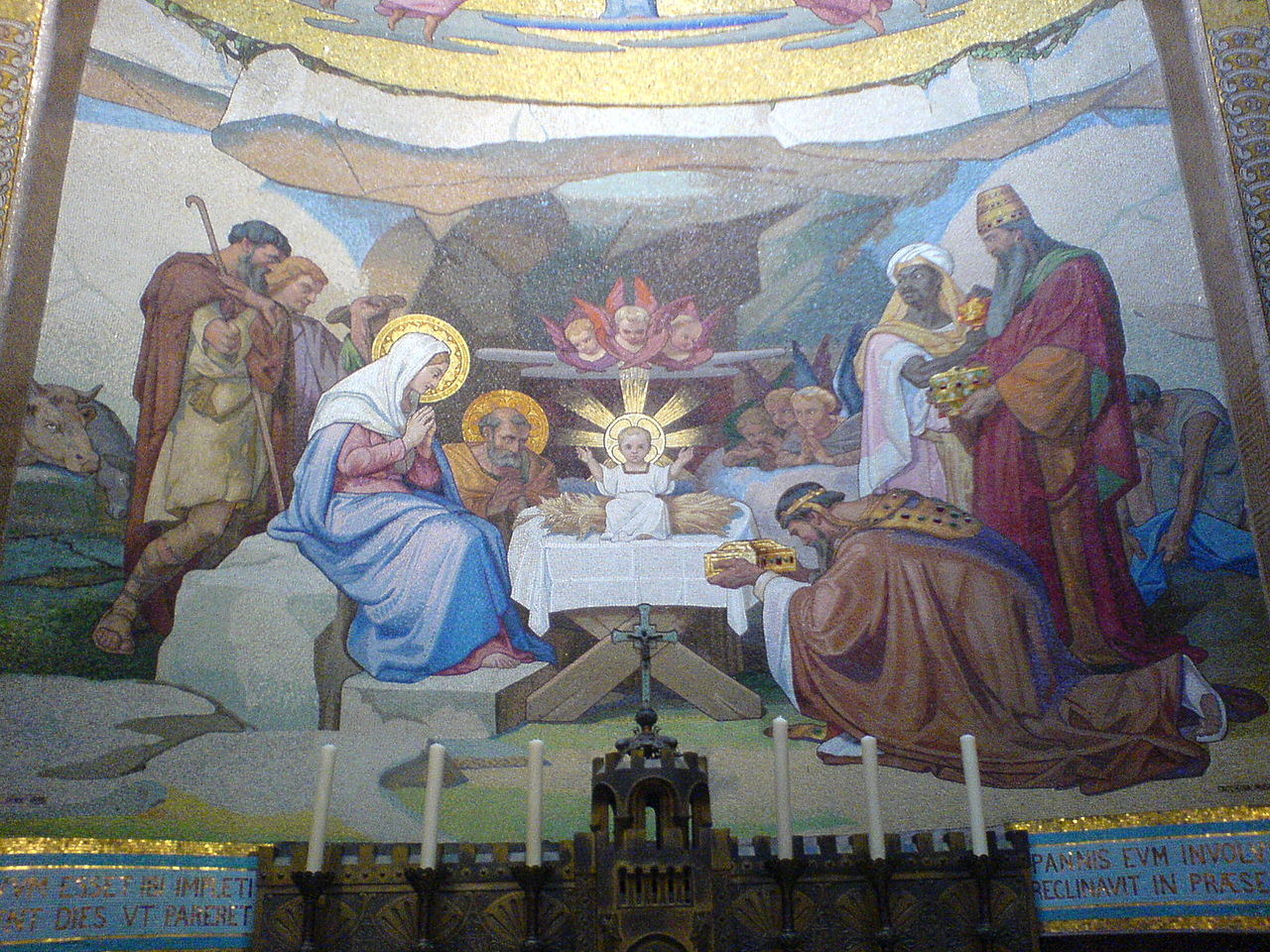
From Joseph’s trip from Galilee
And his new wife, blessed Mary
From Jesus in a manger lay
For no room was found on his birthday
 
Messiah, the Word of God, the Light
That came upon that Holy Night
When the angel proclamation began
Peace on earth, good will to man
 
Come let us go and seek and tell
This child who is Emmanuel
The creator to creation come
A new covenant of grace begun
 
To seek with Magi Bethlehem
To see the king or the great ‘I am’
To ponder deep within our heart
The words the shepherd did impart
 
For that is what I seek this year
In the middle of the holiday cheer
The place where heaven comes to earth
To fill our hearts and souls with mirth

Mosaic in the Rosary Basilica, Lourdes

Mosaic in the Rosary Basilica, Lourdes