Tag Archives: child sacrifice

2 Kings 3 A Strange Story of Kings, Elisha, and Conflict

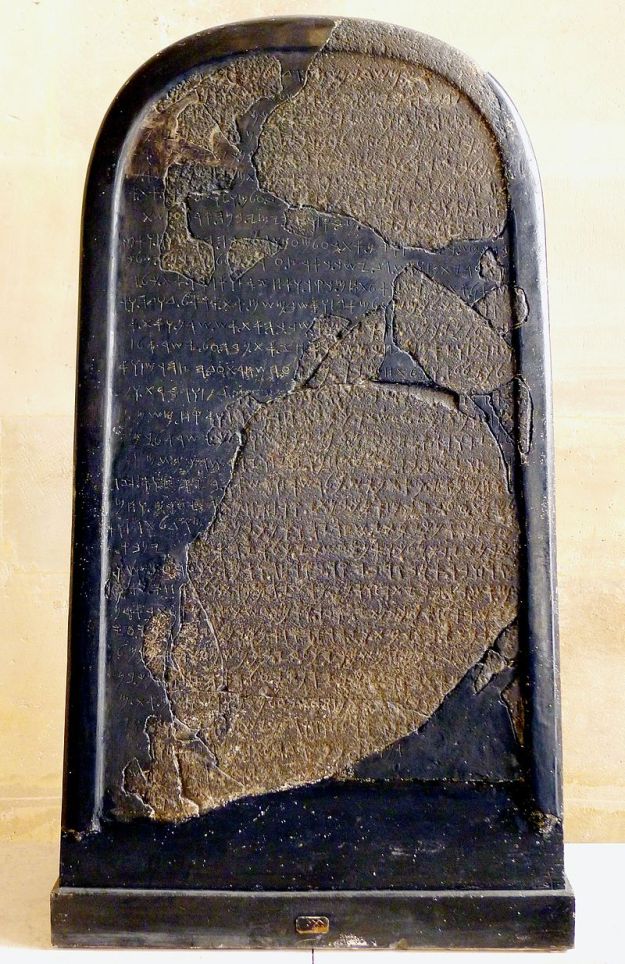
The ‘Mesha Stele’ also known as the Moabite Stone discovered in 1868 which tells of the revolt of Mesha. By Unknown artist – Mbzt 2012, CC BY 3.0, https://commons.wikimedia.org/w/index.php?curid=22090379

2 Kings 3


  1In the eighteenth year of King Jehoshaphat of Judah, Jehoram son of Ahab became king over Israel in Samaria; he reigned twelve years. 2He did what was evil in the sight of the Lord, though not like his father and mother, for he removed the pillar of Baal that his father had made. 3Nevertheless, he clung to the sin of Jeroboam son of Nebat that he caused Israel to commit; he did not depart from it.
  4
Now King Mesha of Moab was a sheep breeder who used to deliver to the king of Israel one hundred thousand lambs and the wool of one hundred thousand rams. 5But when Ahab died, the king of Moab rebelled against the king of Israel. 6So King Jehoram marched out of Samaria at that time and mustered all Israel. 7As he went he sent word to King Jehoshaphat of Judah, “The king of Moab has rebelled against me; will you go with me to battle against Moab?” He answered, “I will; I am as you are; my people are your people; my horses are your horses.” 8Then he asked, “By which way shall we march?” Jehoram answered, “By the way of the wilderness of Edom.”
  9
So the king of Israel, the king of Judah, and the king of Edom set out, and when they had made a roundabout march of seven days, there was no water for the army or for the animals that were with them. 10Then the king of Israel said, “Alas! The Lord has summoned these three kings to hand them over to Moab.” 11But Jehoshaphat said, “Is there no prophet of the Lord here through whom we may inquire of the Lord?” Then one of the servants of the king of Israel answered, “Elisha son of Shaphat, who used to pour water on the hands of Elijah, is here.” 12Jehoshaphat said, “The word of the Lord is with him.” So the king of Israel and Jehoshaphat and the king of Edom went down to him.
  13
Elisha said to the king of Israel, “What have I to do with you? Go to your father’s prophets or to your mother’s.” But the king of Israel said to him, “No; it is the Lord who has summoned these three kings to hand them over to Moab.” 14Elisha said, “As the Lord of hosts lives, whom I serve, were it not that I have regard for King Jehoshaphat of Judah, I would give you neither a look nor a glance. 15But get me a musician.” And then, while the musician was playing, the hand of the Lord came on him. 16And he said, “Thus says the Lord: I will make this wadi full of pools. 17For thus says the Lord: You shall see neither wind nor rain, but the wadi shall be filled with water, so that you shall drink, you, your army, and your animals. 18This is only a trifle in the sight of the Lord, for he will also hand Moab over to you. 19You shall conquer every fortified city and every choice city; every good tree you shall fell, all springs of water you shall stop up, and every good piece of land you shall ruin with stones.” 20The next day, about the time of the morning offering, suddenly water began to flow from the direction of Edom until the country was filled with water.
  21
When all the Moabites heard that the kings had come up to fight against them, all who were able to put on armor, from the youngest to the oldest, were called out and were drawn up at the frontier. 22When they rose early in the morning and the sun shone upon the water, the Moabites saw the water opposite them as red as blood. 23They said, “This is blood; the kings must have fought together and killed one another. Now then, Moab, to the spoil!” 24But when they came to the camp of Israel, the Israelites rose up and attacked the Moabites, who fled before them; as they entered Moab, they continued the attack. 25The cities they overturned, and on every good piece of land everyone threw a stone until it was covered; every spring of water they stopped up, and every good tree they felled. Only at Kir-hareseth did the stone walls remain until the slingers surrounded and attacked it. 26When the king of Moab saw that the battle was going against him, he took with him seven hundred swordsmen to break through opposite the king of Edom, but they could not. 27Then he took his firstborn son who was to succeed him and offered him as a burnt offering on the wall. And great wrath came upon Israel, so they withdrew from him and returned to their own land.

This is a strange story for several reasons. On the one hand it is a story of a bad, but not as bad as his predecessors, king of Israel who calls on an alliance with the kings of Judah and Edom. The king of Israel is not portrayed in a favorable light and Elisha has no regard for him. The act of prophesy by Elisha is also linked to a performance of a musician which sets the mood for a prophetic state. The prophetic command is also strange since it contradicts the rules for war outlined in Deuteronomy. Finally, the strangest note is at the end when the king of Moab’s sacrifice of his firstborn son turns the tide and Israel withdraws. Yet, this is also an interesting passage for historians who have the ‘Mesha Stele’ which provides an independent witness to this time-period from the perspective of Moab.

From a historical perspective the discovery of the ‘Mesha Stele’ confirms several points of the 2 Kings narrative. King Mesha of Moab was ‘oppressed’ by the Omri dynasty, likely paying tribute to the king. In the view of King Mesha this situation is due to Chemosh, the god of the Moabites, being displeased with his people. Finally, it confirms an uprising of Mesha against a son of Omri, presumably Jehoram, in which King Mesha accomplishes some victories. The precipitating events which cause the king of Israel to reach out to his allies and begin to take military action against Moab are given an independent witness by this discovery. This also makes sense within the previous narrative where King Ahab dies and Moab rebels in 2 Kings 1:1. Ahaziah’s brief reign, cut short by his fall and then sending messengers to Ekron seeking insight from Baal-zebub, made him too weak of a leader to respond to this rebellion.

There are numerous similarities between this narrative and the conflict between Aram and the Israel and Judah mentioned in 1 Kings 22. In both narratives King Jehoshaphat of Judah replies both as and ally, but also the weaker party in the relationship, willingly committing his forces to the king of Israel’s conflict. In both stories it is the king of Judah who requests that they seek out the opinion of a prophet of the LORD that is not tied to the royal apparatus of the king of Israel. Unlike the previous story the outcome is mostly favorable for both the king of Israel and the king of Judah.

King Mesha is noted as a sheep-breeder, and his tribute is an excessive quantity of both lambs and wool. There is no time-period for the tribute so it may be an annual tribute, or it may be the tribute over the time of subservience. Although King Mesha may simply preside, “over a semi-nomadic economy in Moab. The principle industry is sheep and the principle products are wool and lamb.” (Brueggemann, 2000, p. 306) It is also worth noting that throughout scripture kings are often portrayed metaphorically as shepherds. The king may be directly involved in sheep-breeding, but it is equally likely that he is the ‘shepherd’ of a people whose primary livelihood revolves around sheep.

The king of Israel moves his army through Judah and through Edom to attack Moab from the south. This move is likely to approach Moab from a direction they do not expect and to utilize the element of surprise, but any advantage quickly dissipates when the army runs out of water.  It is possible that springs or waters they expected to utilize had dried up or that they simply failed to adequately plan and scout the route, but the situation results in an army foundering in the wilderness and vulnerable to the king of Moab’s attack. Jehoram interprets this as a sign of the LORD’s displeasure, but Jehoshaphat suggests they inquire of a prophet of the LORD. Apparently, Elisha has either been traveling in proximity of the company or has at some earlier point moved to the wilderness of Edom to be available at this moment of the kings’ peril.

According to the evaluation of 2 Kings, Jehoram is still a bad king but not as bad as his predecessors. Sometime in his reign he is reported to have removed the pillar of Baal (likely after the LORD’s deliverance in this narrative) and according to the narrative of 2 Kings, he believes that the LORD the God of Israel has called the three kings together in this mission and is also punishing them. Even though it is King Jehoshaphat of Judah who asks to consult a prophet of the LORD, King Jehoram does not seem to resist the kings going to consult with Elisha nor does he push back against Elisha’s harsh words. Elisha, like his predecessor Elijah, has little use for the kings of the Omri dynasty but he does respect the king of Judah.

Elisha requests a musician and then has a moment when the hand of the LORD comes upon him. The hand of the LORD coming upon Elisha was likely viewed by the observers as an ecstatic experience and there is an expectation of prophets being overtaken by an experience they cannot control.[1] Elisha’s message brings an answer not only to the immediate problem of water, but it also foretells victory over their Moabite opponents. Yet, strangely, the prophet’s commands violate the expectations of conflict outlined in Deuteronomy which prohibits the chopping down of trees.[2] There is a biblical desire to preserve the land. In ancient warfare it is common attempt to deny your enemy the fruitfulness of the land, which is what the prophet’s guidance indicates, but the tension between the law in Deuteronomy and the prophet’s guidance is one additional strange element to this strange story.  

The Hebrew storytellers love wordplay and allusion to other narratives, and in the Moabites response to these kings in the wilderness. The waters being red as blood recalls on of God’s first major actions to bring the people out of Egypt by turning the waters of the Nile to blood.[3] But the scene also plays on the origin story of Edom in Genesis being Esau, Jacob/Israel’s brother, whose name means ‘red’ and is famous for selling his birthright for ‘red stuff.’[4] We don’t know why the Moabites interpret the red looking water as blood, but it causes them to camp of Israel in a less cautious manner.

The overall progression of the battle is portrayed as a rout where Israel and its allies overwhelm the Moabite advance on their camp and then proceed to follow Elisha’s guidance against the land and the cities. Only Kir-hareseth’s[5] stone wall briefly stops the advance before slingers attack it. The victories of Israel are not strange in this narrative, but the halting of the success is.

The final verse of this chapter has provoked the greatest debate among interpreters as they wrestle with how to deal with the implications of wrath coming upon Israel as a result of the King of Moab’s sacrifice. The bible shares with the rest of the ancient world the belief that there is power in blood and there is in many ancient belief systems an idea that appears in many fantasy worlds that connects blood, particularly the shedding of blood, in the practice of magic or appeasing deities or demons. The most literal interpretation of the words is that King Mesha sacrifices his first-born heir to Chemosh on the wall and this awakens Chemosh who grants the Moabites power against their foes. The Hebrew scriptures are insistent that the LORD is above all other gods, but it also assumes a world where these other gods of the nations do have power. The offense of this interpretation is that Chemosh successfully resists the LORD and halts the prophesied conquest over Moab. Rabbinic exegetes give an explanation that the son sacrificed is the son of the king of Edom, the ally of Israel and Judah, and this sacrifice causes Edom to turn against his allies. (Cogan, 1988, p. 48) Brueggemann speaks for a lot of modern readers when he states, “The most remarkable fact about the narrative is that everything we would most like to know is left unsaid.” (Brueggemann, 2000, p. 315) It is a strange ending to a strange story. It is unusual that a story where another god may have prevented the outcome the LORD’s prophet indicated to be completed. Yet, the story does not give any reason for the King Mesha of Moab being able to finally resist the kings of Israel, Judah and Edom as well as the LORD who stands behind them.


[1] 1 Samuel 10: 9-13; 19: 23-24.

[2] Deuteronomy 20:19.

[3] Exodus 7: 14-25.

[4] Genesis 25: 25, 30.

[5] Brueggemann notes on Kir-hareseth, “Nothing is known of this city, the site of Israel’s last success in this military campaign. However, the mention of the city in Isa 16;7, Jer 48:31, 36 as a poetic parallel for “Moab” suggest that it was a major site, certainly a freighted item in the prophet’s imagination. (Brueggemann, 2000, p. 313)
Judges 11 Jepthah and a Corrupted View of God

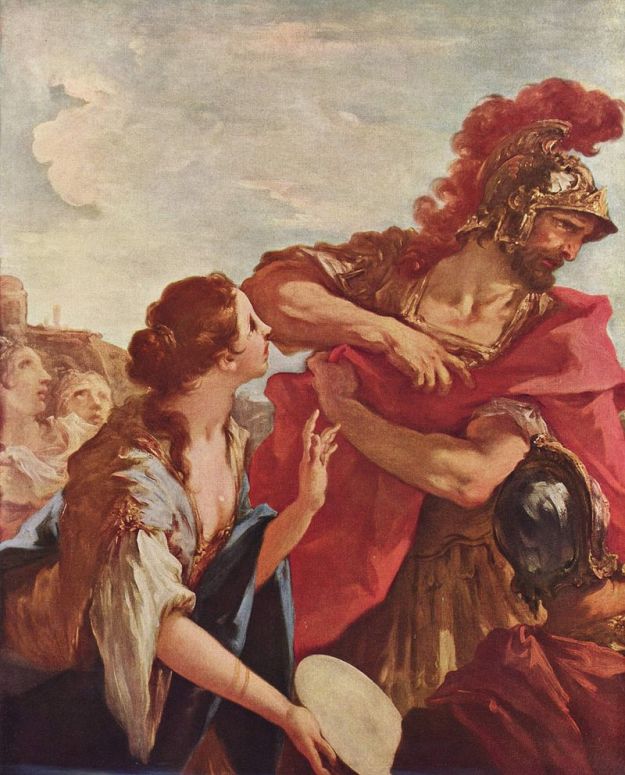
The Return of Jephtha, by Giovanni Antonio Pellegrini

Judges 11:1-11 A Strange Choice to Lead the People

1 Now Jephthah the Gileadite, the son of a prostitute, was a mighty warrior. Gilead was the father of Jephthah. 2 Gilead’s wife also bore him sons; and when his wife’s sons grew up, they drove Jephthah away, saying to him, “You shall not inherit anything in our father’s house; for you are the son of another woman.” 3 Then Jephthah fled from his brothers and lived in the land of Tob. Outlaws collected around Jephthah and went raiding with him.

4 After a time the Ammonites made war against Israel. 5 And when the Ammonites made war against Israel, the elders of Gilead went to bring Jephthah from the land of Tob. 6 They said to Jephthah, “Come and be our commander, so that we may fight with the Ammonites.” 7 But Jephthah said to the elders of Gilead, “Are you not the very ones who rejected me and drove me out of my father’s house? So why do you come to me now when you are in trouble?” 8 The elders of Gilead said to Jephthah, “Nevertheless, we have now turned back to you, so that you may go with us and fight with the Ammonites, and become head over us, over all the inhabitants of Gilead.” 9 Jephthah said to the elders of Gilead, “If you bring me home again to fight with the Ammonites, and the LORD gives them over to me, I will be your head.” 10 And the elders of Gilead said to Jephthah, “The LORD will be witness between us; we will surely do as you say.” 11 So Jephthah went with the elders of Gilead, and the people made him head and commander over them; and Jephthah spoke all his words before the LORD at Mizpah.

The story of Jephthah the Gileadite illustrates how corrupted Israel’s life and faith has become. Jephthah is one step further removed from his father’s line than Abimelech: while Abimelech was the son of a concubine we are immediately told that Jephthah is the son of a prostitute. He is a child of the region. When the narrative names his father as Gilead it is possible that it is a later descendant of Gilead son of Machir that the region is named for, but it is also possible that Gilead replaces the name of his father because it is unknown or to protect his name. Jephthah starts life as a disinherited bastard forced out by his half-brothers and forced to flee his homeland. Jephthah new life begins in the land of Tob (good) but his life is that of a bandit and raider who leads other outlaws and outcasts. He who fled for fear of his half-brothers has emerged as a force to fear and a ‘mighty warrior.’[1]

At the end of the previous chapter the leaders of Gilead have declared that whoever leads them against the Ammonite threat will be their head. The thirty sons of Jair the Gileadite have not risen to the challenge, nor has any of the other leaders. The lack of a compelling leader who can oppose the Ammonite threat causes the elders to seek out a bandit and strongman who they had previously expelled. Jephthah and his social misfits[2] are now brought to Gilead to be the answer to the Ammonite threat. Jephthah refuses to accept anything less that being head over the people of Gilead if he is to rescue those who previously rejected him. This elevation of a strongman who was the son of a prostitute does emphasize the deterioration of the quality of people available to rescue Israel, a quality which is reflective of the alienation from the LORD the God of Israel. Yet it also follows a common theme in the bible of God’s salvation coming from unexpected places. (Hattin 2020, 110-111)

It is worth noting that although Jephthah invokes the name of the LORD to witness the agreement between Jephthah and the leaders of Gilead and, presumably in some type of ceremony, speaks his words before the LORD as he assumes his position, there is no calling of Jephthah by the LORD.  Jephthah is the leader the elders of Gilead have chosen. Like Abimelech, it is the leaders of the area who select a strongman with a checkered past. The story of Jephthah is one of triumph and tragedy. Gilead will be the strongman that the crisis with the Ammonites demands but the story we have of his life also demonstrates that central parts of the relationship between the LORD and the people have been compromised and that the continued life of the tribes of Israel is in a tenuous state.

Judges 11: 12-28 Dueling Histories

12 Then Jephthah sent messengers to the king of the Ammonites and said, “What is there between you and me, that you have come to me to fight against my land?” 13 The king of the Ammonites answered the messengers of Jephthah, “Because Israel, on coming from Egypt, took away my land from the Arnon to the Jabbok and to the Jordan; now therefore restore it peaceably.” 14 Once again Jephthah sent messengers to the king of the Ammonites 15 and said to him: “Thus says Jephthah: Israel did not take away the land of Moab or the land of the Ammonites, 16 but when they came up from Egypt, Israel went through the wilderness to the Red Sea and came to Kadesh. 17 Israel then sent messengers to the king of Edom, saying, ‘Let us pass through your land’; but the king of Edom would not listen. They also sent to the king of Moab, but he would not consent. So Israel remained at Kadesh. 18 Then they journeyed through the wilderness, went around the land of Edom and the land of Moab, arrived on the east side of the land of Moab, and camped on the other side of the Arnon. They did not enter the territory of Moab, for the Arnon was the boundary of Moab. 19 Israel then sent messengers to King Sihon of the Amorites, king of Heshbon; and Israel said to him, ‘Let us pass through your land to our country.’ 20 But Sihon did not trust Israel to pass through his territory; so Sihon gathered all his people together, and encamped at Jahaz, and fought with Israel. 21 Then the LORD, the God of Israel, gave Sihon and all his people into the hand of Israel, and they defeated them; so Israel occupied all the land of the Amorites, who inhabited that country. 22 They occupied all the territory of the Amorites from the Arnon to the Jabbok and from the wilderness to the Jordan. 23 So now the LORD, the God of Israel, has conquered the Amorites for the benefit of his people Israel. Do you intend to take their place? 24 Should you not possess what your god Chemosh gives you to possess? And should we not be the ones to possess everything that the LORD our God has conquered for our benefit? 25 Now are you any better than King Balak son of Zippor of Moab? Did he ever enter into conflict with Israel, or did he ever go to war with them? 26 While Israel lived in Heshbon and its villages, and in Aroer and its villages, and in all the towns that are along the Arnon, three hundred years, why did you not recover them within that time? 27 It is not I who have sinned against you, but you are the one who does me wrong by making war on me. Let the LORD, who is judge, decide today for the Israelites or for the Ammonites.” 28 But the king of the Ammonites did not heed the message that Jephthah sent him.

The correspondence between Jephthah and the king of the Ammonites is illustrative of the deep-seated disagreements that people may have over history. The king of the Ammonite’s justification for invasion is a three-hundred-year-old battle when Israel took possession of this land on the eastern side of the Jordan. The Ammonites likely do not expect Jephthah to yield the territory of Gilead to them, but when asked for a reason for their invasion they make their claim. In modern times Russia can claim a history for why they should invade Ukraine, and Israel and Palestine have competing claims on a common land, but in both ancient and modern conflicts the reason for claiming a land often rests upon the ability to enforce one’s claims militarily. Jephthah’s response demonstrates that some of Israel’s history has been retained as he is able to summarize Numbers 20-21 and Deuteronomy 2, but it is also intriguing that Jephthah refers to the god of the Ammonites as Chemosh. Chemosh is in every other biblical and archeological texts the god of Moab while Molech is the god of the Ammonites. I have my suspicions why the name of the god is mistaken or changed which I will address in the following section, but it is strange to have such a significant mistake, if it was historical, be carried forward in the scriptural remembrance of it.

Ultimately the dueling histories in Jephthah’s mind are to be resolved by dueling deities. The conflict between the armies of Gilead and the Ammonites is a contest between their gods. If the God of Israel can be a mighty warrior who defeats the god of the Ammonites it will be demonstrated on the battlefield and justify whichever party prevails in their occupation of the land of Gilead. Jephthah commits the question to the LORD’s judgment and prepares to meet the Ammonites in battle.

Judges 11:29-40 A Corrupted View of God

29 Then the spirit of the LORD came upon Jephthah, and he passed through Gilead and Manasseh. He passed on to Mizpah of Gilead, and from Mizpah of Gilead he passed on to the Ammonites. 30 And Jephthah made a vow to the LORD, and said, “If you will give the Ammonites into my hand, 31 then whoever comes out of the doors of my house to meet me, when I return victorious from the Ammonites, shall be the LORD’s, to be offered up by me as a burnt offering.” 32 So Jephthah crossed over to the Ammonites to fight against them; and the LORD gave them into his hand. 33 He inflicted a massive defeat on them from Aroer to the neighborhood of Minnith, twenty towns, and as far as Abel-keramim. So the Ammonites were subdued before the people of Israel.

34 Then Jephthah came to his home at Mizpah; and there was his daughter coming out to meet him with timbrels and with dancing. She was his only child; he had no son or daughter except her. 35 When he saw her, he tore his clothes, and said, “Alas, my daughter! You have brought me very low; you have become the cause of great trouble to me. For I have opened my mouth to the LORD, and I cannot take back my vow.” 36 She said to him, “My father, if you have opened your mouth to the LORD, do to me according to what has gone out of your mouth, now that the LORD has given you vengeance against your enemies, the Ammonites.” 37 And she said to her father, “Let this thing be done for me: Grant me two months, so that I may go and wander on the mountains, and bewail my virginity, my companions and I.” 38 “Go,” he said and sent her away for two months. So she departed, she and her companions, and bewailed her virginity on the mountains. 39 At the end of two months, she returned to her father, who did with her according to the vow he had made. She had never slept with a man. So there arose an Israelite custom that 40 for four days every year the daughters of Israel would go out to lament the daughter of Jephthah the Gileadite.

The Daughter of Jephthah, by Alexandre Cabanel (1879).

On the surface this story is an uncomfortable story of a rash vow that costs a daughter her life. Leaning into the story it is an even more ominous look into a corrupted view of the LORD the God of Israel with an intentional human sacrifice as the promised reward for a military triumph. As we saw with Gideon, the spirit of the LORD descending upon an individual does not seem to change the character of the individual. In Gideon’s case it allows him to rally the people, but it does not quell his doubts and fears. With Jephthah it does not cause him to make this declaration to the LORD.

Jephthah until this point has sounded like he is a worshipper of the LORD who is demonstrating faithful adherence to the God of Israel in contrast to the portrayal of the people of Israel. Yet, there is no indication that God has previously selected Jephthah as a judge for the people, it is the leaders of Gilead who come seeking a strongman to lead them in the midst of their crisis. Yet the vow that Jephthah takes should catch our attention, especially in the context of the conflict with the Ammonites. The Hebrew idiom used in the vow (latzet likrat) is used everywhere else in the scriptures for the meeting of two or more people and the term likrat by itself is used over a hundred times and only means an animal once. (Hattin 2020, 125) Jephthah likely intends for the burnt sacrifice to be a human sacrifice. This points to either Jephthah participating in the worship of gods like Molech or blending these practices into the worship of the God of Israel.

The other narrative where the possibility of human sacrifice occurs in Genesis 22. This text, often called the Akedah, is where God asks Abraham to take his son Isaac and offer him as a sacrifice, but Abraham’s God stops this action and provides a ram instead. The practice of offering children as a burnt offering is one of the practices of the people that the God of Israel indicates is abhorrent and the Israelites are not to copy (Deuteronomy 12: 31). As mentioned above it is Molech who is attested in scripture and in other sources as the god of the Ammonites, and the practices that is singled out among Molech worshippers in the bible is the sacrifice of children (Leviticus 18:21, 20: 2-5, 2 Kings 23: 10, Jeremiah 32:35). Perhaps the substitution of Chemosh for Molech calls attention away from the practice of child sacrifice and attempts to make Jephthah’s vow more palatable as an action of faith towards the God of Israel. Yet, something has corrupted the practice and faith of Jephthah and others throughout Israel where the practice of worship the God of Israel is indistinguishable from the practices of the worship of the god of the Ammonites.

The victory is noted very briefly: the LORD gives the Ammonites into Jephthah’s hand, and the Ammonites suffer a massive defeat. The divine contest between the god of the Ammonites and the God of Israel is reflected in the military victory of Jephthah’s forces. The emphasis in the story is on the vow and its tragic fulfillment. Jephthah likely intended a human sacrifice but did not intend for the sacrifice to be his only child. Even the unnamed daughter doesn’t question the propriety of the vow or the need to fulfill it. The impact of this story becomes transformed into practice in the region as young women go out for four days to lament this daughter lost to a father’s foolish and faithless promise, but it also cements this story as a part of the legacy of the people of Israel.

Some later Jewish and Christian interpreters of this story will attempt to change the narrative where this daughter is dedicated to God to live in chastity and service. Yet, the text indicates that Jephthah completed the vow of offering the first person as a burnt sacrifice. One of the indicators of the community’s religious health and faithfulness in Judges is the treatment of women and children (NIB II: 835). Initially women have status and names, but as the book of Judges progresses the status of women and children becomes increasingly perilous. The willingness to causally sacrifice the life of a human being is indicative of the gods which one worships. I write this reflection in the immediate aftermath of shootings in Buffalo and Uvalde, and it makes me question if it was only the ancient Israelites who had a problem with blending the worship of their God with the practices of other gods. One of the benefits of an account like Judges is that it can cause us to ask uncomfortable questions about the society that our God intends for us and our faithfulness to that vision.


[1] Hebrew ‘gibbor hayil’, this is the same title that the messenger of God gives to Gideon

[2] Hebrew ‘nasim reqim’ literally empty men (Webb 2012, 310)