Charles-Antoine Bridan, Relief on the Wall of Notre Dame Cathedral in Chartres (1786-1789) Isaiah speaking to King Ahaz
The practice of a sustained reflection on scripture, particularly the parts I am less familiar with, has been a big part of my growth over the past thirteen years. This is a significant part of my discipline of learning how to use the fullness of wisdom and learning in scripture and every book in its own way changes me a little. The book of Kings as a whole portion of the story of Israel and Judah from Solomon to the collapse of the Davidic line of kings, Jerusalem, and the temple tries to comprehend how the people could go from the pinnacle at the beginning of Solomon’s reign to the pit of the exile. 2 Kings begins in the middle of the stories of Elijah and Elisha and then moves through the end of the northern kingdom of Israel under Assyria and the southern kingdom of Judah under Babylon.
2 Kings provides a context for the pre-exilic prophets. The narrator of 2 Kings provides short narrations of the kings and prophets of Israel and Judah, but when this is paired with Amos, Hosea, early Isaiah (or first Isaiah), Micah, Zephaniah, Nahum, Habakkuk, Jeremiah and Ezekiel it provides multiple windows into this time. I’ve been writing on this blog about the bible since 2013 and one of the earlier books I started in 2013 was the book of Jeremiah which coincides with the final four chapters of 2 Kings. There are a total of sixteen books of the bible I have now worked through in whole or in part, and it is amazing how much I have learned and grown. When I compare what I knew about this period when I worked on Jeremiah to how I see it now it is amazing how much fuller my vision is. 2 Kings shares several connections with Isaiah and Jeremiah
Although it is an ancient story, the book of Kings narrates the struggle of remaining faithful to the LORD the God of Israel in a world of numerous alternatives. Israel and Judah struggled to maintain their distinctiveness among the nations and kings often influenced their people to follow the practices of the nations they traded and made alliances with. The book of Kings could also be the book of Prophets and particularly in the Elijah and Elisha narrative the prophetic seems to take precedence over the kings in the narrative. In Judah in 2 Kings there are some moments of hope, particularly with Jehoash, Hezekiah, and Josiah but there are also many moments where the reforms of these good kings are undone by the wickedness of the next generation. God is slow to give up on this people and eagerly looks for repentance, but by the end of the story both Israel and Judah have exhausted the patience of God.
1Now when the Lord was about to take Elijah up to heaven by a whirlwind, Elijah and Elisha were on their way from Gilgal. 2Elijah said to Elisha, “Stay here, for the Lord has sent me as far as Bethel.” But Elisha said, “As the Lord lives and as you yourself live, I will not leave you.” So they went down to Bethel. 3The company of prophets who were in Bethel came out to Elisha and said to him, “Do you know that today the Lord will take your master away from you?” And he said, “Yes, I know; keep silent.” 4Elijah said to him, “Elisha, stay here, for the Lord has sent me to Jericho.” But he said, “As the Lord lives and as you yourself live, I will not leave you.” So they came to Jericho. 5The company of prophets who were at Jericho drew near to Elisha and said to him, “Do you know that today the Lord will take your master away from you?” And he answered, “Yes, I know; keep silent.” 6Then Elijah said to him, “Stay here, for the Lord has sent me to the Jordan.” But he said, “As the Lord lives and as you yourself live, I will not leave you.” So the two of them went on. 7Fifty men of the company of prophets also went and stood at some distance from them, as they both were standing by the Jordan. 8Then Elijah took his mantle and rolled it up and struck the water; the water was parted to the one side and to the other, and the two of them crossed on dry ground. 9When they had crossed, Elijah said to Elisha, “Tell me what I may do for you before I am taken from you.” Elisha said, “Please let me inherit a double share of your spirit.” 10He responded, “You have asked a hard thing, yet if you see me as I am being taken from you, it will be granted you; if not, it will not.” 11As they continued walking and talking, a chariot of fire and horses of fire separated the two of them, and Elijah ascended in a whirlwind into heaven. 12Elisha kept watching and crying out, “Father, father! The chariots of Israel and its horsemen!” But when he could no longer see him, he grasped his own clothes and tore them in two pieces. 13He picked up the mantle of Elijah that had fallen from him and went back and stood on the bank of the Jordan. 14He took the mantle of Elijah that had fallen from him and struck the water. He said, “Where is the Lord, the God of Elijah? Where is he?” He struck the water again, and the water was parted to the one side and to the other, and Elisha crossed over. 15When the company of prophets who were at Jericho saw him at a distance, they declared, “The spirit of Elijah rests on Elisha.” They came to meet him and bowed to the ground before him. 16They said to him, “See now, we have fifty strong men among your servants; please let them go and seek your master; it may be that the spirit of the Lord has caught him up and thrown him down on some mountain or into some valley.” He responded, “No, do not send them.” 17But when they urged him to the point of embarrassment, he said, “Send them.” So they sent fifty men who searched for three days but did not find him. 18When they came back to him (he had remained at Jericho), he said to them, “Did I not say to you, ‘Do not go’?”
The well-known imagery of the chariot of fire and the ascension of Elijah into heaven in the whirlwind serves as a transition between the prophetic ministry of Elijah and Elisha. The story is told outside of the framing of time in the succession of kings, likely to enhance the special nature of this moment. As Walter Brueggemann states, “the remarkable moment of prophetic transition is so odd and so exceptional that it cannot be held in royal time or understood in royal rationality.” (Brueggemann, 2000, p. 293) In this moment Elisha beholds that God’s power and might are at work in the world in a way that both reflects the imagery of the kingly power of the day (chariots and horses as the primary military technology of the time) but also transcends it. In addition to the transition between the ministries of Elijah and Elisha it also reminds the readers that God’s work in the world, often unseen, continues and occasionally the faithful servants of God have their eyes opened to see God’s power and presence in surprising ways.
Throughout this journey from Gilgal to Bethel to Jericho and then to the Jordan, a journey of at least twenty-four miles, Elijah tells Elisha three times to “Stay here” and Elisha answers, “As the Lord lives and as you yourself live, I will not leave you.” The story has some resonance with the refusal of Ruth to abandon her mother-in-law Naomi in Ruth 1: 15-17, and there are familial overtones to the Elijah and Elisha narrative as well. Both Ruth and Elisha are not related to the person they are clinging to by blood, but both claim the bond and responsibility of primary relations. This is heightened when one realizes that the word “leave” has the connotation of “abandon” in Hebrew. (Brueggemann, 2000, p. 294) Elisha’s ask of a ‘double share’ of Elijah’s spirit also connects with the ‘double share’ that a first-born heir is to receive according to Deuteronomy 21: 15-17. Elisha is probably not asking to receive twice the spirit endowed charisma as Elijah but instead to be recognized by Elisha and ultimately God as the proper heir to the prophetic ministry of Elijah.
Elisha is aware throughout the narrative of Elijah’s impending departure, a knowledge reinforced by the message of the sons of prophets at each location of their journey. Finally, as Elijah approaches the Jordan River, he utilizes his mantle and causes the waters of the river to be divided. Elijah’s mantle functions in a similar manner to Moses’ staff and Elijah’s authority is the authority promised in Deuteronomy 18:18 of a prophet like Moses. After Elijah’s ascension the same mantle in the hands of Elisha demonstrates that this heir to the prophetic ministry of Elijah is also a prophet with the authority and power that God entrusted to both Elijah and Elisha.
Most religious art depicting the ascension of Elijah pictures the prophet riding in the chariot, but that is not explicit in the text. The chariot of fire and the horses[1] separate Elijah from Elisha. Elisha sees a multitude of chariots, a sight he will later share with his servant in 2 Kings 6:17. Elijah, and presumably the chariots as well, ascend in the whirlwind. The company of prophets who observed this from a distance presumably saw something like the whirlwind but not the chariots of Israel and its horsemen.[2] In their limited vision they press Elisha to allow fifty strong men from their company to seek Elijah’s body to give it a proper burial. Elisha says not to send them but eventually is pressed enough that in embarrassment he allows the fifty to seek Elijah.
Elijah’s influence will continue long beyond his death even though he will only be mentioned one additional time in the Hebrew Bible. Elijah is the forerunner of the day of LORD in Malachi 4: 5-6:
See, I will send you the prophet Elijah before the great and terrible day of the Lord comes. He will turn the hearts of parents to their children and the hearts of children to their parents, so that I will not come and strike the land with a curse.
Elijah continues to have a role in the practice of both Judaism and Christianity. In Judaism the role of Elijah would be tied to the coming of the messiah and he continues to have a seat at the practice of circumcision, during the Sedar meal, and the prayer at the end of the Sabbath calls for Elijah to come in the coming week. Elijah’s role in Christianity would rest upon John the Baptist and the one who preceded the coming of Jesus and Elijah along with Moses would appear at the transfiguration. Only Elijah and Enoch would not experience death in their stories in the bible, and this allowed both figures to become popular in the stories and hope of later generations.
2 Kings 2: 19-25 A Prophet of Blessing and Curse
19Now the people of the city said to Elisha, “The location of this city is good, as my lord sees, but the water is bad, and the land is unfruitful.” 20He said, “Bring me a new bowl, and put salt in it.” So they brought it to him. 21Then he went to the spring of water and threw the salt into it and said, “Thus says the Lord: I have made this water wholesome; from now on neither death nor miscarriage shall come from it.” 22So the water has been wholesome to this day, according to the word that Elisha spoke. 23He went up from there to Bethel, and while he was going up on the way, some small boys came out of the city and jeered at him, saying, “Go away, baldhead! Go away, baldhead!” 24When he turned around and saw them, he cursed them in the name of the Lord. Then two she-bears came out of the woods and mauled forty-two of the boys. 25From there he went on to Mount Carmel and then returned to Samaria.
The ministry of Elisha as the main prophetic figure of the time begins with two stories that intentionally bring together the potential for blessing and curse in a figure whose life and ministry are closely tied to God. The first story now links Elisha to Moses with a story with multiple parallels to Moses’ making the bitter waters of Marah sweet. Alex Israel identifies the similarities between the two stories:
Marah follows the splitting of the Reed Sea. Our Jericho story follows the miraculous parting of the Jordan River.
Three Days: Marah followed the crossing of the Reed Sea by three days. Similarly, the events at Jericho transpire three days after the splitting of the Jordan (II Kings 2: 17-18).
In both instances, the water is undrinkable. The people voice the problem to the prophet.
The water is made drinkable by casting into it (vayashleh) a substance that would seem unrelated to the treatment of water (tree/salt).
The proclamation made in God’s name identifies God as their “healer”: At Marah, “I am the Lord, your healer.” (Ex. 15:26) At Jericho, “Thus says the Lord: I have healed this water.” (II Kings 2:21) (Israel, 2019, p. 31)
One could argue, a Choon-Leong Seow does, that Elisha even surpasses the work of Moses by ‘healing’ the waters where Moses only ‘sweetens’ the bitter waters. (NIB III:178) This ministry of blessing in Jericho is now set alongside a curse on the prophet’s journey to Bethel towards the disrespectful small boys.
The second half of these stories cause a fair amount of discomfort for modern readers who view the prophet’s curse and the resulting mauling of the boys as an overreaction to their taunting of the prophet as ‘baldy’ or ‘baldhead.’ Forty-two may be a figure to explain a large number[3] but our modern embarrassment at the mauling of these boys in my view misses the point of the narrative. Elisha, as the prophet of God and speaker of the words of God, is closely tied both to this ministry of Moses and Elijah but more critically to the God of Israel. To disrespect Elisha, for the narrative, is to disrespect God. When the people of entreat Elijah with respect he brings them blessing, when these boys treat the emissary of God with disrespect it brings a curse. A true bearer of God’s message of blessing and curse is a fearful and wonderful thing.
Elisha’s ministry begins by retracing the steps of Elijah from the Jordan to Jericho, from Jericho to Bethel, and finally returning to Mount Carmel. Mount Carmel, as Alex Israel reminds us, is the site of “Elijah’s pièce de resistance” (Israel, 2019, p. 22) where the God of Israel demonstrated victory over the 500 prophets of Baal. (1 Kings 18: 20-40) Now Elisha begins his career by ascending both physically and metaphorically to the zenith of Elijah’s ministry.
[1] The Hebrew word rekeb may refer to a group of chariots (NIB III:176).
[2] This phrase will reappear at the end of Elisha’s ministry in 2 Kings 13: 14-19.
[3] This is also the number of victims slain by Jehu in 2 Kings 10:14
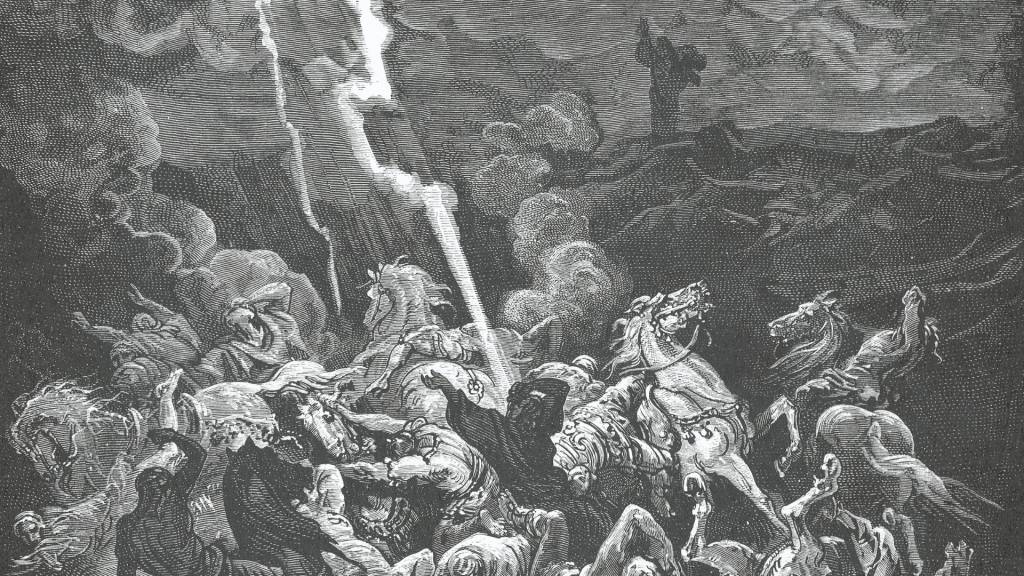
Gustave Dore, Fire Consumes the Soldiers of Ahaziah from the Illustrated Bible. 19th Century Engraving. Cropped Image
2 Kings 1
1 After the death of Ahab, Moab rebelled against Israel. 2 Ahaziah had fallen through the lattice in his upper chamber in Samaria, and lay injured; so he sent messengers, telling them, “Go, inquire of Baal-zebub, the god of Ekron, whether I shall recover from this injury.” 3 But the angel of the LORD said to Elijah the Tishbite, “Get up, go to meet the messengers of the king of Samaria, and say to them, ‘Is it because there is no God in Israel that you are going to inquire of Baal-zebub, the god of Ekron?’ 4 Now therefore thus says the LORD, ‘You shall not leave the bed to which you have gone, but you shall surely die.'” So Elijah went.
5 The messengers returned to the king, who said to them, “Why have you returned?” 6 They answered him, “There came a man to meet us, who said to us, ‘Go back to the king who sent you, and say to him: Thus says the LORD: Is it because there is no God in Israel that you are sending to inquire of Baal-zebub, the god of Ekron? Therefore you shall not leave the bed to which you have gone, but shall surely die.'” 7 He said to them, “What sort of man was he who came to meet you and told you these things?” 8 They answered him, “A hairy man, with a leather belt around his waist.” He said, “It is Elijah the Tishbite.”
9 Then the king sent to him a captain of fifty with his fifty men. He went up to Elijah, who was sitting on the top of a hill, and said to him, “O man of God, the king says, ‘Come down.'” 10 But Elijah answered the captain of fifty, “If I am a man of God, let fire come down from heaven and consume you and your fifty.” Then fire came down from heaven, and consumed him and his fifty.
11 Again the king sent to him another captain of fifty with his fifty. He went up and said to him, “O man of God, this is the king’s order: Come down quickly!” 12 But Elijah answered them, “If I am a man of God, let fire come down from heaven and consume you and your fifty.” Then the fire of God came down from heaven and consumed him and his fifty.
13 Again the king sent the captain of a third fifty with his fifty. So the third captain of fifty went up, and came and fell on his knees before Elijah, and entreated him, “O man of God, please let my life, and the life of these fifty servants of yours, be precious in your sight. 14 Look, fire came down from heaven and consumed the two former captains of fifty men with their fifties; but now let my life be precious in your sight.” 15 Then the angel of the LORD said to Elijah, “Go down with him; do not be afraid of him.” So he set out and went down with him to the king, 16 and said to him, “Thus says the LORD: Because you have sent messengers to inquire of Baal-zebub, the god of Ekron,– is it because there is no God in Israel to inquire of his word?– therefore you shall not leave the bed to which you have gone, but you shall surely die.”
17 So he died according to the word of the LORD that Elijah had spoken. His brother, Jehoram succeeded him as king in the second year of King Jehoram son of Jehoshaphat of Judah, because Ahaziah had no son. 18 Now the rest of the acts of Ahaziah that he did, are they not written in the Book of the Annals of the Kings of Israel?
This final prophetic episode in the Elijah cycle prior to the ascension of Elijah in the following chapter occurs during the year long reign of Ahaziah.[1] The division between 1 Kings and 2 Kings splits the comments on the brief reign of Ahaziah between the final three verses of 1 Kings and the initial chapter of 2 Kings. Ahaziah’s insignificant reign cut short by his injury and offense against God are contrasted with the significant prophet Elijah’s final action. The Book of Kings could easily have been the Book of Prophets, since for most of the book the kings are often secondary characters to the prophets.
Ahaziah fell from his upper chamber to the lower floor and is injured by the fall and confined to his bed. Yet, Ahaziah’s response to his injury is what dominates his portion of the story. Instead of appealing to the LORD, whether through a prophet or through the temple in Jerusalem he sends messengers to Ekron to appeal to the priests of prophets of Baal-zebub. There has been an ongoing animosity between the leaders in Samaria and Jerusalem, and the Omri dynasty has also been hostile to Elijah and other prophets of the LORD so on the one hand the action of Ahaziah to appeal to a foreign god, even a god of the once hostile Philistines, is not out of character for the Omri dynasty. Yet it is an audacious slight of the LORD the God of Israel, one that will have fatal consequences for this insignificant king.
Baal-zebub, the title for the god of Ekron would be the lord of the flies, and this is likely an intended insult of Baal-zebul the lord of the house. This is reflected title Beelzebul in the New Testament when Jesus is accused of being in lead with the lord of demons.[2] This minor spelling change turns the master of the house into the master of something considered a pest and nuisance in the ancient world. It is possible that ‘zebub’ is a local ‘baal’[3] and there is some debate over the rendering of ‘zebub’ as ‘fly’, but the Bible does frequently use insults for the other ‘gods’ that the people of Israel and the surrounding country follow.
Hebrew loves wordplay and it helps to know that the word for messenger (malakh) and angel (malakim) are closely related. Ahaziah sends messengers and the messenger of the LORD comes to Elijah to intercept these messengers of the king. Elijah’s message from the messenger (angel) of God speaks directly to the king’s messengers, “Is it because there is no God in Israel that you (plural) are going to inquire of Baal-zebub, the god of Ekron?” But when the king’s messengers return to the king they now point the blame on the king, “Is it because there is no God in Israel that you (singular) are sending to inquire of Baal-zebub, the god of Ekron?” The sentence declared on the king is terminal by the LORD. As Brueggemann states:
The particular phrase, “surely die,” is repeated three times by the prophet (1:4, 6, 16). While the phrase looks commonplace in the English translation, it is in fact a quite severe, absolute, and formal pronouncement of a death penalty from which there is no escape or reprieve. (Brueggemann, 2000, p. 284)
From the description of the man who intercepted the prophets, a hairy man with a leather belt around his waist, the king realizes that it is the longtime foe of the Omri dynasty, the prophet Elijah. Elijah’s successor Elisha we will learn in 2:23 is bald and so there is a drastic difference in the appearance of the hairy man and the man ridiculed for being bald. The description of Elijah will also be paralleled, although in an inexact manner, by the appearance of John the Baptist at the beginning of the gospels.[4] Elijah and Elisha will be different in appearance and as we transition to the Elisha cycle it will be worthwhile to compare the ministries of these two prophets.
The king views Elijah as a threat and sends three separate leaders and soldiers to bring Elijah down from the mountain.[5] The king desires to bring Elijah down by force but only manages to cause Elijah to bring down the fire of God upon his forces.[6] The first commander of fifty goes up the mountain to approach Elijah and orders the man of God to come down, yet Elijah demonstrates that the forces of the king are no match for the power of God as the first group of fifty is consumed. The second leader goes up to Elijah, but he may not go up the mountain. There may be some hint in the story that this second commander keeps his distance, but his words indicate that now the king orders Elijah to come down. The second group of fifty meets the same fate as the first. The final commander comes and kneels before the prophet and asks the prophet to show grace[7] for his life and the lives of his men. This final commander also indicates that he is Elijah’s servant instead of the king’s. The messenger (angel) of the LORD lets Elijah know it is safe to go with this commander to deliver the message directly to the king.
For the narrative of 2 Kings, King Ahaziah dies because of the declaration of the LORD not the injuries the king receives falling through the lattice. Throughout the Elijah cycle the people under the Omri dynasty have had divided loyalties. Elijah is an uncompromising in his zeal for the LORD the God of Israel and although the Omri will continue beyond the time of Elijah, it is quickly coming to end. Ahaziah in the narrative of the Book of Kings will be one more king whose brief reign in Samaria will be defined by his disobedience to the LORD the God of Israel.
[1] 1 Kings 22:51 notes that Ahaziah ruled for two years. He came to power in the seventeenth year of Jehoshaphat of Judah and died in his eighteenth year, but his total reign was less than twelve months long. (Cogan, 1988, p. 21)
[3] Baal is a general title for lord, and there were multiple ‘Baals’ worshipped regionally throughout Canaan.
[4] John is wearing camel’s hair as clothing rather than being described as hairy, although he does have the leather belt around his waist.
[5] Choon-Leong Seow notes that the same word har is used here as a Mount Carmel and the NIV and NRSV translation of this as ‘hill’ obscures the linkage to the previous story (1 Kings 18). (NIB III:173)
[6] Once again there is a Hebrew wordplay between the word for ‘man’ (‘is) and the word for fire (‘es). NIB III: 173.
[7] NRSV entreat. The Hebrew hanan means “to show grace’. (Brueggemann, 2000, p. 286)
Cry Of Prophet Jeremiah on the Ruins of Jerusalem by Ilya Repin 1870
1&2 Kings together form a narrative that runs from the pinnacle of the nation of Israel under Solomon to its nadir at the beginning of the Babylonian exile. First and Second Kings were initially a common book, the book of Kings, which was later divided into two books in the biblical canon.[1] I worked through 1 Kings in 2022-2023, and now it is time to walk through the remainder of this story of the northern kingdom’s destruction by the Assyrian empire in 721 BCE and the Babylonian empire’s conquering of Judah in roughly 587 BCE. 1 Kings ends during of the ministry of Elijah and Elisha the prophets in northern Israel.
In the Jewish division of the Hebrew Scriptures the Deuteronomic History (Joshua, Judges, 1&2 Samuel, and 1&2 Kings) are all grouped with the prophets. They are history viewed through a theological lens and with the intention of looking backwards to understand the situation of the people in exile. There is a tradition of associating these books with Jeremiah, and they do share a common worldview. This association is heightened by the reality that 2 Kings and Jeremiah end with a narration that is almost identical.
2 Kings narrates the collapse of the land of Israel and the monarchy of both Israel (Samaria) and Judah. The kings throughout the book of Kings are evaluated by the theological perspective of Deuteronomy and with a few notable exceptions most of these kings can be summarized by the phrase, “He committed all the sins that his father did before him; his heart was not true to the LORD his God like the heart of his father David.” (1 Kings 15:3 referring to Abijam, son of Rehoboam, son of Solomon but similar language is used for all the ‘bad’ kings).
If you spend much time working in the Hebrew Scriptures/Old Testament, the impact of the Babylonian exile is unavoidable. It is a central defining crisis for the people of Judah. The books of Jeremiah, Lamentations, and Ezekiel are all centered around this time-period and 2 Kings’ historical narrative ends at the exile. 2 Kings has some stories that are utilized in the life of the church, but as a book the stories of 2 Kings are probably less familiar than the stories of 1 Kings. My journey through 1 Kings provided me a much fuller appreciation of this portion of the story of God’s people, and I look forward to discovering the conclusion of this portion of the story of Israel in a richer way.
Walter Brueggemann is one of the most prolific Christian writers on the Hebrew Scriptures and brings a wide breadth of knowledge on both the collection of scripture as whole. His writing is consistently readable and insightful and tends to explore challenging perspectives. The Smith & Helwys Bible Commentary series is a very attractive resource bringing together commentary and discussion with artwork, maps, and other visual resources. This resource is closer to the blogging format which I write in than many books. More of a thematic commentary which is useful for preaching and teaching. I also utilized this volume during my reflections on 1 Kings.
Cogan, Mordechai and Hayim Takmor, II Kings: A New Translation with Introduction and Commentary (The Anchor Bible). New York City: Doubleday & Company, Inc. 1988
The Anchor Bible, Now the Anchor Yale Bible, is a detailed textual commentary. I utilized Mordechai Cogan’s first volume in my work on 1 Kings. This is the longest and most detailed of the works I used for this journey through 2 Kings. This is a volume more directed to the specialist rather than the preacher or teacher and some knowledge of Hebrew is helpful in using this resource.
Israel, Alex. II Kings: In A Whirlwind. (Maggid Studies in the Tanakh). Jerusalem: Maggid Books, 2019.
I utilized Rabbi Alex Israel’s first volume in my reflections on 1 Kings. When looking at a Hebrew Scripture text I like to have a Jewish voice and the Maggid Studies are an approachable resource. Rabbi Israel’s skill as a teacher is on display in this volume as he writes an approachable text which brings 2 Kings into dialogue with the historical context and rabbinic interpretation. A clear and insightful perspective on the people and events of 2 Kings.
Seow, Choon-Leong. “The Books of 1 and 2 Kings.” In New Interpreter’s Bible III: 1-295.12 Vols. Nashville: Abingdon Press. 1999.
The NIB (New Interpreter’s Bible) is a solid resource as a resource for preaching and teaching that covers the entire bible and goes into some textual issues, but it primarily is focused on giving a fuller context to the story. Choon-Leon Seow’s contribution on the 1 and 2 Kings goes into a little more depth on translational issues than some other portions of this commentary set I’ve utilized, and this was a positive since it identified some interesting things to explore in the Hebrew text. This was another solid portion of the NIB and it is a resource worth having on the shelf for a pastor.
[1] The division initially occurred in the translation of the Hebrew Text into Greek (the Septuagint).



 Sign of the Rose