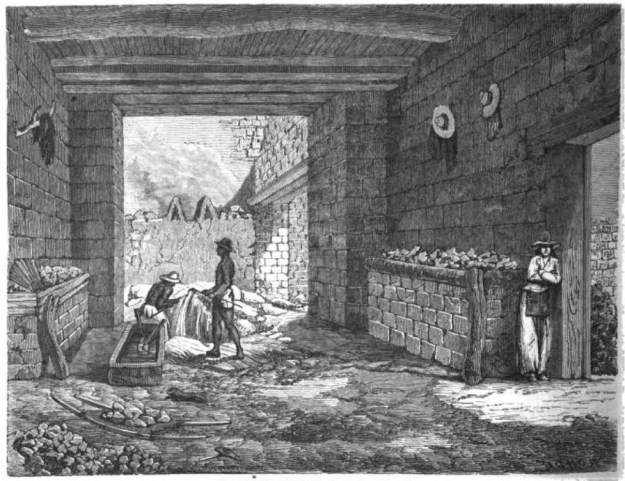
Interior of the Silver Smelter of Corralitos By Philippe Rondé – Le Tour du Monde, volume 4 [1], Public Domain, https://commons.wikimedia.org/w/index.php?curid=82418139
Ezekiel 22: 1-21 The Bloody City
The word of the LORD came to me: 2 You, mortal, will you judge, will you judge the bloody city? Then declare to it all its abominable deeds. 3 You shall say, Thus says the Lord GOD: A city! Shedding blood within itself; its time has come; making its idols, defiling itself. 4 You have become guilty by the blood that you have shed, and defiled by the idols that you have made; you have brought your day near, the appointed time of your years has come. Therefore I have made you a disgrace before the nations, and a mockery to all the countries. 5 Those who are near and those who are far from you will mock you, you infamous one, full of tumult.
6 The princes of Israel in you, everyone according to his power, have been bent on shedding blood. 7 Father and mother are treated with contempt in you; the alien residing within you suffers extortion; the orphan and the widow are wronged in you. 8 You have despised my holy things, and profaned my sabbaths. 9 In you are those who slander to shed blood, those in you who eat upon the mountains, who commit lewdness in your midst. 10 In you they uncover their fathers’ nakedness; in you they violate women in their menstrual periods. 11 One commits abomination with his neighbor’s wife; another lewdly defiles his daughter-in-law; another in you defiles his sister, his father’s daughter. 12 In you, they take bribes to shed blood; you take both advance interest and accrued interest, and make gain of your neighbors by extortion; and you have forgotten me, says the Lord GOD.
13 See, I strike my hands together at the dishonest gain you have made, and at the blood that has been shed within you. 14 Can your courage endure, or can your hands remain strong in the days when I shall deal with you? I the LORD have spoken, and I will do it. 15 I will scatter you among the nations and disperse you through the countries, and I will purge your filthiness out of you. 16 And I shall be profaned through you in the sight of the nations; and you shall know that I am the LORD.
The prophet Nahum in the 7th Century BCE issues oracles against the Assyrian capital Ninevah he declares that it is a city of bloodshed. Ninevah had been responsible for the conquering of Samaria and Nahum viewed their violent actions as meriting God’s judgement. “Ah, City of bloodshed, utterly deceitful, full of booty—no end to plunder” (Nahum 3:1) Although it is not certain that Ezekiel would have known these words from a prophet a couple of decades prior to his ministry, the content of this oracle reflects similar language, although now the bloody city is Jerusalem instead of Ninevah. Ezekiel is now called to judge the city which has transformed itself by its actions from the city of God to the bloody city.
The actions of bloodshed and idolatry have led the city to this space where they stand under God’s judgment. The punishment long withheld is finally arriving and Jerusalem instead of occupying a privileged space of honor as Zion now occupies a space of mockery and dishonor before the nations. The society of Judah has unraveled. They have lost their grounding in the covenant and in this dangerous city the fundamental building block of society (the family) has broken down and the vulnerable are exploited.
Throughout the law it is clear that leaders in Judah have a responsibility to maintain justice among the citizens. Their position is one of responsibility and not primarily one of privilege. Ezekiel accuses the princes of Israel of practicing exploitation instead of justice. Family is treated with contempt, the vulnerable (aliens, orphans, and widows) are exploited, the holy things of God are profaned, dishonest words are used to spill blood, unholy actions and things are lifted up, the boundaries of decency in family and among neighbors is broken, profit is made upon the misfortune of others (by charging interest) and all of this points to the reality that the people has forgotten the LORD. The list of unrighteous actions is the opposite of the righteous man who can save his own life in Ezekiel 18:5-9 and both build upon the understanding of holiness expressed in Leviticus 18-19.
Ezekiel paints a bleak picture of the communal life of Jerusalem. When they can be referred to in a similar way to Ninevah (or Samaria and Sodom as in 16: 44-58) then they are a society that has lost its moorings. When the city of shalom (Jeru-shalom) has become the bloody city the world has turned upside down. Ezekiel’s language is evocative. He paints this blood red image of violence to demonstrate the brokenness of Jerusalem and the righteousness of God in calling for judgment. These words, which are preserved beyond the judgment may have enabled the children to look upon the actions of their parents, consider and not do likewise. (Ezekiel 18:14)
Ezekiel 22: 17-22 Israel is Dross
17 The word of the LORD came to me: 18 Mortal, the house of Israel has become dross to me; all of them, silver, bronze, tin, iron, and lead. In the smelter they have become dross. 19 Therefore thus says the Lord GOD: Because you have all become dross, I will gather you into the midst of Jerusalem. 20 As one gathers silver, bronze, iron, lead, and tin into a smelter, to blow the fire upon them in order to melt them; so I will gather you in my anger and in my wrath, and I will put you in and melt you. 21 I will gather you and blow upon you with the fire of my wrath, and you shall be melted within it. 22 As silver is melted in a smelter, so you shall be melted in it; and you shall know that I the LORD have poured out my wrath upon you.
Israel was to be a treasured possession, a priestly kingdom, and a holy nation (Exodus 19: 5-6). Just as the city of peace became the blood city, now the treasured possession has become dross. The imagery of the refinement of silver from the silver ore which contains multiple elements (copper, iron, lead and tin) becomes the metaphor for God’s action of pouring out anger to melt the elements to separate the dross from the precious metal. There is a resonance with the metaphor here and Egypt as the iron smelter which God delivered his people from (Deuteronomy 4:20) but a stronger resonance exists in Isaiah’s earlier description of Judah:
How the faithful city has become a whore! She that was full of justice, righteousness lodged in her—but now murderers! Your silver has become dross, your wine is mixed with water. Your princes are rebels and companions of thieves. Everyone loves a bribe and runs after gifts. They do not defend the orphan, and the widow’s cause does not come before them. Isaiah 1: 21-23 (emphasis mine).
Yet, Ezekiel’s image may indicate that there is nothing precious left in Israel. They are completely dross. It is only God’s action that dross which has nothing precious can emerge from the smelter as silver. Any hope for Israel’s future lies in the same God whose blast of wrath is melting the people in their current state.
Ezekiel 22: 23-31 No One to Stand in the Breach
23 The word of the LORD came to me: 24 Mortal, say to it: You are a land that is not cleansed, not rained upon in the day of indignation. 25 Its princes within it are like a roaring lion tearing the prey; they have devoured human lives; they have taken treasure and precious things; they have made many widows within it. 26 Its priests have done violence to my teaching and have profaned my holy things; they have made no distinction between the holy and the common, neither have they taught the difference between the unclean and the clean, and they have disregarded my sabbaths, so that I am profaned among them. 27 Its officials within it are like wolves tearing the prey, shedding blood, destroying lives to get dishonest gain. 28 Its prophets have smeared whitewash on their behalf, seeing false visions and divining lies for them, saying, “Thus says the Lord GOD,” when the LORD has not spoken. 29 The people of the land have practiced extortion and committed robbery; they have oppressed the poor and needy, and have extorted from the alien without redress. 30 And I sought for anyone among them who would repair the wall and stand in the breach before me on behalf of the land, so that I would not destroy it; but I found no one. 31 Therefore I have poured out my indignation upon them; I have consumed them with the fire of my wrath; I have returned their conduct upon their heads, says the Lord GOD.
This third section within the chapter continues to build upon previously used imagery and has echoes of the words of Jeremiah, Micah,[1] and especially Zephaniah. The image of princes as roaring lions was seen in chapter 19 and prophets are covering up the flaws in the society with whitewash as in chapter 13. Like many speakers these images are brought again to hearers to reinforce the injustice done by the rulers of the society. For the first time in Ezekiel the priests are brought into the condemnation. The overall passage, as mentioned above, echoes the language of Zephaniah 3:
Ah, soiled, defiled, oppressing city! It has listened to no voice; it has accepted no correction. It has not trusted the LORD; it has not drawn near to its God. The officials within it are roaring lions; its judges are evening wolves that leave nothing until the morning. Its prophets are reckless, faithless persons; its priests have profaned what is sacred they have done violence to the law. Zephaniah 3: 1-4 (emphasis mine).
The echoes between prophets may originate in a tradition of preserving the words of the prophets and studying these words, but if we take seriously the claims that the prophets are proclaiming the word of the LORD, then they share a common source. Through multiple voices similar images and messages have attempted to break through the resistance of the people of Israel, but now the people stand at the precipice of judgment with no one to stand in the gap for them.
The narrative of the flood in the book of Genesis (Genesis 6-9) deals with God’s attempt to cleanse the land from the wickedness, corruption, and violence of humanity. Now this violence, wickedness and corruption are focused in Judah and the action of the LORD is to purify the land once again. The princes, officials, priest, and prophets have all practiced violence, corrupted the teaching of the law and profaned the holy things, shed blood for dishonest gain, and covered up the corruption in the society. The result is a society that was intended to provide justice to the poor, needy, and the alien are now exploiting those vulnerable members of society.
The LORD seeks someone who will stand in the breach before God on behalf of the land. Gary Anderson points to the way Moses filled this role for the people in both Exodus 32: 7-14 and Numbers 14: 11-20. (Anderson, 2008, p. 223) Moses after both the Golden Calf and the rebellion against Moses and Aaron stands between the people and God and calls upon God not to destroy the people, initially for the sake of the name of God and then later picking up on God’s declared identity in the aftermath of the first betrayal. There is no Moses to stand in the breach for the people, to both defend the people from the wrath of the LORD, but also to reorient the people on the way of the law.
In a time where there is no Moses to stand in the breach and the princes, prophets, officials, and priests have all betrayed the ways of God the society is disordered. There is no reform that will reorient this broken society, only the wrath of God which washes over and consumes can purify the dross into silver. When Jerusalem is bloodier than Ninevah then perhaps only the destruction of the city can bring about the healing of the land. There is no hope in Ezekiel which does not pass through the destruction of Jerusalem, the temple, the Davidic line of kings, and the loss of the land. There are only two more chapters of Ezekiel prior to the exile of the majority of the people, and throughout the book there has been no expectation that the people would hear and respond to the words of the prophet. Ezekiel does provide a lens for the people to look backward through in the aftermath of exile once they realize that there has been a prophet among them.
[1] Jeremiah 5: 1-5, 31; Micah 3:11.
 Sign of the Rose