Tag Archives: Babylonian Exile

The Place of Authority: A Brief History Part 3b: The Exile, Reconstructing Identity-Narrative, Practice and Hope

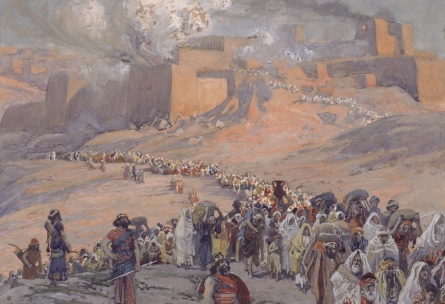
James Tissot, The Flight of the Prisoners

Thus says the Lord of hosts, the God of Israel, to all the exiles whom I have sent into exile from Jerusalem to Babylon: Build houses and live in them; plant gardens and eat what they produce. Take wives and have sons and daughters; take wives for your sons, and give your daughters in marriage that they bear sons and daughters; multiply there, and do not decrease.  But seek the welfares of the city where I have sent you into exile, and pray to the Lord on its behalf, for in its welfare you will find your welfare. Jeremiah 29. 4-7 NRSV

Even when the world as you know it ends, life still goes on, and we have to make sense of the conflict, the struggle and our place within it.  The communal memory becomes important, the stories parents have told their children, the history of families. In the midst of competing narratives what is the story that one can identify with? With the loss of the Davidic monarchy, the temple, the land of their ancestors the people did something amazing, they recast their identity.  They dug deep into their narrative, they began bringing together their stories, and in fact much of the Old Testament is brought together at this point. Stories of creation and exodus begin to be the patterns in which the present is made sensible and the community begins to come up with answers to the hardest question, “why did this happen?” They don’t come up with just one answer, they come up with many. They bring together their stories and the Torah (typically translated into English as law, but it is a term that is much more than what we understand as law in our context) begins to be center of their life.  Practice and story come together to bind together this community in exile.

This does not mean that everyone agrees, there is not a central authorizing authority for the narrative at this point, it is constructed mainly by the remnant of the elite (everyone else would have been illiterate at this point) from both the priestly and prophetic side. Some of the central ideas to emerge include:

Justice: a sense of living in harmony (shalom) with God’s desire for the way things are to be structured in society. This includes a strong sense of economic justice, compassion for the widows, orphan, immigrant, and the dispossessed. It is from this vision that many prophets operate out of, and this is a central image for the prophetic hope. The new Jerusalem, the new Israel is to be a place of justice where the nations around can look and say “Come, let us go up to the mountain of the Lord, to the house of Jacob; that he may teach us his ways and that we may walk in his paths” (Isaiah 3b, NRSV) and within God’s plan the nations will stream to Jerusalem.

Purity/Holiness: For us there is often a tension between Purity/Holiness and Justice, but it was not necessarily seen that way by the Jewish people.  Especially for priests there are practices that are to be done to prevent the contamination of unholiness from infecting them as a people and making them repulsive to the holiness of God. It also becomes a powerful way of distinguishing between themselves as a Hebrew people and the nations around them who are the Gentiles, the unclean ones.  This tends to be more of a priestly focus and there are conflicts between which will dominate going forward, but at the root both justice and holiness are practices which distinguish them from the hostile surrounding culture.

With these two distinctive directions emerges a new strand of a hope for a new beginning, a new temple, a New Jerusalem, a new anointed (and Davidic) king, a messiah.  Wrapped up within the memory of the stories of creation and the exodus of the people from Egypt hope springs forth of a return home and a new beginning:

Do not remember the former things, or consider the things of old. I am about to do a new thing: now it springs forth, do you not perceive it? I will make away in the wilderness and rivers in the desert. The wild animals will honor me, the jackals and the ostriches; for I give water in the wilderness, rivers in the desert, to give drink to my chosen people, the people who I formed for myself so that they might declare my praise. Isaiah 43.18-21

2nd Isaiah (Isaiah 40-55, which reflects the time of preparation for the return home, while Isaiah 1-39 deals with the time before the exile) in particular is full of this vibrant hope, along with other voices.  Empires rise and empires fall, and a generation later Babylon falls to Persia (modern day Iran) and Cyrus (who Isaiah interestingly calls Messiah/Christ-same word in Hebrew/Greek) makes possible the beginning of a return home.  Their stories and practices have maintained their identity and given them hope of a new beginning. With the return to Jerusalem, the land, and the possibility of reconstructing the temple comes yet another transition.  It is to that transition that we turn next.

purple rose 01 by picsofflowers.blogspot.com

The Place of Authority: A Brief History Part 3a: The Exile, the Crisis of Collapse

James Tissot, The Flight of the Prisoners

By the rivers of Babylon—there we sat down and there we wept when we remembered Zion. In the willows there we hung up our harps.For there our captors asked us for songs, and our tormentors asked for mirth, saying,

“Sing us one of the songs of Zion!”

How could we sing the Lord’s song in a foreign land? If I forget you, O Jerusalem, let my right hand wither! Let my tongue cling to the roof of my mouth, if I do not remember you,if I do not set Jerusalem above my highest joy. 

Remember, O Lord, against the Edomites the day of Jerusalem’s fall, how they said,

 “Tear it down! Tear it down! Down to its foundations!”

O daughter of Babylon, you devastator! Happy shall they be who pay you back what you have done to us! Happy shall they be who take your little ones and dash them against the rock!   Psalm 137 NRSV

In 721 BCE, after roughly 200 years of separation from the Southern Kingdom of Judah, the Northern Kingdom Israel falls to the Assyrian Empire (which has its origins in the Northwestern Part of modern day Iraq) and the Northern Kingdom is effectively absorbed into the Assyrian nation.  Somehow Judah holds on, even though it becomes completely surrounded by the Assyrian Empire.  Empires come and go, and power shifts to the Babylonian Empire (which has its origins in modern day Southern Iraq) without going into the bloody details: Jerusalem falls, the temple is destroyed, the Davidic monarchy effectively ends and the people of Judah are taken into exile or captivity in Babylon.  The loss of king and temple, as well as the land cause a crisis of authority which leads to one of the most constructive and important periods in Judaism.

The loss of home is catastrophic, it leads to a ton of questions about the future and there may not be any good answers at that point.  The closest cinematic example I could come up with was the loss of Anatevka in Fiddler on the Roof where families try to make the best of their coming exile, belittling what they are leaving behind-and yet families are broken apart, scattered across the world, many will never see each other again.

Something as catastrophic to not only the physical well-being but also to the communal consciousness can lead to several outcomes, many of which do emerge in this time. One response of the conquered is to assimilate with the conqueror, to align oneself with the victor, to adopt their values and practices and to set aside at least a portion of one’s previous identity to become a part of something different.  This is the perceived response of the Northern Kingdom by the Southern Kingdom-they stay on their land, intermarry with the Assyrians, and what emerges will be a hybrid people-no longer really Jewish, already separated from the Davidic monarchy and the temple hundreds of years before they become the other…the Samaritan (yes this is where those Samaritans that Jesus runs into in the New Testament come from).  But to be fair, a large number of the Judeans also assimilate into Babylon, only a small portion of the Judean people will return to their homeland at the end of the exile, most will remain dispersed throughout the nations.

In the lead up to the exile, the prophetic voice becomes very harsh in its critique of the monarchy, temple, the lack of economic justice within the nation, and the perceived idolatry of the shepherds of the nation.  This is the time where the first parts of Isaiah, much of Jeremiah and Ezekiel and many of the Minor Prophets become active in the memory of the people. The prophetic voice leads the way pointing to the ways in which kings and priests, throne and temple have not only failed as sources of authority but are at the very heart of the crisis viewed as a judgment from the LORD.  The prophets announce condemnation for the shepherds (the leaders, the authority in throne and temple) as one example among many:

The word of the Lord came to me: Mortal, prophesy against the shepherds of Israel: prophesy, and say to them—to the shepherds: Thus says the Lord God: Ah, you shepherds of Israel who have been feeding yourselves! Should not the shepherds feed the sheep? You eat the fat, you clothe yourselves with the wool, you slaughter the fatlings: but you do not feed the sheep. You have not strengthened the weak, you have not healed the sick, you have not brought back the strayed, you have not sought the lost, but with force and harshness you ruled them.  So they were scattered, because there was no shepherd: and scattered wandered over all the mountains and on every high hill; my sheep were scattered over the face of the earth, with no one to search or seek for them. Ezekiel 34.1-6 NRSV

 Instead of coming to believe that somehow their God is weaker than the gods of the Assyrians or the Babylonians, something amazing happens in the prophetic imagination (to use Walter Brueggemann’s keen words) and they begin to understand the transitions and the conflict around them as a part of God’s work—that behind Assyrian and Babylonian is the Lord of hosts (literally the Lord of armies-typically we think of this as heavenly armies, but I am beginning to think that in there is something more earthly to this term than often given credit). The coming destruction is a judgment particularly on the leaders, but also within all this death is the chance for something new: a fresh start, a redefinition, a chance to redefine and re-imagine what it means to be the chosen people.

The hand of the Lord came upon me, and he brought me out by the spirit of the Lord and set me down in the middle of the valley; it was full of bones.  He led me around them; there were very many lying in the valley, and they were very dry.  He said to me, “Mortal, can these bones live?” I answered, “O Lord God, you know.” Then he said to me, “Prophecy to these bones, and say to them: O dry bones, hear the word of the Lord. Thus says the Lord God to these bones: I will cause breath to enter you, and you shall live. I will lay sinews on you, and will cause flesh to come upon you, and cover you with skin, and put breath in you, and you shall live; and you shall know that I am the Lord. Ezekiel 37.1-6 NRSV

The prophetic voice will help the people re-imagine a new way forward, a way that is so critical to the way we understand things that we need to take some time with it.  Hope will not die, in fact it will be reborn in a new and powerful way and the people will understand themselves as a chosen people, but what that means takes a dramatic turn in the exile.  To that we shall turn next.

purple rose 01 by picsofflowers.blogspot.com