Tag Archives: Angel of the Lord

2 Kings 19 The Deliverance of Jerusalem from Assyria

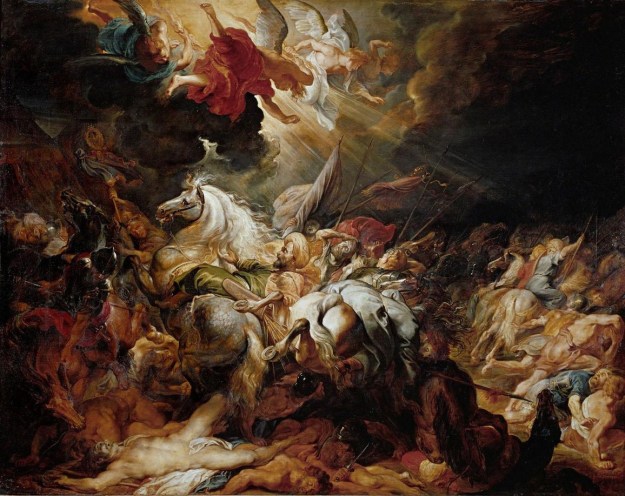
The Defeat of Sennacherib, oil on panel by Peter Paul Rubens, seventeenth century

2 Kings 19: 1-7

 1When King Hezekiah heard it, he tore his clothes, covered himself with sackcloth, and went into the house of the LORD. 2And he sent Eliakim, who was in charge of the palace, and Shebna the secretary, and the senior priests, covered with sackcloth, to the prophet Isaiah son of Amoz. 3They said to him, “Thus says Hezekiah: This day is a day of distress, of rebuke, and of disgrace; children have come to the birth, and there is no strength to bring them forth. 4It may be that the LORD your God heard all the words of the Rabshakeh, whom his master the king of Assyria has sent to mock the living God, and will rebuke the words that the LORD your God has heard; therefore lift up your prayer for the remnant that is left.” 5When the servants of King Hezekiah came to Isaiah, 6Isaiah said to them, “Say to your master: Thus says the LORD: Do not be afraid because of the words that you have heard, with which the servants of the king of Assyria have reviled me. 7I myself will put a spirit in him so that he shall hear a rumor and return to his own land; I will cause him to fall by the sword in his own land.”

The narration of 2 Kings 19 speaks in unison with Isaiah 37 as the prophetic voice brings a note of hope into this critical moment in the life of Jerusalem. The threats of Rabshakeh, and by extension King Sennacherib of Assyria, are now relayed to King Hezekiah and then to the LORD the God of Israel. The hope of the land now rests in the hope the prophet’s intercession with living God will cause this God to act on behalf of the city. King Hezekiah, a king who did right in the sight of the LORD as his ancestor David had done, and the Prophet Isaiah stand with the LORD the God of Israel against the arrayed forces of the empire of Assyria that call from beyond the walls of the city.

The perspective of the narrator of 2 Kings is that the LORD the God of Israel is trustworthy and that the fall from the nation of Israel’s pinnacle under David and Solomon to the reality at the time of Hezekiah where Samaria has been captured and Jerusalem stands under threat was precipitated by the unfaithfulness of the kings and people. Yet, Hezekiah is a king who has shown faithfulness to God’s vision for the people and has been aligned with the prophet Isaiah. In contrast to the bold and idolatrous voice of Rabshakeh and Sennacherib, here Hezekiah assumes the expected posture of repentance: he tears his clothes and covers himself in sackcloth before the LORD as a sign of distress and repentance. As the prophet Isaiah says:

       On that day the Lord God of hosts
  called for weeping and mourning,
  for baldness and putting on sackcloth, Isaiah 22:12[1]

 Now the king assumes this posture of weeping and mourning on this day of distress. The king utilizes the image of a woman who comes to the point of childbirth where the child is in the birth canal and needs the mother to push the child out into the world, but the mother does not have the strength to move the child from this place of extreme pain and danger from both the child and the mother. Hezekiah and Jerusalem are powerless to bring about their own deliverance and can only rely upon the LORD to respond and rescue them.

The king and the prophet relay the mocking words of Rabshakeh and Sennacherib to the LORD in the hope that God will respond and rebuke these arrogant words and actions. Isaiah relays to the servants to Hezekiah God’s response which begins with the reassuring words, “Do not be afraid.” Hezekiah and Isaiah have trusted in God against the overwhelming and mocking might of the Assyrians, and God will not be mocked. God will put a spirit in the king, not unlike the action of the ‘lying spirits’ that Micaiah mentions that deceive King Ahab,[2] which lead him away from Jerusalem and eventually to his death.

2 Kings 19: 8-13

  8The Rabshakeh returned and found the king of Assyria fighting against Libnah, for he had heard that the king had left Lachish. 9When the king heard concerning King Tirhakah of Cush, “See, he has set out to fight against you,” he sent messengers again to Hezekiah, saying, 10Thus shall you speak to King Hezekiah of Judah: Do not let your God on whom you rely deceive you by promising that Jerusalem will not be given into the hand of the king of Assyria. 11See, you have heard what the kings of Assyria have done to all lands, destroying them utterly. Shall you be delivered? 12Have the gods of the nations delivered them, the nations that my predecessors destroyed: Gozan, Haran, Rezeph, and the people of Eden who were in Telassar? 13Where is the king of Hamath, the king of Arpad, the king of the city of Sepharvaim, the king of Hena, or the king of Ivvah?”

  14
Hezekiah received the letter from the hand of the messengers and read it; then Hezekiah went up to the house of the LORD and spread it before the LORD. 15And Hezekiah prayed before the LORD and said, “O LORD the God of Israel, who are enthroned above the cherubim, you are God, you alone, of all the kingdoms of the earth; you have made heaven and earth. 16Incline your ear, O LORD, and hear; open your eyes, O LORD, and see; hear the words of Sennacherib, which he has sent to mock the living God. 17Truly, O LORD, the kings of Assyria have laid waste the nations and their lands 18and have hurled their gods into the fire, though they were no gods but the work of human hands—wood and stone—and so they were destroyed. 19So now, O LORD our God, save us, I pray you, from his hand, so that all the kingdoms of the earth may know that you, O LORD, are God alone.”

Jerusalem may be the capital of a small kingdom caught between the aggressive Assyrian empire and the movements of Egypt to the south, but the audacity of the Jewish belief is that the God of Israel is the LORD of hosts behind not only the armies of heaven but behind the movement of the armies on the face of the earth. The rumored or real movement of the armies of King Tirhakah of Cush[3] prevent a threat to the Assyrians in Judah that must be addressed and this causes both King Sennacherib to move from Lachish and the emissaries of the king of Assyria to prepare to move in support of their king. Yet, King Sennacherib does not want to allow Jerusalem to believe that it has escaped his judgment, and that any removal of the threat is temporary. The Assyrians have conquered numerous other nations and their gods, and in the eyes of Sennacherib Jerusalem, Hezekiah and the LORD are no different. In a similar way Joseph Stalin is attributed with remarking millennia later about the pope, “How many divisions hath the pope?” In the eyes of the empire of the day might makes their position right.

King Hezekiah of Jerusalem views the world differently; it is the LORD who makes things right. Hezekiah takes these words delivered by the messenger, enters the house of the LORD and spreads these words before the LORD. Hezekiah’s prayer calls on the LORD to hear, see, and respond to the mocking words of King Sennacherib. The Assyrians may have defeated the other nations and their gods, who were really no gods at all, but now they have challenged the creator of the heavens and the earth. King Hezekiah calls on God to save Jerusalem from the hands of the Assyrians and to demonstrate that the LORD the God of Israel is the only true God.

2 Kings 19: 20-34


  20
Then Isaiah son of Amoz sent to Hezekiah, saying, “Thus says the LORD, the God of Israel: I have heard your prayer to me about King Sennacherib of Assyria. 21This is the word that the LORD has spoken concerning him:
 She despises you; she scorns you—
  virgin daughter Zion;
 she tosses her head—behind your back,
  daughter Jerusalem.

22
Whom have you mocked and reviled?
  Against whom have you raised your voice
 and haughtily lifted your eyes?
  Against the Holy One of Israel!
23
By your messengers you have mocked the Lord,
  and you have said, ‘With my many chariots
 I have gone up the heights of the mountains,
  to the far recesses of Lebanon;
 I felled its tallest cedars,
  its choicest cypresses;
 I entered its farthest retreat,
  its densest forest.
24
I dug wells
  and drank foreign waters,
 I dried up with the sole of my foot
  all the streams of Egypt.’

25
Have you not heard
  that I determined it long ago?
 I planned from days of old
  what now I bring to pass,
 that you should make fortified cities
  crash into heaps of ruins,
26
while their inhabitants, shorn of strength,
  are dismayed and confounded;
 they have become like plants of the field
  and like tender grass,
 like grass on the housetops
  that is scorched before the east wind.

27
But I know your sitting
  and your going out and your coming in
  and your raging against me.
28
Because you have raged against me
  and your arrogance has come to my ears,
 I will put my hook in your nose
  and my bit in your mouth;
 I will turn you back on the way
  by which you came.

  29
And this shall be the sign for you: This year you shall eat what grows of itself and in the second year what springs from that; then in the third year sow, reap, plant vineyards, and eat their fruit. 30The surviving remnant of the house of Judah shall again take root downward and bear fruit upward, 31for from Jerusalem a remnant shall go out and from Mount Zion a band of survivors. The zeal of the LORD of hosts will do this.
  32
Therefore thus says the LORD concerning the king of Assyria: He shall not come into this city, shoot an arrow there, come before it with a shield, or cast up a siege ramp against it. 33By the way that he came, by the same he shall return; he shall not come into this city, says the LORD. 34For I will defend this city to save it, for my own sake and for the sake of my servant David.”

The poetic response to King Hezekiah’s prayer and King Sennacherib’s mocking letter is delivered through Isaiah and the instrument of the word of the LORD. Jerusalem, personified as a woman, despises and mocks Sennacherib and Assyria, but ultimately it is not Jerusalem that has been disrespected but the Holy One of Israel. Sennacherib has misunderstood his military successes as his own action, but the poem reveals the truth understood from the biblical perspective: the LORD the God of Israel is the LORD of hosts (or armies). The LORD has allowed Sennacherib and Assyria to enjoy the success they have seen, but now they have bitten the hand that fed them. The mocking words of Sennacherib have provoked a reaction from the LORD and now a hook in the nose and a bit in the mouth symbolically shows the powerful king as an unruly animal brought under control by force. Sennacherib will have his head turned like a horse or mule to direct this recalcitrant tyrant back to Ninevah.

The sign discussing eating what grows from the ground for two years before replanting and sowing not only grain, but vineyards set a period for recovery in the aftermath of Assyria’s invasion. The invasion of a land does not only focus on cities. The agricultural land also is used by the invading army as a source of food and unutilized crops are often destroyed to deny food to the invaded population. Yet, the LORD promises there will be enough to glean from the remnant of the current years crop and the volunteer crop of the following year as the armies return to Assyria and depart not only the region around Jerusalem but the entirety of the productive land of Judea. In the third year there will be the security to plant not only annual crops like wheat and barley but also to plant vineyards and to begin to restore the productivity of the land. The expulsion of the armies of Assyria allows both the people and the land to take root and bear fruit. Both nations and people can recover and grow from the remnant of the people of Judah who are gathered in Jerusalem.

The LORD also indicates that the threat to Jerusalem will end without the activities of a siege: no arrows shot into the city, no shields and siege ramps cast up against the walls of Jerusalem. This indicates the army camped near Jerusalem will depart almost immediately before the work of the siege can begin. The LORD promises here to act both on God’s behalf, for the sake of the honor of the name of the LORD which has been insulted by Sennacherib’s words, but also for the sake of David and his faithful heir Hezekiah.

This moment when the armies of Assyria are turned away at the gates of Jerusalem will encourage a focus on the city of Jerusalem, the temple, and the Davidic line as guarantees of divine protection by the LORD. The emergence of a Zion theology, where temple and city occupy a privileged place before God will have to be deconstructed by later prophets like Jeremiah, but in this moment of a faithful king who appeals to God through the prophet Isaiah and in prayer in the temple God answers the prayer of the faithful one. Nevertheless, as Alex Israel states:

When the Temple was eventually destroyed, kings and commoner alike were astonished. They simply failed to comprehend that Jerusalem could fall. Why? Because the victory against Sennacherib had engendered the belief that Jerusalem was under divine protection, that it was invincible.

Similarly, Jeremiah (ch.7) seeks to persuade the people of Jerusalem to stop believing blindly that the Temple was fundamentally indestructible, that God would never abandon His Temple. (Israel, 2019, p. 303)

Or as Lamentations 4:12 states:

The kings of the earth did not believe, nor did any of the inhabitants of the world, that foe or enemy could enter the gates of Jerusalem.

Yet from the perspective of 2 Kings the faithfulness of the king and the people matter. God did not rescue Samaria from Assyria and from the perspective of 2 Kings that conquest is a judgment upon the kings and people of Samaria and their idolatrous practices. Hezekiah restores the people to proper worship of the LORD, and his faithfulness and prayer change God’s authorization of Assyria’s conquest.

2 Kings 19: 35-37

  35That very night the angel of the LORD set out and struck down one hundred eighty-five thousand in the camp of the Assyrians; when morning dawned, they were all dead bodies. 36Then King Sennacherib of Assyria left, went home, and lived at Nineveh. 37As he was worshiping in the house of his god Nisroch, his sons Adrammelech and Sharezer killed him with the sword, and they escaped into the land of Ararat. His son Esar-haddon succeeded him.

Many modern readers struggle with the destruction of the one hundred eighty-five thousand soldiers in the camp of Assyria. I remember during Desert Storm Sadaam Hussein claimed that Allah would strike down the American other allied soldiers who were fighting against him in this ‘holy war/Jihad’ and most modern Western observers responded to this language with scorn. Yet, as Walter Brueggemann states, “the bible hangs or falls on its attestation of the divine difference Yahweh makes in real events.” (Brueggemann, 2000, p. 517) The narrator of 2 Kings has already indicated the power of the LORD the God of hosts when the servant of Elisha has his eyes opened to see the LORD’s chariots of fire and horsemen which surround the Arameans attempting to capture the prophet. (2 Kings 6:15-23) The bible is full of imagery of God as the divine warrior or the leader of armies who saves that people. One hundred eighty-five thousand soldiers is a huge number, especially in the ancient world where populations were much smaller, but I think too many modern readers struggle with accepting that God could act like this through the angel of the LORD.

King Sennacherib retires to Ninevah, likely significantly embarrassed by inability to capture Jerusalem and the loss of soldiers. A defeated king is a vulnerable king, and while worshipping in the house of the unknown god, outside of this mention, Nisroch he is killed by two of his sons who flee and one of his other sons ascends the throne. Assyria’s reign as the empire of the day has not ended, indeed Esar-haddon would conquer Egypt, and Assyria remains a threat through the end of Hezkiah’s life (see 2 Kings 20:6) but God promises to continue to protect Jerusalem.

So much of the biblical language of prophecy is poetry, and so I’m going to close this reflection with Lord Byron’s poem “the Destruction of Sennacherib”

The Assyrian came down like the wolf on the fold,

And his cohorts were gleaming in purple and gold;

And the sheen of their spears was like stars on the sea,

When the blue wave rolls nightly on deep Galilee.

Like the leaves of the forest when Summer is green,

That host with their banners at sunset were seen:

Like the leaves of the forest when Autumn hath blown,

That host on the morrow lay withered and strown.

For the Angel of Death spread his wings on the blast,

And breathed in the face of the foe as he passed;

And the eyes of the sleepers waxed deadly and chill,

And their hearts but once heaved, and for ever grew still!

And there lay the steed with his nostril all wide,

But through it there rolled not the breath of his pride;

And the foam of his gasping lay white on the turf,

And cold as the spray of the rock-beating surf.

And there lay the rider distorted and pale,

With the dew on his brow, and the rust on his mail:

And the tents were all silent, the banners alone,

The lances unlifted, the trumpet unblown.

 And the widows of Ashur are loud in their wail,

And the idols are broke in the temple of Baal;

And the might of the Gentile, unsmote by the sword,

Hath melted like snow in the glance of the Lord!

From the Poetry Foundation website: The Destruction of Sennacherib | The Poetry Foundation


[1] See also the actions of the King of Ninevah in Jonah 3: 6-8 or the action of the unnamed king of Samaria during the siege of Ben-hadad of Aram in 2 Kings 6:30.

[2] 1 Kings 22:22.

[3] King Tirhakah or Taharqa was one of the Cushite or Nubian Pharoahs that came from further south in Africa. These ‘Cushite’ Pharoahs ruled over Egypt for more than a century.
Judges 13 The Birth and Calling of Samson

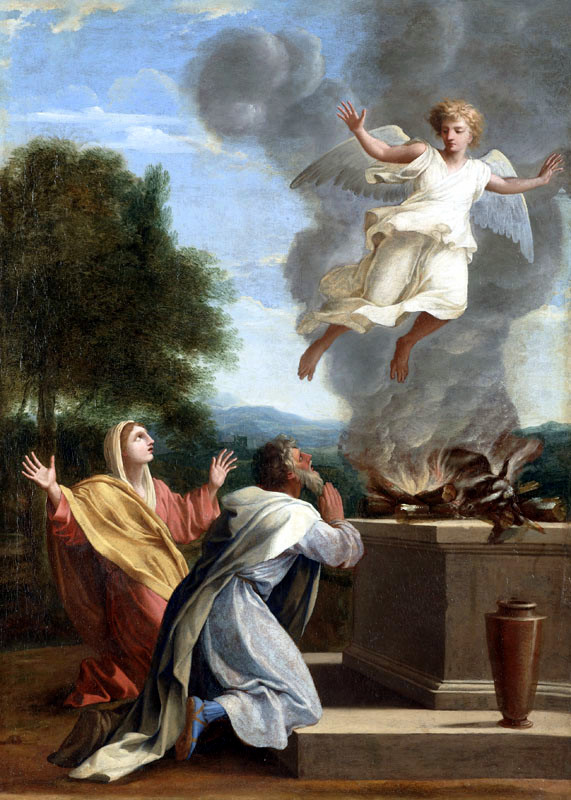
The Sacrifice of Manoah (1640–50) by Eustache Le Sueur

Judges 13

The Israelites again did what was evil in the sight of the LORD, and the LORD gave them into the hand of the Philistines forty years.

2 There was a certain man of Zorah, of the tribe of the Danites, whose name was Manoah. His wife was barren, having borne no children. 3 And the angel of the LORD appeared to the woman and said to her, “Although you are barren, having borne no children, you shall conceive and bear a son. 4 Now be careful not to drink wine or strong drink, or to eat anything unclean, 5 for you shall conceive and bear a son. No razor is to come on his head, for the boy shall be a nazirite to God from birth. It is he who shall begin to deliver Israel from the hand of the Philistines.” 6 Then the woman came and told her husband, “A man of God came to me, and his appearance was like that of an angel of God, most awe-inspiring; I did not ask him where he came from, and he did not tell me his name; 7 but he said to me, ‘You shall conceive and bear a son. So then drink no wine or strong drink, and eat nothing unclean, for the boy shall be a nazirite to God from birth to the day of his death.'”

8 Then Manoah entreated the LORD, and said, “O, LORD, I pray, let the man of God whom you sent come to us again and teach us what we are to do concerning the boy who will be born.” 9 God listened to Manoah, and the angel of God came again to the woman as she sat in the field; but her husband Manoah was not with her. 10 So the woman ran quickly and told her husband, “The man who came to me the other day has appeared to me.” 11 Manoah got up and followed his wife, and came to the man and said to him, “Are you the man who spoke to this woman?” And he said, “I am.” 12 Then Manoah said, “Now when your words come true, what is to be the boy’s rule of life; what is he to do?” 13 The angel of the LORD said to Manoah, “Let the woman give heed to all that I said to her. 14 She may not eat of anything that comes from the vine. She is not to drink wine or strong drink, or eat any unclean thing. She is to observe everything that I commanded her.”

15 Manoah said to the angel of the LORD, “Allow us to detain you, and prepare a kid for you.” 16 The angel of the LORD said to Manoah, “If you detain me, I will not eat your food; but if you want to prepare a burnt offering, then offer it to the LORD.” (For Manoah did not know that he was the angel of the LORD.) 17 Then Manoah said to the angel of the LORD, “What is your name, so that we may honor you when your words come true?” 18 But the angel of the LORD said to him, “Why do you ask my name? It is too wonderful.”

19 So Manoah took the kid with the grain offering, and offered it on the rock to the LORD, to him who work wonders. 20 When the flame went up toward heaven from the altar, the angel of the LORD ascended in the flame of the altar while Manoah and his wife looked on; and they fell on their faces to the ground. 21 The angel of the LORD did not appear again to Manoah and his wife. Then Manoah realized that it was the angel of the LORD. 22 And Manoah said to his wife, “We shall surely die, for we have seen God.” 23 But his wife said to him, “If the LORD had meant to kill us, he would not have accepted a burnt offering and a grain offering at our hands, or shown us all these things, or now announced to us such things as these.”

24 The woman bore a son, and named him Samson. The boy grew, and the LORD blessed him. 25 The spirit of the LORD began to stir him in Mahaneh-dan, between Zorah and Eshtaol.

At this point in the book of Judges the situation for Israel is perilous. The pernicious cycle of disobedience has continued and escalated, the quality of the judges has declined, and intertribal conflict has already proved to be as dangerous as the surrounding nations. Yet, the LORD continues to provide a way for the people to be delivered from their oppression. This unusual announcement of Samson’s birth and calling provides an opportunity for hope in the midst of the despair but in the midst of an ascendent Philistine threat and a disunified and disobedient Israel there is also significant cause for concern.

The Philistines were first mentioned in Judges 3:31 when the minor judge Shamgar kills six hundred Philistines with an oxgoad, and we see evidence of their presence being a threat to Israel in Judges 10:7. Now the Philistines are the primary military threat the Israelites face and they will continue to be a military threat until King David vanquishes them one hundred and fifty years later. The Philistines were a sea faring people that likely originated in the Greek islands and came to Canaan. They had settled in the coastal plain with a confederation of five cities (Gaza, Ashdod, Ashkelon, Ekron, and Gath) and were a militaristic people who had the ability extract iron from its ore for use in weaponry. Their seafaring culture also made them heavily engaged in trading from Anatolia (modern day Turkey) to Egypt. This militaristic people with advanced metallurgical knowledge and extensive trade and mercantile connections formed a sharp contrast with these divided tribes of “agrarian homesteaders with inferior bronze implements and no martial tradition of which to speak.” (Hattin, 2020, p. 145)

The forty years which the Israelites suffer under the hand of the Philistines is twice as long as any previous time period which an enemy had oppressed the people.[1] As Barry Webb can state,

By the time Samson is born the Philistine dominance over Israel is so complete, and the morale of Israel so low, that even the hope that Yahweh might save them has been extinguished.” (Webb, 2012, p. 350)

It is possible that the idolatry of the people has become so pervasive that there is not even the cultural memory of calling upon the LORD remains because they have forgotten their God. The plight of this exhausted people is dire as they exist oppressed by the Philistines and alienated from the LORD their God.

It is into this dire situation that the angel of God approaches this unnamed wife on Manoah with an incredible calling and commission for her future son. Manoah’s wife stands in a tradition of barren women who receive a message from God about her future child/children[2] and with this announcement we are encouraged to wonder about this child to be born. The Danites were one of the weakest tribes and were unable to claim their portion of Canaan at the beginning of Judges (1: 34-35) and it is telling that the Hebrew uses the word for family or clan (mishpahat) instead of the usual word for tribe (sebet).  This messenger from God has appeared in two previous places in the narrative of Judges: at Bochim to rebuke the people (2:1) and at the commissioning of Gideon (6: 11-12).

The setting aside of an individual as a nazirite is described in Number 6: 1-21 and is usually for a designated period, but Samson is designated before his birth to take on this identity for his life. Samson’s life as a nazirite is divinely ordained rather than chosen by himself, and in some respects this reflects the language of the call of Jeremiah (Jeremiah 1: 5). Yet this calling also requires the mother to observe the characteristics of a nazirite while she is pregnant with Samson. Even in the womb Samson is to live under the rules that make him set aside as special and holy.

Another reason for hope in this passage is that the angel of the LORD approaches the wife of Manoah. I have mentioned throughout these reflections that the role and safety of women in the book of Judges is a measure of the security and faithfulness of the people. Even though the woman is not named she has an important role in enabling the future judge to live faithfully into his calling. She may not have as much authority as Achsah or Deborah or end the oppression of a foreign king like Jael, but her role has more hope than Jephthah’s unnamed daughter. Manoah’s role in the story can be read as faithful or as trying to reassert power within the relationship. Manoah, unlike the rest of Israel at this point, does ask the LORD for guidance and this may be an attempt at faithfulness to ensure that the wife and child are brought up the way the LORD desires. Yet, it may also be an attempt to have the emissary of the LORD deal with him and to assert his power in the household. Ultimately both may together form Manoah’s motivation since most ancient families assumed a patriarchal authority in determining how both the spouse and children would live. Yet, the angel of the LORD again approaches the wife of Manoah and she summons her husband to meet this messenger.

When asked by Manoah if this is the same messenger who previously spoke to his wife, his simple response of “I am”[3] and then reiterates the instruction he previously gave to Manoah’s wife. Manoah receives no additional instruction how to guide the boy’s life and it remains the mother and not the father who remains in the foreground of this initial stage of the narrative. As Barry Webb can state “The implication seems to be that Manoah will never “own” the boy as a normal father might; he will be a Nazirite of God (v.7), and it is God, not Manoah, who will shape his life.” (Webb, 2012, p. 355)

Manoah belatedly remembers to offer hospitality to this strange messenger who has come to his wife. His wife has previously had some insight into the character of the messenger when she describes him, ‘like and angel of God, most awe-inspiring’ but Manoah seems oblivious. He is convinced that the child will be born but he treats this messenger like a prophet instead of an angel. Yet, Manoah obediently prepares the offering and then asks for the name of the messenger. The angel of the LORD stating his name is ‘too wonderful’ and the offering to the God who “works wonders[4] do draw a closer connection between the messenger and God. When the angelic messenger ascends in the flames Manoah finally ascertains a portion of the truth yet his wife continues to remain one step ahead of him realizing that the visit of the angel of the LORD is not going to cause their death since their offering was accepted and their death would make the announced birth impossible.

Yet, in the midst of all the hope engendered by the announcement of the future child set apart from birth there is an ominous word. In verse five the angel announces that, “he will begin to save Israel from the hands of the Philistines.” Unlike the Moabites, the Ammonites and the other threats in the book of Judges the Philistines are different and it will be a longer struggle to be free of this opponent. Samson can only begin what will be a long struggle between Israel and the Philistines. As mentioned above it will be one hundred fifty years when the Israelites are united under King David when the Philistines are no longer a feared oppressor. Yet, this provision by God to a people who no longer ask for God’s assistance gives some hope in the midst of the oppression by this external opponent. It remains to be seen if this hoped for child can turn Israel from its practice of ‘doing evil in the sight of the LORD.’

[1] Eight years under Kushan-rishathaim (3:8), eighteen years under Moab (3: 14), twenty years under King Jabin of Canaan (4:3), seven years under Midian (6: 1), and eighteen years under the Ammonites (10: 8)

[2] Sarah (Genesis 21: 1-3), Rebecca (Genesis 25: 19-21),  Rachel (Genesis 29:31, 30: 22), Hannah (1 Samuel 1:2), and the Shunamite woman (2 Kings 4: 8-17)

[3] The Hebrew ‘ani does not have any formal correspondence to the name of God ‘YHWH’ from Exodus 3:14 and so it is unlikely this is an allusion to the identity of the angel of the LORD and the LORD the God of Israel being the same. (Webb, 2012, p. 354) Yet, see below on the use of ‘wonder’ and ‘wonderful’.

[4] Wonderful pieli’y and wonder pele’ are the adjective and noun form of the same word and pele’ in its thirteen uses in the scriptures is always used for God. (Webb, 2012, p. 356)

Matthew 2: 13-23 Hearing Hope in Tragedy

Jean-Marie Pirot (aka Arcabas) The angel of the Lord speaks to Joseph in a Dream

Matthew 2: 13-23

13 Now after they had left, an angel of the Lord appeared to Joseph in a dream and said, “Get up, take the child and his mother, and flee to Egypt, and remain there until I tell you; for Herod is about to search for the child, to destroy him.” 14 Then Joseph got up, took the child and his mother by night, and went to Egypt, 15 and remained there until the death of Herod. This was to fulfill what had been spoken by the Lord through the prophet, “Out of Egypt I have called my son.”

16 When Herod saw that he had been tricked by the wise men, he was infuriated, and he sent and killed all the children in and around Bethlehem who were two years old or under, according to the time that he had learned from the wise men. 17 Then was fulfilled what had been spoken through the prophet Jeremiah:

 18 “A voice was heard in Ramah, wailing and loud lamentation, Rachel weeping for her children; she refused to be consoled, because they are no more.”

19 When Herod died, an angel of the Lord suddenly appeared in a dream to Joseph in Egypt and said, 20 “Get up, take the child and his mother, and go to the land of Israel, for those who were seeking the child’s life are dead.” 21 Then Joseph got up, took the child and his mother, and went to the land of Israel. 22 But when he heard that Archelaus was ruling over Judea in place of his father Herod, he was afraid to go there. And after being warned in a dream, he went away to the district of Galilee. 23 There he made his home in a town called Nazareth, so that what had been spoken through the prophets might be fulfilled, “He will be called a Nazorean.”

This is a scripture shaped story. In ten short verses Matthew will reference two of the major events in the story of Israel and Judah: the Exodus narrative where God takes Israel out of its slavery in Egypt and the Babylonian exile, already highlighted by one of the major breaks in the genealogy in Matthew 1: 1-17. Matthew will adopt a practice used frequently throughout the bible using the language and imagery from one event and recasting it to bring additional light on the meaning of a current event. Matthew is not looking for prooftexts to prove a point but instead is using this recasting to shed additional light on a densely packaged story which is full of meaning.

Joseph, as in Matthew 1: 21-22, is once again approached in a dream by the angel of the Lord and twice in these ten verses the angel’s message in a dream will set Joseph, Mary and Jesus in motion on a path that will model the story of Israel in Genesis through Joshua. Joseph, like his namesake, will go down to Egypt but unlike the Joseph in the book of Genesis he is not going as one going into slavery but instead as a refugee fleeing the murderous policies of a paranoid king. Jesus has been linked to God, David, and here again he is linked to Israel and their story.

Scripture is again given a voice to interpret what is happening in this narrative when Hosea 11:1 is quoted: “When Israel was a child, I loved him, and out of Egypt I called my son.” Hosea 11 taps into the central defining event for the Jewish people, the Exodus, and uses that event to engage the struggle of the people of Israel in the time before they are conquered by Assyria (722 BCE). In Hosea, God refuses to give up on this people even though they have abandoned God’s ways. Within this chapter in Hosea God proclaims that he will call them back from Assyria and Egypt and they will return to their homes. More than simply the remnant of Judah, in this story somehow all of Israel now has an opportunity to return. Egypt is also one of the major sites for diaspora Judaism and as Jesus, embodying Israel, goes to Egypt we also tap into Hosea’s hope that, “They shall come trembling like birds from Egypt, and like doves from the land of Assyria; and I will return them to their homes, says the LORD.” (Hosea 11: 11)

In addition to tapping into the larger context of Hosea, the quotation of Hosea brings us into the larger narrative of the Exodus and this story will recast the Exodus narrative in some powerful ways. Within this echo of Exodus we see the king of Judea, Herod the Great, acting in the role of Pharaoh by ordering the death of infants who he fears will challenge his power. With Herod now being cast as Pharoah, Jesus now occupies the role of Moses who is saved from the murderous policies of a tyrant, and yet ironically this new Moses is saved by going to Egypt. The rhetorical effect of this is similar to the way the Civil Rights movement was able to use the way the United States adopted the Exodus narrative as their own in being the new Israel and instead prophetically cast the leaders who opposed the Civil Rights movement as embodying Egypt instead.

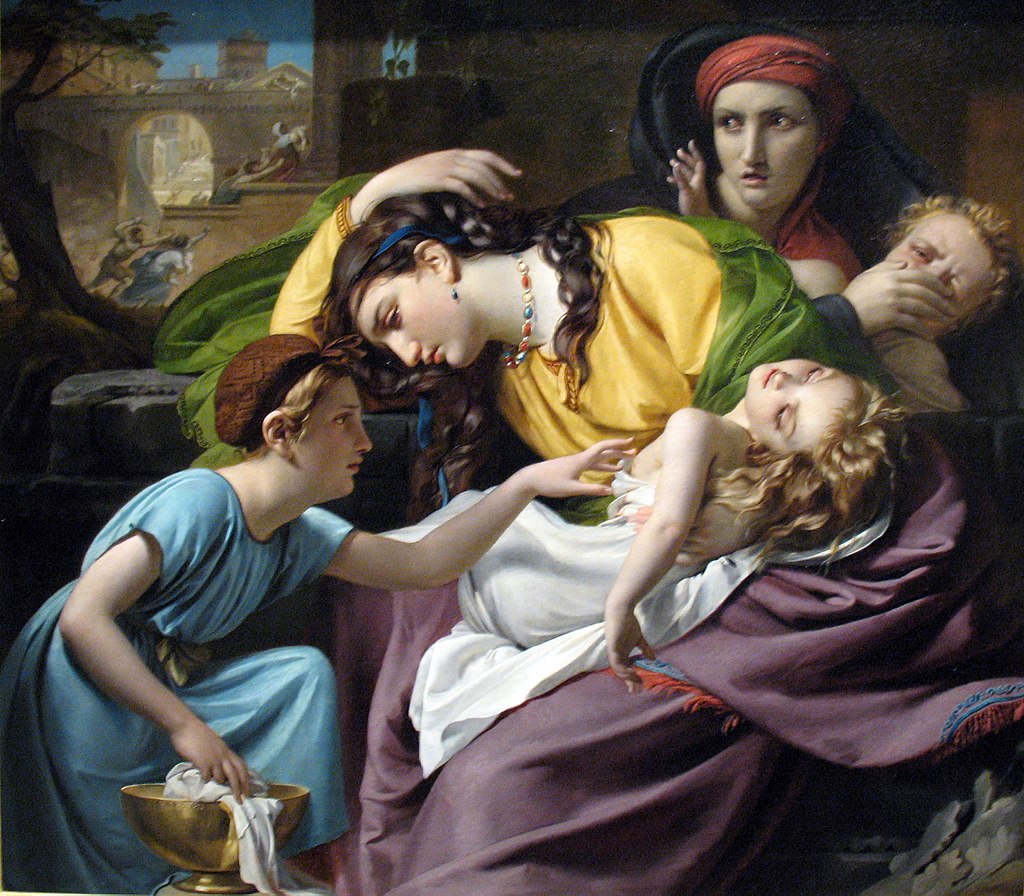
Francois-Joseph Naves, The Massacre of the Innocents (1824)

Knowing some of Herod the Great’s story may make the actions attributed to Herod in Matthew’s gospel understandable in his worldview and yet this story seems shocking to our modern ears. While the slaughter of the children of Bethlehem is not recorded in any sources external to Matthew, I do believe it is consistent with not only Herod but also the violent nature of the ancient world. Bethlehem was a small town and the number of children killed would have been smaller than an event like Columbine or Sandy Hook in our times, yet for the people of Bethlehem (and Columbine and Sandy Hook and others) these children would become one more example of the terror that violence can bring into families and communities without notice. As humans we attempt to make sense of these stories of violence and Matthew attempts to do this by linking this prophetically to the reign of terror in Egypt. Herod in this story is not a ‘King of the Jews’ but is instead a new Pharaoh whose policies bring death to those he is to shepherd.

I think we also need to remember that the world at the time of Jesus was a violent place and that there were no news reporters to carry the violence to the broader world. In recent times we saw ISIS beheading people as a terrorist act and are rightly horrified, but I think it is worth remembering that in Jesus’ time beheading was a noble way to die, especially in light of crucifixion and other practices. The ancient world was a violent world and the death of innocents rarely makes it into recorded history. Yet, within the gospels we do see a willingness to embrace the prophetic voice that was willing to challenge those in power and in many ways by his very being Jesus becomes a challenge to the Herods of the world.

Scripture speaks for a second time in this section by quoting Jeremiah 31: 15, and with this quotation the additional frame of the Babylonian exile is introduced into the narrative. Rachel crying for her children would be particularly poignant for Bethlehem because it is the site where Rachel is buried according to Genesis 35: 19-20:

So Rachel died, and she was buried on the way to Ephrath (that is, Bethlehem), and Jacob set up a pillar at her grave; it is the pillar of Rachel’s tomb which is there to this day.

Now this matriarch of the Jewish people which cried out at the at the loss of her children during the deportation to Babylon mourns with the mothers who have lost their children as a result of the actions of Herod. Now Herod who attempts to build his credentials as the King of Judea by building the temple is also framed as Nebuchadnezzar who is the destroyer of Jerusalem and the temple. Yet, within this particular choice in Jeremiah is the broader context of hope coming out of the destruction, Rachel’s weeping proceeds a prophesy of the end of the exile. As the next two verses of Jeremiah can state:

Thus says the LORD: Keep your voice from weeping, and your eyes from tears; for there is a reward for your work, says the LORD: they shall come back from the land of the enemy;  there is hope for your future, says the LORD: your children shall come back to their own country. Jeremiah 31: 16-17

The allusions and quotations of scripture in this chapter point to something larger that Matthew wants to communicate about who Jesus is and how he embodies Israel’s story. Matthew’s carefully constructed gospel wants us to understand through tapping into key portions of Israel’s story a bigger picture of who Jesus is and what he will mean for Israel and by extension for the rest of the world. As Richard B. Hays can describe Matthew as an interpreter of scripture:

Matthew is not merely looking for random Old Testament prooftexts that Jesus might somehow fulfill (as is sometimes suggested); rather, he is thinking about the specific shape of Israel’s story and linking Jesus’ life with key passages that promise God’s unbreakable redemptive love for his people. That is why Matthew’s comments on Herod’s slaughter of the children by selecting a citation from the same chapter in Jeremiah that also promises “a new covenant with the house of Israel and the house of Judah.” (Jer 31:31) (Hays, 2016, p. 116)

O. Wesley Allen highlighted that Matthew modifies his normal word pattern when introducing a direct quotation from scripture. Normally Matthew will say that something happens ‘so that’ (Greek hina) but instead Matthew simply says “then (Greek tote) was fulfilled what had been spoken through the prophet Jeremiah.” For those who are familiar with the recurring pattern in scriptures it shouldn’t be surprising that God’s action to set people free is met by violence by those invested in the current order. Yet, even though this violence may be a response to God’s initiative that does not make it God’s will. The slaughter of the innocents may be in Matthew’s view a fulfillment of scripture but unlike the other places where scripture is quoted it doesn’t link this to divine causality. (Allen, 2013, p. 32)

Herod the Great’s death makes the return of Jesus and his family to Israel possible. Herod’s death doesn’t remove his family from the scene and Herod Archelaus (simply called Archelaus here) is reigning in Judea. We aren’t given any clues why Herod Archelaus would be perceived as a threat and his brother Herod Antipas (ruling in Galilee) was not, perhaps it was merely a return to Bethlehem that would have caused questions by those in power. Joseph continues to be guided by the angel of the Lord appearing to him in dreams and this places the family in Nazareth for the beginning of the Jesus’ adult story. Perhaps to answer the perception we see in the gospel of John voiced by Nathanael, “Can anything good come out of Nazareth?” (John 1: 46) Matthew includes this what final attribution to the prophets that Jesus will be called a Nazorean. Matthew is referencing the tradition of Nazorites who were set aside for the Lord as holy (see Numbers 6, both Samson and Samuel were Nazorites).

Even though Matthew will reference multiple pieces of scripture and allude to two major stories of the Jewish people to frame this passage he is also communicating that in Jesus, God is doing a new thing. The original texts will have their meaning broadened and expanded upon. As Anna Case-Winters can state,

For Matthew, new meaning break forth from these texts as God is doing a new thing. Matthew reimagines these texts, if you will, to make a theological claim that God is at work in all these happenings and is bringing to fulfilment what was promised of old. (Case-Winters, 2015, p. 32)

Even though the Herods of the world may seem to be the ones who wield power in these texts, Matthew wants us to understand that God is at work in ways that may seem hidden, but which to a person familiar with the rhythms of scripture are familiar. God is speaking both through scripture, the angel of the Lord, through dreams and the stars in the heavens for those with eyes to see and ears to hear. The king of the Judeans may be acting as Pharaoh, but God has heard the cries of God’s people and even in this time to use Martin Luther’s words in a Mighty Fortress “this tyrant’s doomed to fail: God’s judgment must prevail! One little word shall triumph” (A Might Fortress is our God, verse 3 Fredrick H. Hedge translation)