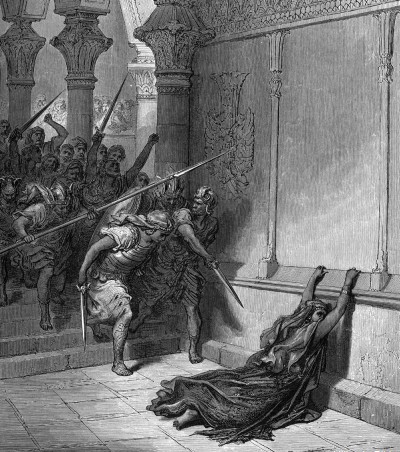
2 Kings 11
1 Now when Athaliah, Ahaziah’s mother, saw that her son was dead, she set about to destroy all the royal family. 2 But Jehosheba, King Joram’s daughter, Ahaziah’s sister, took Joash son of Ahaziah and stole him away from among the king’s children who were about to be killed; she put him and his nurse in a bedroom. Thus she hid him from Athaliah, so that he was not killed; 3 he remained with her six years, hidden in the house of the LORD, while Athaliah reigned over the land.
4 But in the seventh year Jehoiada summoned the captains of the Carites and of the guards and had them come to him in the house of the LORD. He made a covenant with them and put them under oath in the house of the LORD; then he showed them the king’s son. 5 He commanded them, “This is what you are to do: one-third of you, those who go off duty on the Sabbath and guard the king’s house 6 (another third being at the gate Sur and a third at the gate behind the guards), shall guard the palace, 7 and your two divisions that come on duty in force on the Sabbath and guard the house of the LORD 8 shall surround the king, each with weapons in hand, and whoever approaches the ranks is to be killed. Be with the king in his comings and goings.”
9 The captains did according to all that the priest Jehoiada commanded; each brought his men who were to go off duty on the Sabbath, with those who were to come on duty on the Sabbath, and came to the priest Jehoiada. 10 The priest delivered to the captains the spears and shields that had been King David’s, which were in the house of the LORD; 11 the guards stood, every man with his weapons in his hand, from the south side of the house to the north side of the house, around the altar and the house, to guard the king on every side. 12 Then he brought out the king’s son, put the crown on him, and gave him the covenant; they proclaimed him king and anointed him; they clapped their hands and shouted, “Long live the king!”
13 When Athaliah heard the noise of the guard and of the people, she went into the house of the Lord to the people; 14 when she looked, there was the king standing by the pillar, according to custom, with the captains and the trumpeters beside the king, and all the people of the land rejoicing and blowing trumpets. Athaliah tore her clothes and cried, “Treason! Treason!” 15 Then the priest Jehoiada commanded the captains who were set over the army, “Bring her out between the ranks and kill with the sword anyone who follows her.” For the priest said, “Let her not be killed in the house of the Lord.” 16 So they laid hands on her; she went through the horses’ entrance to the king’s house, and there she was put to death.
17 Jehoiada made a covenant between the LORD and the king and people, that they should be the LORD’s people; also between the king and the people. 18 Then all the people of the land went to the house of Baal and tore it down; his altars and his images they broke in pieces, and they killed Mattan, the priest of Baal, in front of the altars. The priest posted guards over the house of the LORD. 19 He took the captains, the Carites, the guards, and all the people of the land; then they brought the king down from the house of the LORD, marching through the gate of the guards to the king’s house. He took his seat on the throne of the kings. 20 So all the people of the land rejoiced, and the city was quiet after Athaliah had been killed with the sword at the king’s house.
21 Jehoash was seven years old when he began to reign.
The final remaining figure of the Omri dynasty is not in Israel but in Judah. Jehu’s bloody revolt in Israel has eliminated both the ruling line in Samaria as well as Ahaziah, the king of Judah, who was linked to the line of Ahab by his mother Athaliah. Jehoram, son of king Jehoshaphat, the father of the recently murdered King Ahaziah was married to Athaliah the daughter of Ahab. Athaliah who holds power in Judah for seven years is not listed in the line of Davidic kings because she is not of the Davidic line. Aside from her violent actions the problem with Ahaziah is not primarily that she is a woman but instead that she is of the line of King Ahab and Jezebel and apparently brings the religious and moral practices of Tyre into Jerusalem.
Athaliah seizes power in the aftermath of her sons death attempting to wipe out any other claimants to the throne. As a person with a tenuous grip on power the elimination of potential claimants to the throne is coldly logical in a world where political power is seized in often bloody manners. To use the logic of George R.R. Martin’s Game of Thrones “when you play the game of thrones (power) you either win or you die.” Although Athaliah is not viewed favorably in either 2 Kings or the parallel telling of this story in 2 Chronicles 22, her seizure of power is likely less bloody than Jehu’s in Samaria. Yet, unlike Jehu her seven years on the throne in Jerusalem pull the people further from the worship of the LORD the God of Israel and she ends up being the only woman in the bible, “to be awarded the moniker: “the Wicked”” in 2 Chronicles 24:7. (Israel, 2019, p. 178) And as Choon-Leong Seow states accurately, “Athaliah is to Judah what Jezebel was to Israel…Like the ruthless Jezebel, Athaliah is willing to commit murder in order to have her way.” (NIB III: 228) She is a mother who seizes power by killing the royal family which likely contains her own children and grandchildren.[1]
Yet, Athaliah’s plot to wipe out the line of David is thwarted by her sister Jehosheba who hides young Joash. 2 Chronicles 22: 10-12 states that Jehosheba is the wife of Jehoida the priest that will play a dominant role in the protection of Joash and the elimination of Athaliah. Yet, 2 Kings does not give us Jehosheba’s motive in saving this child, but she like many of the women in Exodus,[2] are responsible for thwarting the murderous intentions of a ruler. Joash will be hidden and raised in the house of the LORD.
The plot to place Joash on the throne begins in the seventh year of Athaliah’s occupying the throne in Jerusalem. The priest Jehoida summons summons the Carites, which may be the Cherethites mentioned elsewhere as body guards and soldiers of David or a different armed group, and the guards to both swear loyalty to the new king and to act as protection for the moment of the revelation of the king to the people. The exact details of the deployment of these troops may be a challenge for translators to render in an exact format but the overall intent is clear. The full complement of soldiers will be armed and ready in key positions on the day when young Joash is anointed publicly and acclaimed as king.
The king is crowned, anointed and either given an insignia or a covenant document. As Walter Brueggemann states of the term that can be rendered emblem/insignia or covenant,
The term here is not very clear. It may refer to insignia of office. Or it might more precisely refer to a scroll, a written charter delineating both the prerogatives and requirements of power, a document that situates royal power in something like a constitutional frame of reference that precludes royal arbitrariness. (Brueggemann, 2000, p. 409)
If it is a covenant, it probably reflects an understanding of the expectations of a king similar to Deuteronomy 17: 14-20.
14 “When you have come into the land that the Lord your God is giving you and have taken possession of it and settled in it, and you say, ‘I will set a king over me, like all the nations that are around me,’ 15 you may indeed set over you a king whom the Lord your God will choose. One of your own community you may set as king over you; you are not permitted to put a foreigner over you, who is not of your own community. 16 Even so, he must not acquire many horses for himself or return the people to Egypt in order to acquire more horses, since the Lord has said to you, ‘You must never return that way again.’ 17 And he must not acquire many wives for himself or else his heart will turn away; also silver and gold he must not acquire in great quantity for himself. 18 When he has taken the throne of his kingdom, he shall write for himself a copy of this law on a scroll in the presence of the Levitical priests. 19 It shall remain with him, and he shall read in it all the days of his life, so that he may learn to fear the Lord his God, diligently observing all the words of this law and these statutes, 20 neither exalting himself above other members of the community nor turning aside from the commandment, either to the right or to the left, so that he and his descendants may reign long over his kingdom in Israel.
This anointed and crowned king now receives the vocal acclamation from the guards and priests, “Long live the king.”
Athaliah hears the commotion and discovers the plot underway. The young king is standing by the pillar, perhaps the pillars at the front of the temple or in the position where Ezekiel envisions the king supervising the offerings. (Ezekiel 48: 2-8)[3] Athaliah echoes the words of Joram, “Treason! Treason!”[4] but like Joram her realization of the plot afoot is too late to save her life. She is brought out of the temple and killed with the sword. Then the covenant is renewed between the LORD, the king, and the people. The people then destroy the house of Baal, possibly built under Athaliah’s instructions, and Mattan the priest of Baal is also killed. The verbs in 2 Kings on the destruction of the temple of Baal echo the instructions of Deuteronomy 12: 2-3:
2 “You must demolish completely all the places where the nations whom you are about to dispossess served their gods, on the mountain heights, on the hills, and under every leafy tree. 3 Break down their altars, smash their pillars, burn their sacred poles with fire, and cut down the idols of their gods, and thus blot out their name from their places.
In contrast to Jehu’s revolution, the coup enacted by the priest Jehoida is much less violent. Only Athaliah and Mattan are killed and then the city was quiet. As Brueggemann notes about the final phrase about the city being quiet,
The assertion that the “city was quiet” is more important than the simple phrasing might suggest (11:20). The term “quiet” (shaqath) is the same term used in the book of Judges in the recurring phrase “the land had rest” (Judg 3:11, 30; 5:31; 8:28) (Brueggemann, 2000, p. 413)
Joash, or Jehoash, begins his long reign at the age of seven. He is under the influence of Jehoida and yet his reign will be one of the times that 2 Kings views favorably. The covenant between God, the king, and the people is restored, the land has rest, and there is a chance for renewal in Judah after the decline of the house of David over the past two kings.
[1] There were probably other children of Jehoram by wives other than Athaliah as well as others in the line of David.
[3] Ezekiel’s words come in the time immediately after the time of the kings and the temple, but his visions are likely informed by his familiarity with the temple practices before its destruction.
 Sign of the Rose