Ezekiel as depicted by Michelangelo on the Sistene Chapel ceiling
I am glad to be coming to the end of this long journey with the prophet Ezekiel and I appreciate the work of scholars who make this book in particular their life work. Working through both Jeremiah and Ezekiel has given me a much richer view of the time leading up to and after the Babylonian exile. I have a much richer view of the history, technology, and culture of the time but also of the way this people of Israel and these prophets had to deconstruct and reconstruct their view of the world. Prior to the exile, for Judah, the Davidic king, the temple of Solomon, the city of Jerusalem (or Zion), and the land were all central images for the faith of the people and Babylon shattered all of these. Ezekiel as a prophet of primarily written word due to communicating to Jerusalem from the exile in Babylon, although many of his visions, sign acts, and proclamations were likely done for a local audience first, is a part of the transition of the people of Judah from being the people of the land, temple and king to being a people of the book. Ezekiel’s perspectives are very different, even from his elder contemporary Jeremiah and there was a lot I gained from this protracted study.
Jeremiah has often been called the ‘wailing prophet’ and his dialogues with God are often honest and pathos filled while Ezekiel only protests when God asks him to do something that offends his priestly sensibilities. In this book obedience to God is a central idea and Ezekiel is a contrast to a disobedient and rebellious people. I do think both Jeremiah and Ezekiel illustrate different aspects of a faithful relationship to the God of Israel and especially for an independently minded person like myself in an independent and individualistic culture Ezekiel’s obedience was both uncomfortable but also provided a necessary correction for me.
Ezekiel’s priestly perspective on holiness was also an uncomfortable but necessary corrective for me. Within many Protestant traditions the focus on the intimacy of the relationship with God or the closeness of God has obscured the dangerous and holy God that Ezekiel knows. This holiness in Ezekiel impacts everything from the design of the new temple to God’s reaction to the disobedience of the people. God’s holiness and the careless actions of idolatry and abomination committed by the people which defile this holiness form Ezekiel’s justification (or God’s justification in Ezekiel) for the death and suffering caused by the Babylonian destruction of Jerusalem and the exile of the people. This way of thinking and believing enabled Ezekiel and those who heard and passed on his words to make sense of the disorienting reality of their homes and beliefs being shattered by the armies of Chaldeans and their allies.
Ezekiel’s imagery can be offensive. The culture that I live in can occasionally silence offensive voices, especially in academic circles, and promote offensive voices in other contexts. Sometimes the offensive message, as in Ezekiel, can point to an uncomfortable truth. Would there be different images or words we would utilize in our context, almost certainly, but there is a reason these words have been transmitted for more than two millennia (often by hand copying the words). I think in general much of the church’s response to Ezekiel has been either embarrassment or neglect. Ezekiel may never be our favorite messenger, but I am thankful that I have taken this time to reflect on his strange and uncomfortable messages.
There were several times as I was working through Ezekiel that I noted his influence on Revelation. Even when I worked through Revelation in 2018, I wished that I could have worked through Ezekiel and Daniel first, but now the echoes of Ezekiel in Revelation are much clearer. Ezekiel may not be at the center of the cannon within the cannon for the Lutheran tradition I am a part of, but I am beginning to have a fuller grasp of the breadth, depth and width of the scriptures which have been handed on to us and the ways in which the law, the prophets, the poetry and narratives of the Hebrew Scriptures enrich and inform the New Testament and ultimately my faith.
This is the thirteenth book I have walked through, and it was one of the hardest. My faith and life were enriched by this journey, and I can appreciate this book in ways I didn’t before. Next, I will be returning to Psalms, now for Psalm 101-110, before selecting another book to begin. Back in 2022 I mapped out the journey through 1 Kings, Joel, and Ezekiel with ten psalms surrounding each reading and I am finally approaching the final leg of this group of texts from the Hebrew Scriptures.
This is a list of the major sources I used on this fourteen-month journey through the book of Ezekiel. I selected each resource for a reason and below is a brief evaluation of each source. It is not a comprehensive evaluation of the literature on Ezekiel, but it may be a useful place to start for those interested in learning more about this book of scripture. Ezekiel is a very difficult book to approach from a scholarly perspective and yet I can now see the way some of the imagery of Ezekiel has influenced both later prophets and New Testament authors.
Version 1.0.0
Block, Daniel I. The Book of Ezekiel: Chapters 1-24. (New International Commentary on the Old Testament series) Grand Rapids, MI: William B. Eerdmans Publishing Company, 1997.
_______. The Book of Ezekiel: Chapters 25-48. (New International Commentary on the Old Testament series) Grand Rapids, MI: William B. Eerdmans Publishing Company, 1998.
Daniel Block’s massive two volume commentary on the prophet Ezekiel is probably more information than the casual reader will probably ever want, but it ended up being the source I referenced the most throughout this study. Daniel Block is both a phenomenal interpreter of the Hebrew text and very familiar with both the literature of the surrounding world and the archeological/historical context of the period around the Babylonian exile. I typically try to consult at least one textual commentary that pays attention to translational issues and especially with a text like Ezekiel that is both hard to translate due to unusual words and gaps. This work was highly valuable. Block and a lot of readers of Ezekiel tend to lean a little farther into source criticism that I would prefer, but Ezekiel’s history of interpretation is heavily influenced by that period of Old Testament scholarship.
Darr, Katheryn Pfisterer. “The Book of Ezekiel.” In The New Interpreter’s Bible. (New International Commentary on the Old Testament series) Grand Rapids, MI: William B. Eerdmans Publishing Company, 1997.Volume VI. Nashville, Abingdon Press, 1994.
The NIB is a solid all-around commentary on the entire bible and apocrypha. It is designed for pastors and those leading in congregations, so it does not normally engage the textual issues as deeply as the NICOT or Anchor Bible commentaries. Katheryn Pfisterer Darr does a good job of providing textual notes when they are important but remains focused on making Ezekiel intelligible to a reader with some education in the text, but who may not want to wade too deeply into the waters of this rarely utilized book in Christian circles. There are times where you can tell that the author is uncomfortable with Ezekiel’s language as a feminist scholar, but she does a good job of remaining attentive to the text even when the language or content becomes challenging.
Davis, Ellen F. Swallowing the Scroll: Textuality and the Dynamics of Discourse in Ezekiel’s Prophecy. Sheffield, England: Almond Press, 1989.
Ellen Davis is one of the scholars who I attempt to read anything that they write. This is her doctoral dissertation, and it really focuses on the initial call of Ezekiel and his position as a composer of a written text. I found this text particularly helpful in the early chapters of Ezekiel as I was trying to understand this strange prophet. Most readers are not going to pick up a doctoral dissertation, no matter how well written, but Ellen Davis is a gifted author, and you can see in this early work how she will develop as a patient and generous reader of scripture.
Version 1.0.0
Klein, Ralph W. Ezekiel: The Prophet and His Message. Clemson, SC: University of South Carolina Press, 1988. Reprinted by Minneapolis: Fortress Press, 2024.
Ralph Klien is a Lutheran Old Testament scholar and when I picked this up, I thought it was a new work. I quickly realized that it was a reprint of a work published in 1988 that dealt with Ezekiel in a more introductory manner. This may have been more useful if I was not reading it in conjunction with several other authors discussing Ezekiel, but it was the source I referenced the least once I read through it.
Ganzel, Tova. Ezekiel: From Destruction to Restoration. Maggid Studies in Tanakh. Jerusalem: Maggid Books, 2020.
When I can I attempt to utilize a Jewish scholar when reading the scriptures that we share. The Maggid Studies I have utilized in the past have been approachable but also provide a window into perspectives that most Christian scholars may not explore. This volume was also readable and had some insightful comments.
1These are the names of the tribes: Beginning at the northern border, on the Hethlon road, from Lebo-hamath, as far as Hazar- enon (which is on the border of Damascus, with Hamath to the north), and extending from the east side to the west, Dan, one portion. 2Adjoining the territory of Dan, from the east side to the west, Asher, one portion. 3Adjoining the territory of Asher, from the east side to the west, Naphtali, one portion. 4Adjoining the territory of Naphtali, from the east side to the west, Manasseh, one portion. 5Adjoining the territory of Manasseh, from the east side to the west, Ephraim, one portion. 6Adjoining the territory of Ephraim, from the east side to the west, Reuben, one portion. 7Adjoining the territory of Reuben, from the east side to the west, Judah, one portion. 8Adjoining the territory of Judah, from the east side to the west, shall be the portion that you shall set apart, twenty-five thousand cubits in width, and in length equal to one of the tribal portions, from the east side to the west, with the sanctuary in the middle of it. 9The portion that you shall set apart for the LORD shall be twenty-five thousand cubits in length, and twenty thousand in width. 10These shall be the allotments of the holy portion: the priests shall have an allotment measuring twenty- five thousand cubits on the northern side, ten thousand cubits in width on the western side, ten thousand in width on the eastern side, and twenty-five thousand in length on the southern side, with the sanctuary of the LORD in the middle of it. 11This shall be for the consecrated priests, the descendants of Zadok, who kept my charge, who did not go astray when the people of Israel went astray, as the Levites did. 12It shall belong to them as a special portion from the holy portion of the land, a most holy place, adjoining the territory of the Levites. 13Alongside the territory of the priests, the Levites shall have an allotment twenty-five thousand cubits in length and ten thousand in width. The whole length shall be twenty-five thousand cubits and the width twenty thousand. 14They shall not sell or exchange any of it; they shall not transfer this choice portion of the land, for it is holy to the LORD. 15The remainder, five thousand cubits in width and twenty-five thousand in length, shall be for ordinary use for the city, for dwellings and for open country. In the middle of it shall be the city; 16and these shall be its dimensions: the north side four thousand five hundred cubits, the south side four thousand five hundred, the east side four thousand five hundred, and the west side four thousand five hundred. 17The city shall have open land: on the north two hundred fifty cubits, on the south two hundred fifty, on the east two hundred fifty, on the west two hundred fifty. 18The remainder of the length alongside the holy portion shall be ten thousand cubits to the east, and ten thousand to the west, and it shall be alongside the holy portion. Its produce shall be food for the workers of the city. 19The workers of the city, from all the tribes of Israel, shall cultivate it. 20The whole portion that you shall set apart shall be twenty-five thousand cubits square, that is, the holy portion together with the property of the city. 21What remains on both sides of the holy portion and of the property of the city shall belong to the prince. Extending from the twenty-five thousand cubits of the holy portion to the east border, and westward from the twenty-five thousand cubits to the west border, parallel to the tribal portions, it shall belong to the prince. The holy portion with the sanctuary of the temple in the middle of it, 22and the property of the Levites and of the city, shall be in the middle of that which belongs to the prince. The portion of the prince shall lie between the territory of Judah and the territory of Benjamin. 23As for the rest of the tribes: from the east side to the west, Benjamin, one portion. 24Adjoining the territory of Benjamin, from the east side to the west, Simeon, one portion. 25Adjoining the territory of Simeon, from the east side to the west, Issachar, one portion. 26Adjoining the territory of Issachar, from the east side to the west, Zebulun, one portion. 27Adjoining the territory of Zebulun, from the east side to the west, Gad, one portion. 28And adjoining the territory of Gad to the south, the boundary shall run from Tamar to the waters of Meribath- kadesh, from there along the Wadi of Egypt to the Great Sea. 29This is the land that you shall allot as an inheritance among the tribes of Israel, and these are their portions, says the Lord GOD.
As we come to the end of Ezekiel’s final vision recorded in the book of Ezekiel, we are given a vision of a perfectly ordered arrangement of the tribes surrounding a perfectly ordered temple and city. Ezekiel takes us back to the memory of the tribal order of Israel prior to the monarchy. Solomon had centralized much of the power in Israel[1] and later kings likely continued to centralize power. Yet, for Ezekiel the nasi (prince) does not exercise the same type of authority as previous monarchs. Reestablishing the twelve tribes in the land is a regathering of both the exiles in Babylon and Egypt from Judah, but also a reconstitution of the northern tribes which have been separated from Judah for almost four centuries and have were scattered among the Assyrian empire two and a half centuries ago. Any close look at a topographical map will cause most readers to realize that, in Daniel Block’s words, we are looking at, “a cartographic painting by an artist with a particular theological agenda.” (Block, 1998, p. 723)
The positions of the tribe do not match the original assignments in Joshua[2] or the tribal areas reflected throughout the Deuteronomic history. The territory east of the Jordan, which Reuben, Gad, and one half of Manesseh settled in is not a part of the territory of Israel. Issachar, Zebulun, and Gad are now in the south instead of the north, and even in this equalizing scheme of granting each tribe one portion, there is a reality of assigning Judah and Benjamin, the former royal tribes, a position closest to the temple and city while the tribes descended from Zilpah and Bilhah occupy the farthest distance from the temple. The breadth of the land also is significantly wider in the north than in the south but since there are no dimensions given for the portions that may be accounted for by making the northern portions narrower. The biggest problem with this map is topographical. Each tribal boundary crosses the coastal plains, the northern spine and the Jordan rift valley and travel north and south along those natural boundaries is easier than east and west inside the territory. Ezekiel never mentions the topography of this recreated Israel so in his mind the mountains may be made low and the low places raised up, but this is never alluded to in his visions.
Between the tribes in the north and the tribes in the south is the set aside area for the prince, the priests and Levites, and especially in Ezekiel’s view the temple. This area was previously discussed in Ezekiel 45:1-8, and this is another example of Ezekiel discussing an item at a previous point and then revisiting it in a later portion of the text. For Ezekiel this perfectly ordered land is centered on the temple and has an equitable distribution of land for each of the reconstituted tribes. Pragmatic difficulties are set aside as Ezekiel discloses this vision of a renewed land and people.
Ezekiel 48: 30-35 The City Named the LORD is There
30These shall be the exits of the city: On the north side, which is to be four thousand five hundred cubits by measure, 31three gates, the gate of Reuben, the gate of Judah, and the gate of Levi, the gates of the city being named after the tribes of Israel. 32On the east side, which is to be four thousand five hundred cubits, three gates, the gate of Joseph, the gate of Benjamin, and the gate of Dan. 33On the south side, which is to be four thousand five hundred cubits by measure, three gates, the gate of Simeon, the gate of Issachar, and the gate of Zebulun. 34On the west side, which is to be four thousand five hundred cubits, three gates, the gate of Gad, the gate of Asher, and the gate of Naphtali. 35The circumference of the city shall be eighteen thousand cubits. And the name of the city from that time on shall be, The LORD is There.
Ancient cities are tiny in comparison to modern cities since the effort of creating a wall to protect a city is expensive. This newly created city is roughly one and a half miles on each of its four sides. Ancient walled cities normally had one or a small number of gates that are easier to defend and a twelve gated city is unusual, although the Jerusalem of Ezekiel’s youth had at least six. (Block, 1998, p. 736) This perfectly square city with a gate named for each of the twelve tribes fits within Ezekiel’s scheme and if the city is a place where ‘the LORD is there’ the defensive needs of a walled city are less important.
The new city name ‘YHWH samma’ (the LORD is there) is phonetically similar to Jerusalayim, but there is more than a simple renaming of the city occurring in this image. (NIB VI: 1607) This city placed in the center of the tribes is no longer the city of David, or the capital of Judah, instead the twelve gates indicate it is the city of all the people. The names of the tribes are organized by their mother, with the tribes descended from Leah comprising the north and south gates, Rachel’s two children are on the west, Zilpah’s two children are on the east, and Bilhah’s two children fill in the remaining slots on east and west. It is a perfectly square city near the perfectly ordered temple in the center of a perfectly ordered land. But centrally, the city like the temple is a place where the LORD is there.
Ezekiel 47: 1-12 The Renewing Waters from the Temple
1Then he brought me back to the entrance of the temple; there, water was flowing from below the threshold of the temple toward the east (for the temple faced east); and the water was flowing down from below the south end of the threshold of the temple, south of the altar. 2Then he brought me out by way of the north gate, and led me around on the outside to the outer gate that faces toward the east; and the water was coming out on the south side. 3Going on eastward with a cord in his hand, the man measured one thousand cubits, and then led me through the water; and it was ankle- deep. 4Again he measured one thousand, and led me through the water; and it was knee-deep. Again he measured one thousand, and led me through the water; and it was up to the waist. 5Again he measured one thousand, and it was a river that I could not cross, for the water had risen; it was deep enough to swim in, a river that could not be crossed. 6He said to me, “Mortal, have you seen this?” Then he led me back along the bank of the river. 7As I came back, I saw on the bank of the river a great many trees on the one side and on the other. 8He said to me, “This water flows toward the eastern region and goes down into the Arabah; and when it enters the sea, the sea of stagnant waters, the water will become fresh. 9Wherever the river goes, every living creature that swarms will live, and there will be very many fish, once these waters reach there. It will become fresh; and everything will live where the river goes. 10People will stand fishing beside the sea from En-gedi to En-eglaim; it will be a place for the spreading of nets; its fish will be of a great many kinds, like the fish of the Great Sea. 11But its swamps and marshes will not become fresh; they are to be left for salt. 12On the banks, on both sides of the river, there will grow all kinds of trees for food. Their leaves will not wither nor their fruit fail, but they will bear fresh fruit every month, because the water for them flows from the sanctuary. Their fruit will be for food, and their leaves for healing.
Ezekiel’s vision of a renewed society starts with the temple, but then from the temple it flows out to a renewed land and people. This vision of a life-giving stream that flows from the temple may originate in the imagery of the Garden of Eden in Genesis 2:10-14 where a river flows from through the garden providing life for both the flora and fauna of creation. This imagery is picked up in Psalm 46:4 and centered in Zion when that poet writes: “There is a river whose streams make glad the city of God, the holy habitation of the Most High.” This vision of Ezekiel adopts this stream flowing out of Zion and fixes its source as the holy habitation of the Most High, specifically the threshold of the temple becomes the source of this bubbling spring of renewing waters which bring life to dead waters and desiccated lands. A renewed temple where God’s presence dwells is the source of life for the renewed land.
This image of comfort is one of the portions of Ezekiel that would have the greatest reach in later years, but for a people who had been through the destruction of their home and their hope was a potent vision. As Daniel Block can state:
This marvelous picture of renewal would have stirred the heart of any true Israelite, especially one who had lived through the desolation of Judah and spent many years in exile. (Block, 1998, p. 690)
The people of Judah and Israel have no reason to believe that they can be recreated as a people unless the LORD acts in new and creative ways. Here Ezekiel joins with Jeremiah, Isaiah, and other prophets in viewing a land recreated by the God of Israel. This impossible stream which in the span of a little more than a mile and a quarter moves from a trickling flow bubbling up from the foundation to a stream too deep to wade across defies everything that water should be able to do, and yet this impossible stream can only occur within the world made possible by their God.
Daniel Block is correct from a logical point of view that everything about this stream is unrealistic: streams do not grow from a bubbling source to water too deep to cross without tributaries, nor do they come from temple thresholds or flow uphill. Freshwater when it encounters water that is too salty for life becomes fouled rather than renewing the larger body of water. (Block, 1998, pp. 700-701) Yet, the impossibility of this stream is part of the imaginative power of this image, for this is the image of a God who is doing a new thing and making streams of water to flow in the desert.[1] These miraculous waters which bubble up from the temple threshold and rapidly accumulate depth and volume as they proceed away from their source bringing vegetation to the wastelands and renewing the waters of the Dead Sea can only be an act of the creating God. The path from the temple to the Arabah would require the waters to pass over or through the Mount of Olives and a series of valleys and mountain ranges. Perhaps Ezekiel imagines a scene like Zechariah 14: 4 where the Mount of Olives is split in two which would allow the river to proceed through that space, but that is not explicit in this brief image.
The Dead Sea is the lowest land elevation on earth and its salinity is nine and a half times higher than the ocean. These waters are unable to support life and although salt is a valuable commodity in the ancient world, this place is known for its absence of life. The vision shows the image of the sea and surrounding land revitalized to be a place where fishermen gather food, and the land becomes fruitful. Yet, the marshes[2] still provide valuable salt that can be harvested by the people for preservation, seasoning, and sale.[3] The geographical markers of En-gedi and En-eglaim[4] form a “topographical merismus” (Block, 1998, p. 695) indicating the eastern and western borders of the area and indicating that the entire region is renewed.
This section of Ezekiel resonates with Genesis and the Psalms, but this vision of Ezekiel will have echoes in several other portions of scripture. Among the prophets both Joel 3:18 and Zechariah 14:8 will make a passing reference to water flowing out of the temple or Jerusalem and may be influenced by Ezekiel. In John’s gospel, Jesus will paraphrase scripture saying that, “Out of the believer’s heart shall flow rivers of living water.”[5] It is likely that with John’s imagery that utilizes Jesus as the temple that here Jesus may envision the community of faith as the new temple which these living waters flow out of and may be alluding to Ezekiel 47. The most direct New Testament reference is Revelation 22:1-2 where the water of life flows out of the New Jerusalem and develops Ezekiel’s imagery of trees that continually bear fruit and whose leaves are medicinal. One significant difference between Ezekiel’s and Revelation’s imagery is that in Revelation the living waters, fruit and healing leaves are for the healing of the nations but in Ezekiel there is no indication of any transformation outside of Israel. (NIB VI:1599) Ezekiel’s vision of a renewed temple, a renewed land, and a renewed people emerging out of the devastation of the exile was probably as amazing as this impossible stream that he narrates. Yet, this image of this stream of living water which may have originated in the Garden of Eden will flow through the scriptures to the ultimate chapter of Revelation as God work of healing and renewal reaches its culmination.
Ezekiel 47: 13-23 The Boundaries of the Land
13Thus says the Lord GOD: These are the boundaries by which you shall divide the land for inheritance among the twelve tribes of Israel. Joseph shall have two portions. 14You shall divide it equally; I swore to give it to your ancestors, and this land shall fall to you as your inheritance. 15This shall be the boundary of the land: On the north side, from the Great Sea by way of Hethlon to Lebo-hamath, and on to Zedad, 16Berothah, Sibraim (which lies between the border of Damascus and the border of Hamath), as far as Hazer-hatticon, which is on the border of Hauran. 17So the boundary shall run from the sea to Hazar-enon, which is north of the border of Damascus, with the border of Hamath to the north. This shall be the north side. 18On the east side, between Hauran and Damascus; along the Jordan between Gilead and the land of Israel; to the eastern sea and as far as Tamar. This shall be the east side. 19On the south side, it shall run from Tamar as far as the waters of Meribath-kadesh, from there along the Wadi of Egypt to the Great Sea. This shall be the south side. 20On the west side, the Great Sea shall be the boundary to a point opposite Lebo-hamath. This shall be the west side. 21So you shall divide this land among you according to the tribes of Israel. 22You shall allot it as an inheritance for yourselves and for the aliens who reside among you and have begotten children among you. They shall be to you as citizens of Israel; with you they shall be allotted an inheritance among the tribes of Israel. 23In whatever tribe aliens reside, there you shall assign them their inheritance, says the Lord GOD.
Map of the Land of Israel as defined in Numbers 34 and Ezekiel 47 by Emmanuelm 21 October 2007. Shared under CC 3.0.
For most readers this section describing the territory of the renewed Israel is a place where a picture is worth one thousand words. Yet, there is an important caveat that any pictorial representation of Ezekiel’s map of Israel is an educated guess because many of the place, especially along the northern border cannot be identified with any certainty. Ezekiel does generally follow the Mosaic description of the land in Numbers 34: 3-12, even though the order of describing the boundaries is different (SWNE in Numbers, NESW in Ezekiel). Like Numbers, Ezekiel excludes the Transjordanian originally occupied by Gad, Reuben and one half of the tribe of Manasseh and the holy land stops at the Jordan. (Block, 1998, p. 716) The northern boundary of Lebo-hamath[6] to the southern boundary of the Wadi of Egypt is the northern and southern border of Solomon’s Kingdom (1 Kings 8:65) and this recreated land for the people recreates Israel at its peak.
The reconstruction of the land and people of Israel is as incredible as the stream that flows from the temple, crosses mountains, swells in depth, and renews the Arabah. At this point Northern Israel, sometimes called Samaria or Ephraim, has been scattered throughout the former Assyrian empire for two and a half centuries and has been separated from Judah for almost four centuries by the time the first remnants of Judah return to Jerusalem in the time of Cyrus the Great. Even Judah has been brought in exile to Babylon with some portions of the population fleeing to Egypt and others likely scattered across the empire. The recreation of Israel is not a creation ex nihlo[7] but it is a resurrection of a people long imagined as a dead stump, leaderless and lost.
The loss and dispersal of the people may be the reason that there is a space for the gerim, the “resident aliens” to be incorporated into the people and the tribes. Leviticus 19: 33-34 prohibits the resident alien from being oppressed and the people are commanded to treat these aliens like they treat themselves in remembrance of their time as aliens in Egypt. We don’t know how these people were treated throughout the history of Israel, but even Ezekiel seems to have viewed them through the lens of Leviticus 19. In Ezekiel 14:7 these aliens are held to the same standard as the people of Judah in relation to idol worship and in Ezekiel 22 they are listed with the vulnerable members of society: the widows and orphans, the poor and needy who are exploited by the residents and leaders of the bloody city.[8] As Daniel Block remarks, Ezekiel takes the fringe territories of Numbers 35: 13-15 and replaces them with a fringe people. (Block, 1998, p. 717) With the loss of connection between the tribes and the loss of population due to both war and scattering, these aliens now become citizens owning land in the tribes that are now their tribe and whose inheritance they share. They become grafted onto the vine of Israel and are a new growth among the recreated people.
[2] Daniel Block indicates this likely refers to the Lashon, a peninsula jutting into the sea from the eastern shore that has shallow waters that are not deep enough for fish to live in. (Block, 1998, p. 695)
[3] Preservation was the primary usage for salt in a world prior to refrigeration. Meats and fishes were packed in salt to prevent their spoilage. Salt was a heavily traded commodity in the ancient world and was so essential that our word ‘salary’ evolved from the Roman soldier’s allowance to buy salt.
[4] The location of En-eglaim is less certain, (NIB VI:1596) but most scholars believe Ezekiel intends to indicate opposite ends of the region of the Dead Sea.
[6] Jeroboam II also restores this border for Northern Israel in 2 Kings 14:25, yet this is during the divided kingdom but Lebo-hamath seem to be the northern edge of the territory Israel manages to secure during its history.
James Tissot, Solomon Decicates the Temple (1896-1902)
Ezekiel 46: 1-15 The Sabbath and New Moon
1Thus says the Lord GOD: The gate of the inner court that faces east shall remain closed on the six working days; but on the sabbath day it shall be opened and on the day of the new moon it shall be opened. 2The prince shall enter by the vestibule of the gate from outside, and shall take his stand by the post of the gate. The priests shall offer his burnt offering and his offerings of well-being, and he shall bow down at the threshold of the gate. Then he shall go out, but the gate shall not be closed until evening. 3The people of the land shall bow down at the entrance of that gate before the LORD on the sabbaths and on the new moons. 4The burnt offering that the prince offers to the LORD on the sabbath day shall be six lambs without blemish and a ram without blemish; 5and the grain offering with the ram shall be an ephah, and the grain offering with the lambs shall be as much as he wishes to give, together with a hin of oil to each ephah. 6On the day of the new moon he shall offer a young bull without blemish, and six lambs and a ram, which shall be without blemish; 7as a grain offering he shall provide an ephah with the bull and an ephah with the ram, and with the lambs as much as he wishes, together with a hin of oil to each ephah. 8When the prince enters, he shall come in by the vestibule of the gate, and he shall go out by the same way. 9When the people of the land come before the LORD at the appointed festivals, whoever enters by the north gate to worship shall go out by the south gate; and whoever enters by the south gate shall go out by the north gate: they shall not return by way of the gate by which they entered, but shall go out straight ahead. 10When they come in, the prince shall come in with them; and when they go out, he shall go out. 11At the festivals and the appointed seasons the grain offering with a young bull shall be an ephah, and with a ram an ephah, and with the lambs as much as one wishes to give, together with a hin of oil to an ephah. 12When the prince provides a freewill offering, either a burnt offering or offerings of well-being as a freewill offering to the LORD, the gate facing east shall be opened for him; and he shall offer his burnt offering or his offerings of well-being as he does on the sabbath day. Then he shall go out, and after he has gone out the gate shall be closed. 13He shall provide a lamb, a yearling, without blemish, for a burnt offering to the LORD daily; morning by morning he shall provide it. 14And he shall provide a grain offering with it morning by morning regularly, one-sixth of an ephah, and one-third of a hin of oil to moisten the choice flour, as a grain offering to the LORD; this is the ordinance for all time. 15Thus the lamb and the grain offering and the oil shall be provided, morning by morning, as a regular burnt offering.
The reestablishment of the temple enables a resumption of the weekly and monthly offerings to the LORD. One of the first things that a careful reader of the Hebrew Scriptures will notice is the differences between the offerings in Ezekiel and in the Mosaic torah (Numbers 28:9-15). The quantity of sacrificial animals and the type of additional items offered with the sacrifice has changed between Numbers and Ezekiel. Although the sense of order is very important for the prophet, it is also possible that he does not have access to the torah scrolls. When the temple is reestablished under Nehemiah and Ezra, they explicitly indicate they are utilizing the Mosaic torah and may be unaware of this portion of Ezekiel. Yet to understand the prophet Ezekiel’s ordered world these sacrifices weekly and monthly are important.
The Mosaic torah on the sabbath dictates two lambs, 2/10 ephah of flour mixed with oil and the drink offering compared to Ezekiel’s ram and six lambs, with an ephah of flour with a hin of oil for the ram and ‘the gift of his hand’[1] for the grain offering with the lambs. The drink offering of wine is omitted by Ezekiel, and this may be intentional to prevent the priests from becoming intoxicated while performing their duty.[2] In Ezekiel’s vision everything occurs in an orderly manner. These sabbath offerings are provided by the prince on behalf of the people and the prince enters with the people and oversees the offerings he has provided on their behalf. The eastern door of the inner court is opened on the sabbath, and new moon festivals and it is at this door (at the post of the gate) he watches the offerings. The prince prostrates himself before the offerings which is the appropriate position for a mortal in the presence of the holy, yet even the prince does not enter this holy space. He remains in the outer courtyard looking through the gate at the inner courtyard. He arrives with the people and when the ceremony is over, he departs with the people.
The Jewish calendar is a lunar calendar, and so the ‘new moon’ festival is a monthly commemoration and not associated with the worship of the moon. The offering for this festival is reduced from the two bulls, one ram, and seven lambs in Numbers 28:11-15 to one bull, one ram, and six lambs here, but the amount of grain offering increases. For both sabbath and the festivals the eastern gate to the inner court is opened for the sacrifice and then closed when the people and prince depart and remains closed throughout the non-sabbath, non-celebration days. Perhaps this is to prevent the people from being observed by the LORD at their work when they are not physically clean from working in the fields, but it also is likely an additional barrier between the holiness of God and the lack of holiness among the people.
For the daily offering the pronoun shifts from third person to second person (not reflected in the NRSV) and this may indicate that now the prophet is being addressed. The prince would not be present at the temple on the non-sabbath days and so the prophet or priest would be responsible for the conduct of the morning offerings, yet the prince likely was the patron who provided the animals. For Ezekiel a perfectly ordered world has a role for the priests every day but delineates ceremonially the sabbath and monthly festivals. Yet, as Tova Ganzel notes:
The book of Numbers enumerates the sacrifices to be brought at other times: Shavuot, Rosh HaShana, Yom Kippur, and Shemini Atzeret. Ezekiel mentions none of these. Each of these holidays lasts for a single day, and perhaps the book of Ezekiel does not mention any of them because Ezekiel’s prophecy makes no change in any of them. However, this may be a deliberate omission – implying no future commemoration of these holidays. (Ganzel, 2020, p. 391)
For both Jewish and Christian scholars the differences between the calendar and offerings of Numbers and Ezekiel are perplexing. Ezekiel’s world is a highly ordered world, yet it seems disconnected from the ordering of the world laid out in Torah. As mentioned above Ezekiel may not have had access to the torah when he recorded his vision, but the differences between the Mosaic torah and Ezekiel’s visions continue to cause interpreters to puzzle over which takes precedence in which circumstance. Ezra utilized the Mosaic torah in the reconstruction of the temple, but without the temple these discussions may be academic to concrete action. Yet, they remain important to understanding this prophet’s view of the world.
Ezekiel 46:16-18 The Prince, Inheritance and Land Protection
16Thus says the Lord GOD: If the prince makes a gift to any of his sons out of his inheritance, it shall belong to his sons, it is their holding by inheritance. 17But if he makes a gift out of his inheritance to one of his servants, it shall be his to the year of liberty; then it shall revert to the prince; only his sons may keep a gift from his inheritance. 18The prince shall not take any of the inheritance of the people, thrusting them out of their holding; he shall give his sons their inheritance out of his own holding, so that none of my people shall be dispossessed of their holding.
A central conviction of both the Mosaic torah and the prophet Ezekiel is that the land is a gift from God, and that God is the owner of the land. In the torah and in Joshua the intent is for inheritance to remain in families and now this ideal for all Israel is concentrated on the prince’s family. The prince may hand down an inheritance to his sons, but anything granted to a servant must be returned in the year of liberty (or Jubilee) every fifty years. The land granted to the prince in 45:1-8 is to remain in the prince’s family so that the prince can continue to be a patron for the temple and not need to take advantage of the people of Israel. The princes and nobles of Israel preying on the best land and best resources of the people has been a fear from Samuel’s initial warning in 1 Samuel 8: 10-18. The prophets have continually protested the actions by kings, princes, and nobles to exercise power over the people and deprive them of their inheritance. Here the protection of the royal lands is linked with the princes honoring the lands of the people.
Ezekiel 46:19-24 Set Aside Kitchens for Holy People
19Then he brought me through the entrance, which was at the side of the gate, to the north row of the holy chambers for the priests; and there I saw a place at the extreme western end of them. 20He said to me, “This is the place where the priests shall boil the guilt offering and the sin offering, and where they shall bake the grain offering, in order not to bring them out into the outer court and so communicate holiness to the people.” 21Then he brought me out to the outer court, and led me past the four corners of the court; and in each corner of the court there was a court — 22in the four corners of the court were small courts, forty cubits long and thirty wide; the four were of the same size. 23On the inside, around each of the four courts was a row of masonry, with hearths made at the bottom of the rows all around. 24Then he said to me, “These are the kitchens where those who serve at the temple shall boil the sacrifices of the people.”
Ezekiel’s ordered world separates into different gradients of holiness. The priest who are engaged in the holiest of work and occupy the holiest space have a place inside the holy chambers to prepare a meal. There is one kitchen inside this space for the priests to eat as they perform their work, so they do not communicate holiness to the people. Similarly, there are four kitchen-like structures in the outer court where the Levites likely prepare the food that the people will eat during the sacrifices. Within the temple there is a place for the priests, a place for the Levites, and a place for the people. Sacrifices were times of gathering to worship but also eat, and the portion of the priests must be separated from the portions of the people. The holiness of God is too dangerous for the majority of the population to approach.
[1] This is a literal rendering of the idiom translated ‘as much as he wishes to give’ by the NRSV. Block renders this as ‘Whatever he can afford.’ (Block, 1998, p. 668)
Grigory Mekheev, Exodus (2000) artist shared work under Creative Commons Attribution-Share Alike 3.0
Ezekiel 45: 1-8 The Set Aside Portions of the LORD and the Prince
1When you allot the land as an inheritance, you shall set aside for the LORD a portion of the land as a holy district, twenty-five thousand cubits long and twenty thousand cubits wide; it shall be holy throughout its entire extent. 2Of this, a square plot of five hundred by five hundred cubits shall be for the sanctuary, with fifty cubits for an open space around it. 3In the holy district you shall measure off a section twenty-five thousand cubits long and ten thousand wide, in which shall be the sanctuary, the most holy place. 4It shall be a holy portion of the land; it shall be for the priests, who minister in the sanctuary and approach the LORD to minister to him; and it shall be both a place for their houses and a holy place for the sanctuary. 5Another section, twenty- five thousand cubits long and ten thousand cubits wide, shall be for the Levites who minister at the temple, as their holding for cities to live in. 6Alongside the portion set apart as the holy district you shall assign as a holding for the city an area five thousand cubits wide, and twenty- five thousand cubits long; it shall belong to the whole house of Israel. 7And to the prince shall belong the land on both sides of the holy district and the holding of the city, alongside the holy district and the holding of the city, on the west and on the east, corresponding in length to one of the tribal portions, and extending from the western to the eastern boundary 8of the land. It is to be his property in Israel. And my princes shall no longer oppress my people; but they shall let the house of Israel have the land according to their tribes.
As a modern Protestant Christian entering the worldview of Ezekiel the experience can seem disorienting or alien. The focus on holiness contrasts strongly with the modern Protestant Christian emphasis on the closeness and even intimacy of the relationship with God. The need to set aside holy space separated from the rest of the world has been lost to most modern people, but perhaps even stranger to us is Ezekiel’s focus on the land belonging to the LORD. The allotment of the land (literally casting lots for the land) indicates that all the land belongs to God and God can allocate the land however God chooses. The priests and Levites are highlighted for relying on God for their inheritance.
This section will be more fully developed in chapter forty eight (48:8-22) with the allocation of land to all the tribes, yet here we are given a way of looking at the holy space of the sanctuary with its bordering regions of buffer from the rest of the population. The location of this portion will be shown in chapter forty-eight, but here the focus is on the dimensions of this space surrounding the temple. This portion of land set aside by the LORD for the temple, the priests, and the Levites is slightly more than eight miles in length and six and a half miles in width, fifty square miles or 33,500 acres. (Block, 1998, p. 652) At the heart of this large section of the land is the 500 cubit square of the sanctuary and the fifty cubit buffer zone around the sanctuary.[1] The next layer of buffer is provided by the living area that the LORD provides for the priests. One half of this space (minus the area dedicated to the temple) is for the priests and their families who minister before the LORD. The remaining half of the space is for the Levites and their families. This space, designated as ‘arim which recollects the Levitical cities of Numbers 35:1-8, yet now instead of towns spread throughout the territory there is a concentrated space for the Levites to dwell. There are numerous changes throughout this section of Ezekiel to the original design of territory allocated in Numbers and Joshua, but worship is centralized in a common location in Ezekiel’s vision so the concentration of the priests and Levites in proximity to the temple is logical.
The next section that separates the holy space of the temple, priests, and Levites from the people is the ‘ahazzat ha’ir which is set aside for the whole house of Israel. This may have been a designated place for pilgrims to come to offer sacrifices or participate in the festivals to stay for the celebrations. Although there may have been a vision for structures to serve as temporary housing for the pilgrims that come, it may have also been an open space for people to set up camps or booths. Finally, there is a large section of land given to the prince (nasi) of Israel. The two sections of land for the prince should be sufficient that the prince does not need to claim the land of the people while still being able to provide for the proper sacrifices and festivals around the temple.
Ezekiel 45: 9-12 Just Expectations of Leaders and Trade
9Thus says the Lord GOD: Enough, O princes of Israel! Put away violence and oppression, and do what is just and right. Cease your evictions of my people, says the Lord GOD. 10You shall have honest balances, an honest ephah, and an honest bath. 11The ephah and the bath shall be of the same measure, the bath containing one-tenth of a homer, and the ephah one-tenth of a homer; the homer shall be the standard measure. 12The shekel shall be twenty gerahs. Twenty shekels, twenty-five shekels, and fifteen shekels shall make a mina for you.
We live with the expectation of common standards for measurement where governments maintain the standards for economic commerce. That was also expected in the practice of Hebrew society, but the lack of common measurements that allowed merchants or nobles to exploit the population were a common protest of the prophets. The best-known example is probably Amos:
Hear this, you that trample on the needy, and bring ruin to the poor of the land, saying, “When will the new moon be over so that we may sell grain; and the sabbath, so that we may offer wheat for sale? We will make the ephah small and the shekel great, and practice deceit with false balances, buying the poor for silver and the needy for a pair of sandals, and selling the sweepings of the wheat. Amos 8:4-6
Even Proverbs opines that, “A false balance is an abomination to the LORD, but an accurate weight is his delight.” Proverbs 11:1.
The prince of Israel has just received a sizeable grant of land from the LORD, and now the attention turns to the unjust ways the princes of Israel have preyed upon the people.[2] This new future for a reordered people centered around a holy temple will also be expected to be a just people. Sometimes holiness and justice, or righteousness, are looked upon as contradictory impulses but in the prophets, both are expectations of covenantal faithfulness to the LORD. Rather than preying upon the people and evicting them from their land, the LORD has provided a substantial portion for the prince with the expectation of righteousness by these princes of Israel.
The ephah and the bath are the dry and liquid units of measurement for the people. An ephah is one tenth of a homer, a unit that comes from what a donkey could carry (NIB VI: 1583)[3] Both the ephah and the bath are roughly 22 liters (5.8 gallons). The unit of measure also needs to correspond to a consistent unit of payment in the shekel and mina. Ezekiel’s shekel would be 11.4 g (0.4 oz), and the sixty-shekel mina probably is inspired by Babylon’s “sexagesimal system.” (Block, 1998, p. 657)
Ezekiel 45: 13-17 The Temple Offerings
13This is the offering that you shall make: one-sixth of an ephah from each homer of wheat, and one-sixth of an ephah from each homer of barley, 14and as the fixed portion of oil, one-tenth of a bath from each cor (the cor, like the homer, contains ten baths); 15and one sheep from every flock of two hundred, from the pastures of Israel. This is the offering for grain offerings, burnt offerings, and offerings of well-being, to make atonement for them, says the Lord GOD. 16All the people of the land shall join with the prince in Israel in making this offering. 17But this shall be the obligation of the prince regarding the burnt offerings, grain offerings, and drink offerings, at the festivals, the new moons, and the sabbaths, all the appointed festivals of the house of Israel: he shall provide the sin offerings, grain offerings, the burnt offerings, and the offerings of well-being, to make atonement for the house of Israel.
A rebuilt and rededicated temple exists for the sacrifice of the offerings of the people. Although instruction was undoubtably a part of the activities of the temple, much of the actions and learning is associated with the cultic practices of sacrifice of well-being, to atone for sin, and to give thanks for the prosperity of the people. Just as the land is a grant from God that can be rescinded, so is the prosperity the people enjoy. The requested sacrifices are modest as a percentage of the bounty of the field and flock:
To provide for these offerings wheat and barley are to be taxed at the rate of 1/6 of an ephah for every homer of grain, which amounts to a 1/60 levy, or 1.6 percent. The rate for olive oil is 1/10 a bath for every homer, or 1 percent. Sheep are to be taxed at one animal per 200, that is, at the rate of 0.5 percent. (Block, 1998, p. 659)
The people participate in bringing in the offering, but ultimately it is the responsibility of the prince to collect or provide for the actions of the temple and supply the sacrifices for the festivals as well as the regular offerings. The actions of worship are centralized in the temple and the prince centralizes the provision of offerings.
Ezekiel 45: 18-25 First Month Purification of Temple and Passover
18Thus says the Lord GOD: In the first month, on the first day of the month, you shall take a young bull without blemish, and purify the sanctuary. 19The priest shall take some of the blood of the sin offering and put it on the doorposts of the temple, the four corners of the ledge of the altar, and the posts of the gate of the inner court. 20You shall do the same on the seventh day of the month for anyone who has sinned through error or ignorance; so you shall make atonement for the temple. 21In the first month, on the fourteenth day of the month, you shall celebrate the festival of the passover, and for seven days unleavened bread shall be eaten. 22On that day the prince shall provide for himself and all the people of the land a young bull for a sin offering. 23And during the seven days of the festival he shall provide as a burnt offering to the LORD seven young bulls and seven rams without blemish, on each of the seven days; and a male goat daily for a sin offering. 24He shall provide as a grain offering an ephah for each bull, an ephah for each ram, and a hin of oil to each ephah. 25In the seventh month, on the fifteenth day of the month and for the seven days of the festival, he shall make the same provision for sin offerings, burnt offerings, and grain offerings, and for the oil.
Calendars matter in the ancient world. My one reading of the Old Testament Pseudepigrapha was enough to reinforce that reality since many of the documents struggle over calendar. The beginning of a year, particularly the beginning of a year in this new temple, requires a purification of the site for its utilization throughout the year. Although there is some debate about whether the purification done here is an annual event or an initial event with the opening of the temple at the beginning of the new year, my gut tells me that Ezekiel intends this as an annual event. The closest analogue is Exodus 40:2 where the tabernacle is set up on the first day of the first month, and the echo is likely intentional. This parallel lends support to readers who view this as an initial event, but the beginning of the year is a significant event in most cultures and an annual purification in a worldview concerned with the holiness of this space seems appropriate. The offering of the young bull without blemish on the first and seventh day of the month seems reasonable accommodation to make atonement for the temple.
Ezekiel’s brief description of the Passover is shocking for its differences from the original celebration. Passover as initially outlined in Exodus 12: 1-28 is an event that occurs at the familial level, but now the event is centralized and is a festival that people are expected to make a pilgrimage for. In Exodus 34:21-24 it appears that the Passover is one of the three times the people are to gather and Deuteronomy 16: 1-8 does envision a central place where the people would gather for the Passover, but now the prince takes the central role in providing for the Passover rather than the family and the sacrifice moves from lamb to bull, ram, and goats. “Ezekiel retains the label of the ancient rite as Passover, his ordinances call for a dramatic transformation of the festival.” (Block, 1998, p. 667) Both Hezekiah and Josiah in their reforms bring the people together to celebrate the Passover and add bulls and goats to the offering of lambs (2 Chronicles 30, 35). Yet here the lamb, so central to the imagery and story of the original Passover, is gone as is the familial role in the celebration.
Ezekiel’s perspective values a centralization of worship and activities around the temple. In addition, there is a value for the role of the prince of Israel as a provider for the festival. This may look back fondly on the times of Hezekiah and Josiah where these two kings reestablished the festival from their own resources. Another factor may be the inability of families to ensure the faithful execution of the festival in the past. The practice of the Passover in Israel seems to quickly disappear without royal and priestly encouragement. For Ezekiel, who has seen the disastrous results of the people’s idolatry and their abominable practices, a return to a less centralized celebration of this critical festival may be unthinkable.
1Then he brought me back to the outer gate of the sanctuary, which faces east; and it was shut. 2The LORD said to me: This gate shall remain shut; it shall not be opened, and no one shall enter by it; for the LORD, the God of Israel, has entered by it; therefore it shall remain shut. 3Only the prince, because he is a prince, may sit in it to eat food before the LORD; he shall enter by way of the vestibule of the gate, and shall go out by the same way.
The eastern gate of this temple is to remain closed for all human traffic because it is the path that the LORD has utilized to enter the temple. Even the priests and the prince (mentioned here for the first time in Ezekiel 40-48) must enter by the north or south gateways. The repetition of this gate remaining shut emphasizes the important nature of this command for the sanctity of the temple and the safety of the people. It also may serve as a polemic against the Babylonian New Year’s festival where Marduk is paraded from the temple and then reenters in procession to that temple’s central space. On the one hand, the LORD the God of Israel does not need human hands to carry the presence of God into the temple. Additionally, this permanent closing reinforces the LORD’s intention to be among the people forever and not to depart as the LORD’s presence did in Ezekiel 10.
The presence of the prince (Hebrew nasi) in this section will be expanded on later in Ezekiel 45:21-46:12 as the provider of offerings at festivals and a participant in those celebrations. Yet even this expansion does not offer a lot of specificity about the role of this prince of the people. On the one hand, the prince is permitted to eat before the LORD and has a special relation to the LORD. The presence of a new prince has been promised in both in Ezekiel 34: 23-24 and 37: 24-25 as a new David and one who is a faithful shepherd. Yet, this prince does not construct this temple like Solomon and Ezekiel’s focus is less upon this prince who shepherds the people, and more on the Levites and Zadokite priests who will keep the people from defiling the temple. This prince may have an honored role in God’s future but Ezekiel’s concern is primarily with priestly things and not princely things.
Ezekiel 44:4-31 The Levites and the Zadokite Priests
4Then he brought me by way of the north gate to the front of the temple; and I looked, and lo! the glory of the LORD filled the temple of the LORD; and I fell upon my face. 5The LORD said to me: Mortal, mark well, look closely, and listen attentively to all that I shall tell you concerning all the ordinances of the temple of the LORD and all its laws; and mark well those who may be admitted to the temple and all those who are to be excluded from the sanctuary. 6Say to the rebellious house to the house of Israel, Thus says the Lord GOD: O house of Israel, let there be an end to all your abominations 7in admitting foreigners, uncircumcised in heart and flesh, to be in my sanctuary, profaning my temple when you offer to me my food, the fat and the blood. You have broken my covenant with all your abominations. 8And you have not kept charge of my sacred offerings; but you have appointed foreigners to act for you in keeping my charge in my sanctuary. 9Thus says the Lord GOD: No foreigner, uncircumcised in heart and flesh, of all the foreigners who are among the people of Israel, shall enter my sanctuary. 10But the Levites who went far from me, going astray from me after their idols when Israel went astray, shall bear their punishment. 11They shall be ministers in my sanctuary, having oversight at the gates of the temple, and serving in the temple; they shall slaughter the burnt offering and the sacrifice for the people, and they shall attend on them and serve them. 12Because they ministered to them before their idols and made the house of Israel stumble into iniquity, therefore I have sworn concerning them, says the Lord GOD, that they shall bear their punishment. 13They shall not come near to me, to serve me as priest, nor come near any of my sacred offerings, the things that are most sacred; but they shall bear their shame, and the consequences of the abominations that they have committed. 14Yet I will appoint them to keep charge of the temple, to do all its chores, all that is to be done in it. 15But the levitical priests, the descendants of Zadok, who kept the charge of my sanctuary when the people of Israel went astray from me, shall come near to me to minister to me; and they shall attend me to offer me the fat and the blood, says the Lord GOD. 16It is they who shall enter my sanctuary, it is they who shall approach my table, to minister to me, and they shall keep my charge. 17When they enter the gates of the inner court, they shall wear linen vestments; they shall have nothing of wool on them, while they minister at the gates of the inner court, and within. 18They shall have linen turbans on their heads, and linen undergarments on their loins; they shall not bind themselves with anything that causes sweat. 19When they go out into the outer court to the people, they shall remove the vestments in which they have been ministering, and lay them in the holy chambers; and they shall put on other garments, so that they may not communicate holiness to the people with their vestments. 20They shall not shave their heads or let their locks grow long; they shall only trim the hair of their heads. 21No priest shall drink wine when he enters the inner court. 22They shall not marry a widow, or a divorced woman, but only a virgin of the stock of the house of Israel, or a widow who is the widow of a priest. 23They shall teach my people the difference between the holy and the common, and show them how to distinguish between the unclean and the clean. 24In a controversy they shall act as judges, and they shall decide it according to my judgments. They shall keep my laws and my statutes regarding all my appointed festivals, and they shall keep my sabbaths holy. 25They shall not defile themselves by going near to a dead person; for father or mother, however, and for son or daughter, and for brother or unmarried sister they may defile themselves. 26After he has become clean, they shall count seven days for him. 27On the day that he goes into the holy place, into the inner court, to minister in the holy place, he shall offer his sin offering, says the Lord GOD. 28This shall be their inheritance: I am their inheritance; and you shall give them no holding in Israel; I am their holding. 29They shall eat the grain offering, the sin offering, and the guilt offering; and every devoted thing in Israel shall be theirs. 30The first of all the first fruits of all kinds, and every offering of all kinds from all your offerings, shall belong to the priests; you shall also give to the priests the first of your dough, in order that a blessing may rest on your house. 31The priests shall not eat of anything, whether bird or animal, that died of itself or was torn by animals.
Charles Taylor, in his massive work A Secular Age, talks about the way the ancient world was viewed by its inhabitants as a ‘porous’ place with specific thin places where the holiness of the divine or the profanity of the demonic could come into contact with the people. These spaces were both places of great blessing and great danger, and it required the actions of the entire community to maintain a proper relationship with the divine to prevent the holiness of the God the community worshipped from either abandoning the protection of the community or actively inflicting punishment on the community. (Taylor, 2007, pp. 25-90) The purpose of the ordinances and regulations, the Levites, the priests, and the prophets within this world is to protect the holiness of the temple, the holy place for the city and people, as well as the life and prosperity of the people. Proximity to the LORD the God of Israel is a fraught reality and careless trespassing of the LORD’s holy space, in addition to the other ethical covenant violations of the people led to the departure of the LORD from the previous temple and the exile of the people. In this reconfigured world where the LORD will be present in the temple, the priests and Levites must maintain this holy space in a proper and respectful manner to the powerful God who resides at the center of the temple.
Up to this point in the temple vision Ezekiel has been asked to see and observe, but now Ezekiel’s focus moves to hearing and reporting. As Katheryn Pfisterer Darr states:
Until this point in the vision, Ezekiel has been called to focus attention upon everything his guide shows him (40:4); now, he is told to focus attention upon everything Yahweh tells him (44:5)… attention turns from the visual revelation of Yahweh’s glory filling the Temple (v.4) to God’s aural revelation in the form of ordinances and instructions concerning access to the Temple and its personnel. (NIB VI:1573)
Ezekiel is now giving actions that prescribe and prohibit activities within the temple to ensure that the temple remains undefiled and the people are protected from the holy and yet dangerous presence of God. The Levites, the priests, and the structure all separate the mundane from the holy, the clean from the unclean.
This temple vision which includes the return of the LORD to Israel is a renewal of Ezekiel’s call. The people have been receiving messages of hope from the prophet but now his role is to form a new way of being for the people to operate in this hopeful and reordered future. To ensure this future Ezekiel becomes a new lawgiver providing critical actions the people must do to remain in a good relationship with their God and covenant partner. The departure of the people from Mosaic Torah has been drastic, and even the Levites have followed the people in their abandonment of the LORD. Now the reorganized temple and people have restated laws and ordinances to order their lives.
Although foreigners working in the temple was not mentioned earlier in Ezekiel 8 when the previous temple was examined the influence of foreigners on the policies and worship of Israel and Judah has been a regular part of the narration of Israel’s history. These foreigners may have been visiting dignitaries who participated in the celebrations of the people, but they may also have had some official function in the temple. It is conceivable that they would serve as guards since most kings of this time had foreigners who served in their household and military.[1] It is also possible that Israel and Judah, in their fascination with their neighbors, brought other religious leaders into the temple. Leviticus rejects even offerings coming from a foreigner as unacceptable,[2] yet this seems to be one of many ordinances that were either forgotten or ignored in the practice of the people. Now a reordered temple requires the right people performing the right tasks to ensure that the LORD’s offerings are holy.
The Levites were originally set apart for responding faithfully to Moses when the rest of the people abandoned themselves to the worship of the golden calf.[3] Now as the people strayed from following the covenant of the LORD the Levites followed the people and some may have led the people astray. The Levites are to bear responsibility for the space of worship and bear the responsibility for their own offenses and the offenses that happen within that space.[4] They stand between God and Israel and the consequences for their actions. Daniel Block quotes Jacob Milgrom’s note on the implications of this position for the Levites:
the Levites function as a “lightning rod to attract God’s wrath upon themselves” for Israel’s sin… for their own failure to guard the house against encroachment, the Levites will experience Yahweh’s punishment. Because of their guilt they may not perform the most sacred aspects of the temple ritual. (Block, 1998, p. 629)
The Levites serve as a focal point for God’s punishment and they become the ones who must bear it for the people. They also are charged with the security of the temple and ensuring the separation of the holy from the mundane. They will not participate in the full work of the Zadokite priests, but they do serve as a buffer between the people and the priests. The access of the people to the inner court has been removed and the priests now stand in this place securing the sanctuary but also preparing the burnt offerings and other sacrifices for the people.
The priests were originally Aaron and his family, referred to as the Elide line of the priesthood. The descendants of Aaron by the time of Eli had become corrupt and were eliminated by God (1 Samuel 3-4). Zadok becomes high priest under David and is one of the people who backs Solomon in his ascension to kingship at the end of David’s life.[5] Ezekiel may come from this line of Zadok and Ezra who will lead the renewal of the temple in a rebuilt Jerusalem is also from this line.[6] Ezekiel implies that the Zadokites never departed from the covenant while the Levites did, and because of their faithfulness they are given the central role in the ministry of the temple. We encountered the Zadokites previously in 40:46 as the priests who have charge of the altar and in 43:19 in the purification of the altar. Now these Zadokite priests have the privilege and responsibility of ministering before the LORD.
To minister before the LORD requires attention to the care of one’s body and clothing. The vestments, mentioned earlier in 42:14 where these vestments are to be stored, are to be linen, and the priest is not to wear any wool that would cause perspiration before the LORD. Sweat or any bodily excretion was viewed as a defiling thing.[7] In a similar manner the regulations on cutting hair or disfigurement are brought forward from Leviticus 21. Just as the animals brought for the sacrificial acts were to be unblemished, those who were to stand before God were not to be sweaty, not to have shaved their heads nor have unkempt hair. They also were not to drink and by their inebriation do something that would bring defilement to the space and offend the presence of God. For these priests there is an element of cleanliness being required to be in the space of godliness. Everything in this reordered temple among the reestablished priesthood was to have its proper actions and places. The Zadokites have no inheritance among the land, they are to trust in the LORD and the people of God to provide for them. They have no other responsibility than the maintenance of the holy temple. These priests are given the privilege of eating the offerings provided for the LORD, and that should satisfy them.
The priests are also to be holy in their relationships. Priests are only allowed to marry a virgin from the house of Israel or the widow of another priest. Their presence in this critical role before God requires a certain distance from the people. This concern for purity was also behind Ezra’s denunciation of mixed marriages for both priests, Levites, and even the people of Israel.[8] The priest were also not allowed to be in the presence of a dead person unless it is a very close relative (father, mother, son, daughter, brother, or unmarried sister) and even in the case of a close relative they must undergo a week for purification before they can resume priestly duties. Their job before the LORD is of critical importance in the life of the people and it impacts every aspect of their lives and relationships.
The priestly role has three components. First, they are commanded to educate the people in matters holy and profane, unclean and clean. Second, the priests are charged with responsibility for the administration of justice according to the law. The priests and religious leaders in Israel have been the ones with access to the law of God and are charged with ensuring that judgments are handled according to God’s law. Finally, the priests were to be models of obedience to the will of God. (Block, 1998, pp. 642-643) The temple was to be the center of life for the people, and the priests who ministered in the temple were to ensure that the actions that defiled the temple and the people in the past are not repeated.
[1] For example many of David’s mighty men are foreigners (2 Samuel 23:8-38).
[7]Deuteronomy 23:9-14 discusses nocturnal emissions and the necessity of covering excrement. For Ezekiel sweat likely falls under this type of consideration for defiling this holy space. Sweat is not prohibited in the camp, but only in this place in close proximity to the LORD.
Ezekiel 43: 1-12 The Return of God’s Presence to the Temple
1Then he brought me to the gate, the gate facing east. 2And there, the glory of the God of Israel was coming from the east; the sound was like the sound of mighty waters; and the earth shone with his glory. 3The vision I saw was like the vision that I had seen when he came to destroy the city, and like the vision that I had seen by the river Chebar; and I fell upon my face. 4As the glory of the LORD entered the temple by the gate facing east, 5the spirit lifted me up, and brought me into the inner court; and the glory of the LORD filled the temple. 6While the man was standing beside me, I heard someone speaking to me out of the temple. 7He said to me: Mortal, this is the place of my throne and the place for the soles of my feet, where I will reside among the people of Israel forever. The house of Israel shall no more defile my holy name, neither they nor their kings, by their whoring, and by the corpses of their kings at their death. 8When they placed their threshold by my threshold and their doorposts beside my doorposts, with only a wall between me and them, they were defiling my holy name by their abominations that they committed; therefore I have consumed them in my anger. 9Now let them put away their idolatry and the corpses of their kings far from me, and I will reside among them forever. 10As for you, mortal, describe the temple to the house of Israel, and let them measure the pattern; and let them be ashamed of their iniquities. 11When they are ashamed of all that they have done, make known to them the plan of the temple, its arrangement, its exits and its entrances, and its whole form — all its ordinances and its entire plan and all its laws; and write it down in their sight, so that they may observe and follow the entire plan and all its ordinances. 12This is the law of the temple: the whole territory on the top of the mountain all around shall be most holy. This is the law of the temple.
The divine presence departed the temple and Jerusalem in chapter ten and the previous three chapters have been preparing a space for the divine presence to return to. God’s desire for Israel was to be a community where God could dwell among them, yet God’s presence is a dangerous and holy thing. God will not inhabit a defiled place, and the God of Israel will not be taken for granted. The mistakes of the previous generations are not to be repeated in this newly reorganized people gathered around a newly constructed people where God’s holiness is separated by walls and gates from the corruption that may be present among the people. Previously the glory of God departed through the east gate of the earlier temple, now God’s presence comes back from the east to enter the eastern gate and move along the spine of sacrality into the holiest place. The approaching presence of God is the same overwhelming visual and auditory experience that the prophet had both in his initial calling at the river Chebar and that he saw depart the temple in chapter ten. Here the departure in chapter ten is reimagined as when the LORD came to destroy the city and the temple, rather than utilizing the Babylonians to accomplish this work. Ezekiel’s response to the divine presence is the appropriate one, he prostrates himself before the glorious presence of God.
At the dedication of both the tabernacle (Exodus 25–40) and Solomon’s temple (1 Kings 6-8) the presence (Hebrew kabod) of God comes and fills the space in an overwhelming manner. Now this new temple becomes a place where God’s presence inhabits the space and demonstrating divine approval of the new building. God claims this place as both throne and footstool, language familiar from 1 Chronicles 28:2 where David desires to build a holy place for the ark that can be a footstool for God. This place where God’s presence can rest on earth among the people is a place of great holiness that must not be defiled. The action of profaning God’s name before the nations and the action of Israel defiling by their actions this holy space are two different things as Tova Ganzel illustrates:
Unlike the concept of “profaning (ĥillul) of God,” which, in the book of Ezekiel, always refers to God’s status in the eyes of the other nations, the “defiling (tuma) of God’s name” arises from the actions of Israel – actions whose gravity causes a more profound desecration of God’s name than any outward apparent damage to His standing. (Ganzel, 2020, p. 371)
The unfaithfulness of Israel previously to the Torah as well as the actions of the kings of Israel and Judah have provoked God by their defiling actions. The ‘whoring’ refers to their practices of idolatry but may also have other covenantal implications. The corpses of kings at their death being in the presence of God may refer to the actions of Manasseh and Amon who are buried in the ‘gardens in his house’ (2 Kings 21:18, 26) presumably close to the temple. It may also refer to some unknown practice of having the deceased king lying in state before the temple prior to their committal to their burial place with the other kings of Israel or Judah. Regardless, the presence of a corpse would be a defiling presence in this holy space. In addition, the presence of the household of the kings of Judah directly beside the temple (with only a wall separating) would be dangerously proximity for these kings whose actions have previously defiled the place and the people. The presence of God among the people requires a separation of the holy space where God’s presence inhabits and the mundane space where the people, even the kings, inhabit.
God has acted to reestablish a newly reordered people around a new temple building where God’s presence and glory can inhabit. God is the actor throughout this section, there is no indication of a human builder. Even the presence of the human-like individual acting as a surveyor of the temple is clearly a figure from the heavenly realm. Israel has nothing to claim in this new beginning. As Katheryn Pfisterer Darr highlights the ending of this section:
Here as elsewhere, God’s restorative action elicits shame from the people for their past iniquities. True to form, Ezekiel permits no glimpse of a restored community celebrating the return of Yahweh’s glory in their midst. (NIB VI: 562)
Ezekiel 43: 13-27 The Dimensions and Purification of the Altar
13These are the dimensions of the altar by cubits (the cubit being one cubit and a handbreadth): its base shall be one cubit high, and one cubit wide, with a rim of one span around its edge. This shall be the height of the altar: 14From the base on the ground to the lower ledge, two cubits, with a width of one cubit; and from the smaller ledge to the larger ledge, four cubits, with a width of one cubit; 15and the altar hearth, four cubits; and from the altar hearth projecting upward, four horns. 16The altar hearth shall be square, twelve cubits long by twelve wide. 17The ledge also shall be square, fourteen cubits long by fourteen wide, with a rim around it half a cubit wide, and its surrounding base, one cubit. Its steps shall face east. 18Then he said to me: Mortal, thus says the Lord GOD: These are the ordinances for the altar: On the day when it is erected for offering burnt offerings upon it and for dashing blood against it, 19you shall give to the levitical priests of the family of Zadok, who draw near to me to minister to me, says the Lord GOD, a bull for a sin offering. 20And you shall take some of its blood, and put it on the four horns of the altar, and on the four corners of the ledge, and upon the rim all around; thus you shall purify it and make atonement for it. 21You shall also take the bull of the sin offering, and it shall be burnt in the appointed place belonging to the temple, outside the sacred area. 22On the second day you shall offer a male goat without blemish for a sin offering; and the altar shall be purified, as it was purified with the bull. 23When you have finished purifying it, you shall offer a bull without blemish and a ram from the flock without blemish. 24You shall present them before the LORD, and the priests shall throw salt on them and offer them up as a burnt offering to the LORD. 25For seven days you shall provide daily a goat for a sin offering; also a bull and a ram from the flock, without blemish, shall be provided. 26Seven days shall they make atonement for the altar and cleanse it, and so consecrate it. 27When these days are over, then from the eighth day onward the priests shall offer upon the altar your burnt offerings and your offerings of well-being; and I will accept you, says the Lord GOD.
For Ezekiel obedience to the LORD is central and Israel who was supposed to uphold the holiness of the temple instead defiled it. Now Israel is ashamed of their past as God creates a new future for them.
The examination of the altar may make sense to occur prior to the return of the glory of God, but Ezekiel, nor most ancient authors, are not concerned about our modern sense of organization. Previous generations of scholars saw the previous section as coming from a different time and place than this examination of the altar, but that is not necessary. Throughout my reflections I have focused on the text as we have received it and not some earlier generations of scholars’ quest for the original text.
Ezekiel’s altar is a large structure measuring roughly thirty-four feet on each side when you include the bottom gutter and lip which would catch any blood and other fluids from the animal. The altar proper is twenty-four feet on each side with horns at each corner. The horns are a common feature in ancient altars and previously had been a place a person could come to for sanctuary. I’m not sure in Ezekiel’s vision that the sanctuary of the horns would remain a crucial function with the focus on holiness throughout this section.
For the altar to conduct its holy function it must be sanctified by sacrificial offerings of goats, rams, and bulls for a period of seven days as outlined in the text. Ezekiel has been focused on the impurity of the people and although there is not an equivalent action prior to the dedication of the tabernacle or temple, any altar constructed for this space must be set aside and consecrated for its use. Both the prophet and the priests from the family of Zadok are to be a part of this week-long process of preparing to offer the sacrifices of the people in an acceptable manner.
Daniel Block notes that later when Ezra and Nehemiah build the temple after the return of the exiles to Jerusalem, they do not use Ezekiel’s vision. As he states, “Either the returned exiles were ignorant of Ezekiel’s vision, or they rejected it as normative Torah for themselves.” (Block, 1998, p. 602) Both are viable options. In the ancient world it would be surprising for there to be a complete collection of the scrolls we now consider scripture in one place, and it is plausible that Ezra and Nehemiah were not familiar with Ezekiel’s writings, but with both the focus of Ezra and Nehemiah on reestablishing the Torah they would likely privilege Moses over Ezekiel. As a modern reader we can see the way that Ezekiel in the book of Ezekiel is functioning as a new Moses, but for the exiles trying to begin again they likely tried to focus on the law received from Moses.
Schematic of Ezekiel’s Temple drawn by Dutch architect Bartelmeüs Reinders, Sr. (1893–1979) released into public domain by artist.
Ezekiel 42:1-14
1 Then he led me out into the outer court, toward the north, and he brought me to the chambers that were opposite the temple yard and opposite the building on the north. 2 The length of the building that was on the north side was one hundred cubits, and the width fifty cubits. 3 Across the twenty cubits that belonged to the inner court, and facing the pavement that belonged to the outer court, the chambers rose gallery by gallery in three stories. 4 In front of the chambers was a passage on the inner side, ten cubits wide and one hundred cubits deep, and its entrances were on the north. 5 Now the upper chambers were narrower, for the galleries took more away from them than from the lower and middle chambers in the building. 6 For they were in three stories, and they had no pillars like the pillars of the outer court; for this reason the upper chambers were set back from the ground more than the lower and the middle ones. 7 There was a wall outside parallel to the chambers, toward the outer court, opposite the chambers, fifty cubits long. 8 For the chambers on the outer court were fifty cubits long, while those opposite the temple were one hundred cubits long. 9 At the foot of these chambers ran a passage that one entered from the east in order to enter them from the outer court. 10 The width of the passage was fixed by the wall of the court.
On the south also, opposite the vacant area and opposite the building, there were chambers 11 with a passage in front of them; they were similar to the chambers on the north, of the same length and width, with the same exits and arrangements and doors. 12 So the entrances of the chambers to the south were entered through the entrance at the head of the corresponding passage, from the east, along the matching wall.
13 Then he said to me, “The north chambers and the south chambers opposite the vacant area are the holy chambers, where the priests who approach the LORD shall eat the most holy offerings; there they shall deposit the most holy offerings — the grain offering, the sin offering, and the guilt offering — for the place is holy. 14 When the priests enter the holy place, they shall not go out of it into the outer court without laying there the vestments in which they minister, for these are holy; they shall put on other garments before they go near to the area open to the people.”
Holy space and holy things are important in the life of a people whose life is centered around a holy God. Holiness is an under appreciated concept in many Christians, particularly in protestant traditions. For many Christians we expect the intimacy of God drawing close to us in Christ and the Spirit without appreciating the terrifying nature of God’s power and holiness. Most of the early followers of Jesus and even the Reformers understood the mystery of God’s was, to use the words of Rudolph Otto, were both fascinating (fascinans) and terrifying (tremendum). There was a deep understanding for reformers like Martin Luther of their own unworthiness to be in the holy presence of God, but in a world where intimacy has eclipsed holiness Ezekiel’s visions of holy space and holy vestments seem strange and alien to many modern readers.
Throughout the bible there is a concern about holiness and its opposite impurity or defilement. Impurity desecrates holy places and things. The idolatrous practices in the previous temple (Ezekiel 8–10) have led to God abandoning that people and by extension this defiled people. God’s vision was for Israel to be a priestly kingdom and a holy nation (Exodus 19:6) where God’s presence could dwell among them in the temple that bore God’s name. Instead, the people, places and things became corrupted by the abominations that Ezekiel has continually protested.
The recreation of sacred space has been the focus of this and the previous two chapters, a place where God’s presence can again dwell among the people. The text is full of rarely used words and so even the translation is provisional and any visual portrayal lacks both the necessary dimensions and precision, but the complete visualization of the space is probably not the intent. As Daniel Block states:
The burden of the present account is to show that the holiness of the sacred space extends beyond the concentric design of the temple complex to the form of the auxiliary structures, and the conduct of humans within those structures. (Block, 1998, p. 568)
For the priests to work in the presence of the holy God, they must be separated from the rest of the people of Israel. These concentric rings of increasing holiness provide a buffer between the complete holiness of God, the set aside Levites and priests, the people and ultimately the nations. Even the clothing worn in the service of God is not to depart the place and risk contamination beyond the walls. The priests are to dress and eat in this holy place they inhabit before the God of the people.
In the New Testament, particularly with Jesus, holiness will be ‘contagious’ and overwhelm uncleanness and unholiness. A prime example of this is Jesus healing leper who are unclean due to their illness. Yet, throughout the law and the prophets the primary fear is the unclean coming into the presence of the holy. Many scholars use the language of uncleanness contaminating the holiness of God, but I prefer to think of it as offending or perhaps being repellant to God. That is the entire thrust of Ezekiel’s frequent highlighting of the abominations and desecrations of the people that have made all of Israel, even the holy space of the previous temple, abhorrent to the God of Israel.
Ezekiel 42: 15-20
15 When he had finished measuring the interior of the temple area, he led me out by the gate that faces east, and measured the temple area all around. 16 He measured the east side with the measuring reed, five hundred cubits by the measuring reed. 17 Then he turned and measured the north side, five hundred cubits by the measuring reed. 18 Then he turned and measured the south side, five hundred cubits by the measuring reed. 19 Then he turned to the west side and measured, five hundred cubits by the measuring reed. 20 He measured it on the four sides. It had a wall around it, five hundred cubits long and five hundred cubits wide, to make a separation between the holy and the common.
The vision of the new temple moved from the exterior walls, through the gates into the outer courtyard, through a second set of gateways into the inner courtyard and the temple itself along the “central spine of sacrality” (Block, 1998, p. 571) leading to the most holy place. Then remaining in holy space are the places and spaces for the set aside priests to do their work on behalf of the LORD without being contaminated by the people. Now as the description of this holy space is completed we are taken to the exterior of the temple structure to view the total dimensions of the space. This five hundred cubit (eight hundred sixty feet) long walls on each side structure separate the mundane exterior from the holy spaces within these walls.
The walls, which are more like the walls of a fortified city than most temples in the ancient world, could be used as a defensive structure. Yet, for Ezekiel’s purposes they are primarily to separate holy space from mundane space. The walls prevent the unholiness of the people from coming into contact with the holiness of the LORD. Ultimately these walls and gates protect the people from defiling this sacred space and lead to a perfectly ordered temple for a reordered people to assemble around. The return of the divine presence will also need a reestablished priesthood, a renewed practice of the practices of faith, and ultimately a reordered land. Yet, in a Jewish view, this holy space where the presence of God dwells among the people is a central part of this renewed people of God.

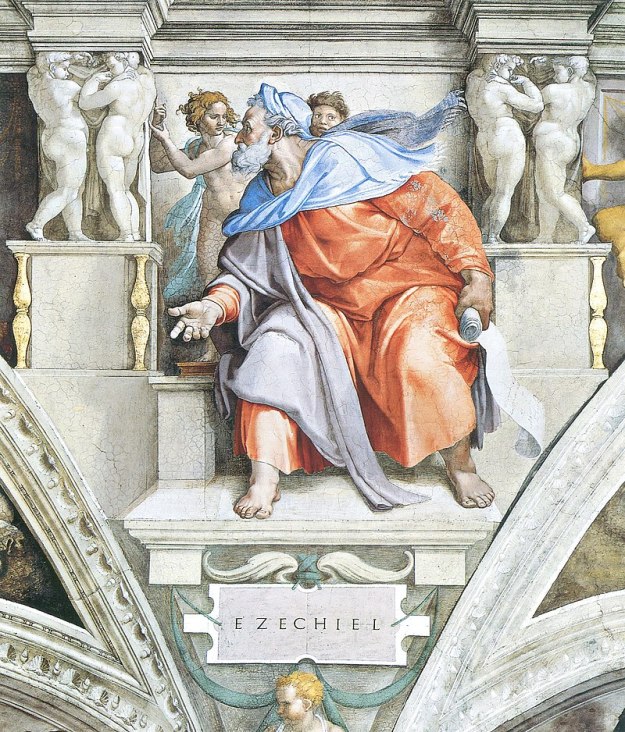

 Darr, Katheryn Pfisterer. “The Book of Ezekiel.” In The New Interpreter’s Bible. (New International Commentary on the Old Testament series) Grand Rapids, MI: William B. Eerdmans Publishing Company, 1997.Volume VI. Nashville, Abingdon Press, 1994.
 Davis, Ellen F. Swallowing the Scroll: Textuality and the Dynamics of Discourse in Ezekiel’s Prophecy. Sheffield, England: Almond Press, 1989.
 Ganzel, Tova. Ezekiel: From Destruction to Restoration. Maggid Studies in Tanakh. Jerusalem: Maggid Books, 2020.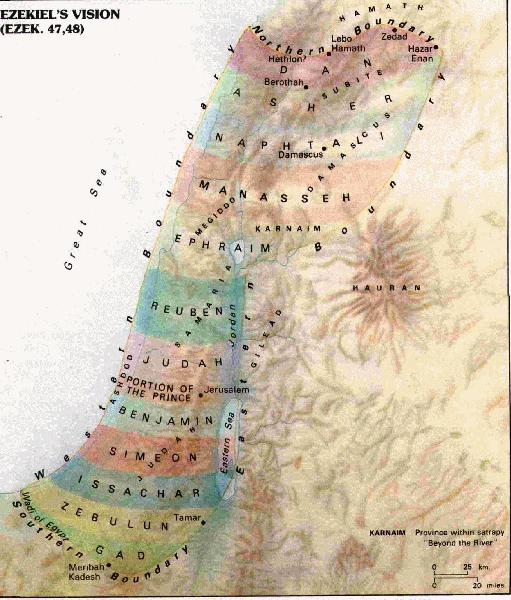
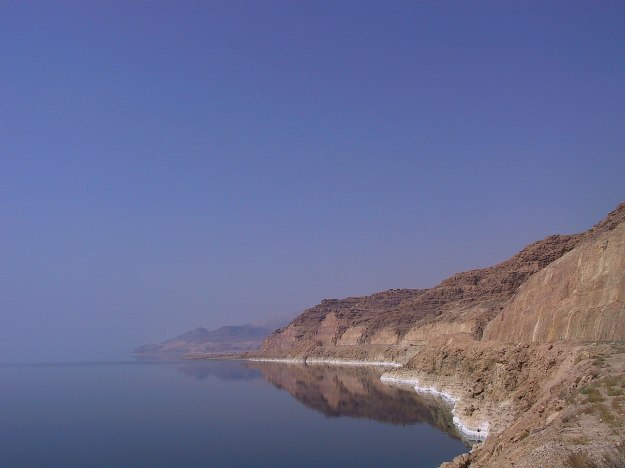
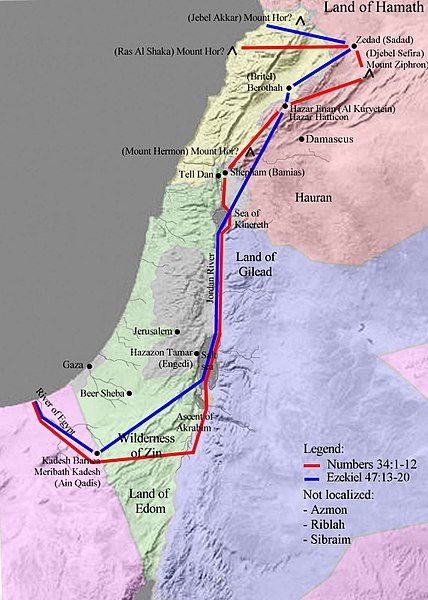


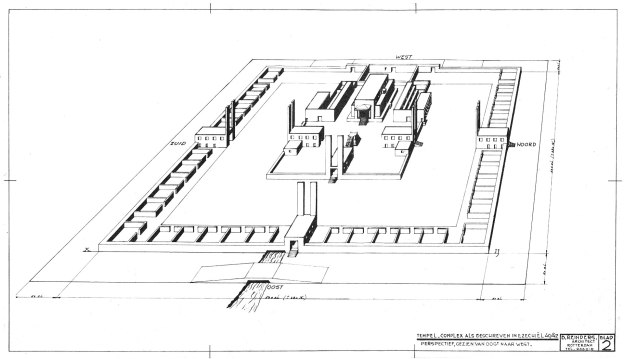

 Sign of the Rose