Category Archives: Deuteronomy

Deuteronomy 7 A People Set Apart

Gustave Dore, The Midianites Are Routed (1866)

Gustave Dore, The Midianites Are Routed (1866)

Deuteronomy 7: 1-6: The Command to Destroy

When the LORD your God brings you into the land that you are about to enter and occupy, and he clears away many nations before you– the Hittites, the Girgashites, the Amorites, the Canaanites, the Perizzites, the Hivites, and the Jebusites, seven nations mightier and more numerous than you– 2 and when the LORD your God gives them over to you and you defeat them, then you must utterly destroy them. Make no covenant with them and show them no mercy. 3 Do not intermarry with them, giving your daughters to their sons or taking their daughters for your sons, 4 for that would turn away your children from following me, to serve other gods. Then the anger of the LORD would be kindled against you, and he would destroy you quickly. 5 But this is how you must deal with them: break down their altars, smash their pillars, hew down their sacred poles, and burn their idols with fire. 6 For you are a people holy to the LORD your God; the LORD your God has chosen you out of all the peoples on earth to be his people, his treasured possession.

In Neil Gaiman’s novel, American Gods, there is a scene where the main character, Shadow, enters an endless room of forgotten gods. This uncountable number of gods’ followers have vanished from the earth and they have vanished as well, passed away from the memory of time or history. The desire of this and other passages in Deuteronomy desire that the gods of these other nations would also be destroyed and wiped away from the memory of the peoples and the remembrances of time. This is a difficult passage for it calls for a divinely authorized extermination of other peoples and cultures. The word behind you must utterly destroy is the Hebrew word herem and sensitive interpreters should feel uncomfortable with this commands for the genocide of these other nations. It stands in contrast even within Deuteronomy for the mercy they are to show to the alien in their midst with the contrast that they are to show no mercy. This is a part of our scriptures and it, like many other passages, are something we should engage and wrestle with as we come to determine how we will use this and other passages in Deuteronomy and throughout the bible.

As a Lutheran pastor I try to follow a hermeneutic that is similar to Luther’s in what I do. Luther’s hermeneutic views the bible through the lens of Was Christum treibut (what pushes Christ) (Wengert, 2013, p. 5) and while I will use many lenses when trying to interpret scripture when it comes to authority, as a Christian and particularly as a Lutheran Christian, it is this coherence to the revelation of God in Jesus that forms the canon within the canon for my interpretation. So the command in Deuteronomy to utterly destroy cannot command a greater authority for me to ‘love my enemies and to pray for those who persecute me.’ (Matthew 5.43 paraphrased) Yet, too frequently Christians have been all too willing to enter into wars or campaigns to wipe out other religions, in particular our Jewish and Muslim brothers and sisters, as well as other groups of Christians.

Another point in this passage is it demonstrates two among the possible responses of a group of people encountering a religiously pluralistic world. One response it to eliminate that religious pluralism by force, to wipe out the other peoples and gods to provide a place where everybody can believe and practice in the same manner. This has been a response at innumerable places and times throughout history.  In our world it may be difficult for modern people to understand when we see the world very differently than those who viewed the outsider as a contamination of the purity of their worship and group and therefore a threat to their holiness. However, we still see religiously and secularly motivated attempts at genocide happen in our time as well. The second option is to pull away from the surrounding society, and that option is also demonstrated in this passage when they are commanded not to intermarry. This is still an option that many religious groups undertake in our society today. Yet for most people of faith destruction or isolation are not options in their pluralistic world and so they have to find a way to live distinctively in the midst of the surrounding culture.

Deuteronomy 7: 7-11: The Divine Choice

7 It was not because you were more numerous than any other people that the LORD set his heart on you and chose you– for you were the fewest of all peoples. 8 It was because the LORD loved you and kept the oath that he swore to your ancestors, that the LORD has brought you out with a mighty hand, and redeemed you from the house of slavery, from the hand of Pharaoh king of Egypt. 9 Know therefore that the LORD your God is God, the faithful God who maintains covenant loyalty with those who love him and keep his commandments, to a thousand generations, 10 and who repays in their own person those who reject him. He does not delay but repays in their own person those who reject him. 11 Therefore, observe diligently the commandment– the statutes, and the ordinances– that I am commanding you today.

The God of the Bible is an active, passionate, and uncontrollable God. In contrast to many modern conception of God where the divine is passive and uninvolved in the lives and concerns of the world, the biblical picture of God is of one who takes sides, chooses one people over another, involves Godself in the movement of empires and the lives of individual people. This God has chosen the people of Israel and they now live in the gift and challenge of that choice. God saw their oppression and their weakness and chose to act on their behalf and because of God’s hearing and acting they are now constituted as God’s people. This love of God is something that God refuses to give up on. For example the prophet Hosea can record:

How can I give you up, Ephraim? How can I hand you over, O Israel? How can I make you like Admah? How can I treat you like Zeboiim? My heart recoils within me; my compassion grows warm and tender. I will not execute my fierce anger; I will not again destroy Ephraim; for I am a God and no mortal, the Holy One in your midst, and I will not come in wrath. Hosea 11.8f.

Those who have read my work on Jeremiah know that I approach the book of Jeremiah from the perspective of a wounded God who is mourning the broken relationship between God and God’s people. Perhaps a disengaged god is easier to manage, or a god who dispassionately answers prayers but this is not the God of Israel, the LORD presented in the Hebrew Bible or the New Testament. This choice of God also involves commitment from Israel, to be chosen is to be held to a different standard, to be called to be a distinctive gift to the rest of the world. The people of Israel and the people of the Church will both fail in this calling, and yet the persistent calling of God remains.

Deuteronomy 7: 12-16: No Need for the Fertility Gods of the Surrounding Lands

                12 If you heed these ordinances, by diligently observing them, the LORD your God will maintain with you the covenant loyalty that he swore to your ancestors; 13 he will love you, bless you, and multiply you; he will bless the fruit of your womb and the fruit of your ground, your grain and your wine and your oil, the increase of your cattle and the issue of your flock, in the land that he swore to your ancestors to give you. 14 You shall be the most blessed of peoples, with neither sterility nor barrenness among you or your livestock. 15 The LORD will turn away from you every illness; all the dread diseases of Egypt that you experienced, he will not inflict on you, but he will lay them on all who hate you. 16 You shall devour all the peoples that the LORD your God is giving over to you, showing them no pity; you shall not serve their gods, for that would be a snare to you.

In the worldview of the Deuteronomist where obedience to the LORD of Israel and blessings are directly correlated there is no need for any other gods. The LORD is promising to provide for the people fertility in their homes, flocks and fields, freedom from illness and all the blessings they need to be an abundant people. This is an exclusive covenant that the people have been offered and the continual fear of the Deuteronomist is that the people will be led astray by the people of the land to follow these other gods. On the positive side this is concerned with passing on the faith and the story of the way their LORD has been active on their behalf from generation to generation. Yet in the midst of the continual return to this theme there seems to be an underlying fear of the loss of their children or their children’s children to these other seductive faiths.

The loss of the children to the faith is a fear that is present in most religious bodies, certainly in the United States with the changes in the broader culture there has been a lot of concern about the decline of Christianity in the United States. Recently the Pew Research Center released a study where the number of people who are unaffiliated is now larger than both Catholics and mainline Protestants and the number of unaffiliated is growing rapidly while all major groups of Christians show decline (report at: http://www.pewforum.org/2015/05/12/americas-changing-religious-landscape/). I know a lot of congregations are dealing with the anxiety that their children or their grandchildren are no longer active parts of their congregation or any congregation. Perhaps in our own time and situation of digital pluralism the biggest concern of the faithful is no longer other religions but rather other competing ideals. In a world of almost infinite options for how time can be utilized and the expectation that people of all ages will be involved in a wide array of activities from sports to work to politics to entertainment or shopping. Although the struggle of the people of Israel entering into the promised land and encountering other people with new sets of beliefs and practices was challenging and different than our time, there is always the allure of these alternative images which are seen in the street, schools and marketplace. In every generation the congregation of the faithful has to wrestle with how they will remain faithful in their time and pass on the faith to the next generation to enable them for their own journey in their own time.

Deuteronomy 7: 17-26: Do Not Fear and Do Not Covet

 17 If you say to yourself, “These nations are more numerous than I; how can I dispossess them?” 18 do not be afraid of them. Just remember what the LORD your God did to Pharaoh and to all Egypt, 19 the great trials that your eyes saw, the signs and wonders, the mighty hand and the outstretched arm by which the LORD your God brought you out. The LORD your God will do the same to all the peoples of whom you are afraid. 20 Moreover, the LORD your God will send the pestilence against them, until even the survivors and the fugitives are destroyed. 21 Have no dread of them, for the LORD your God, who is present with you, is a great and awesome God. 22 The LORD your God will clear away these nations before you little by little; you will not be able to make a quick end of them, otherwise the wild animals would become too numerous for you. 23 But the LORD your God will give them over to you, and throw them into great panic, until they are destroyed. 24 He will hand their kings over to you and you shall blot out their name from under heaven; no one will be able to stand against you, until you have destroyed them. 25 The images of their gods you shall burn with fire. Do not covet the silver or the gold that is on them and take it for yourself, because you could be ensnared by it; for it is abhorrent to the LORD your God. 26 Do not bring an abhorrent thing into your house, or you will be set apart for destruction like it. You must utterly detest and abhor it, for it is set apart for destruction.

As the narrative continues to prepare the people for their entry into the promised land and the beginning of the leadership of Joshua where the people will enter the promised land. These words above resonate with one of the recurring themes of Joshua that can be seen, among many other places in Joshua, in Joshua 1: 9

I hereby command you: Be strong and courageous; do not be frightened or dismayed, for the LORD God is with you wherever you go.

Through Moses the people are reminded of the way God has acted for them in the past: that they were a people who were rescued from the superpower of their day and who the LORD has sustained throughout their journey. If the LORD can handle Egypt, the LORD can handle these nations that are before them. They are not to fear these nations for they will be slowly driven out before the Israelites but they are also not to covet what they have. The lure of the silver and gold the nations have committed is to be dedicated to destruction. They are not to take an idol and value it for its components, instead they are to destroy it rather than risk the wrath of their LORD. They are not to try to secure their own wealth and prosperity in the land but rather their relationship is one where they are dependent on their LORD to provide their prosperity and blessing. They are to resist the materialistic urge to procure their own security through the captured wealth of these nations but rather they are to rely upon the abundance of the blessings the will receive in this land flowing with milk and honey from their LORD who brought them into the land.

Deuteronomy 6-The Center of the Faith

The Shema in Hebrew

The Shema in Hebrew

Deuteronomy 6: 1-8 the Shema

1 Now this is the commandment– the statutes and the ordinances– that the LORD your God charged me to teach you to observe in the land that you are about to cross into and occupy, 2 so that you and your children and your children’s children may fear the LORD your God all the days of your life, and keep all his decrees and his commandments that I am commanding you, so that your days may be long. 3 Hear therefore, O Israel, and observe them diligently, so that it may go well with you, and so that you may multiply greatly in a land flowing with milk and honey, as the LORD, the God of your ancestors, has promised you.

                        4 Hear, O Israel: The LORD is our God, the LORD alone. 5 You shall love the LORD your God with all your heart, and with all your soul, and with all your might. 6 Keep these words that I am commanding you today in your heart. 7 Recite them to your children and talk about them when you are at home and when you are away, when you lie down and when you rise. 8 Bind them as a sign on your hand, fix them as an emblem on your forehead, 9 and write them on the doorposts of your house and on your gates.

When Jesus was asked what the greatest commandment he, like most Jewish people of his day, quotes Deuteronomy 6: 4-5 and then he attached on Leviticus 19:18, “you shall love your neighbor as yourself”. This is the heartbeat of the Jewish, and later Christian, walk with the LORD. They are to be a people who have one LORD and only the LORD who is to be the center of their life and devotion.

Deuteronomy 6:4 is known as ‘the Shema’, which gets its name from the first word in Hebrew of the verse. Shema means to hear or listen and these are to be the first words on their lips as the rise and when they lie down, they are to be seen and heard in their coming and in their going. They are a people constituted by these words and they are not only to say them but to talk about them to their children and their children’s children. Parents become the primary vessels by which the heartbeat of their faith is passed down. They would even wear these words as a reminder of who they were and a public statement of their devotion to the world around them. These words are to be at the heart of their identity and their life. They are not just words to be said but rather to be lived and in continually hearing these words they are recalled to their own identity.

With both the Ten Commandments and ‘the Shema’ the hearing of these words is to all Israel and it is primarily the household that is responsible for passing on the faith. There will be a tension between the household and the priestly authority in times to come, within the story of Israel after the construction of the temple there will be increasing efforts to make the temple the focal point of religious authority, yet for the passing on of the faith much of that will happen in the homes. The church in America is rediscovering the reality that after a couple generations of placing the formation of faith primarily in the hands of the church that we have many who are not equipped to pass on their faith or to think about the ethical dilemmas they encounter on a day to day basis. Martin Luther understood this when he wrote the Small Catechism which equips parents to hand on the faith to their children almost 500 years ago, and perhaps the struggle is finding the balance. Families need the church or temple to call them back to their vocation of training themselves and their children but the church cannot be the only vessel of faith formation when the primary indicator of an adult’s remaining attached to their faith tradition are the conversations about their faith primarily from family members.

It is also helpful to remember that, even though compared to many modern countries, the nation of Israel is fairly tiny that most people would not be able to travel to the tabernacle or the temple for more than festival type occasions and that without having access to the written texts in the home (that we take for granted) they relied on the continual hearing of these words to form their identity. I think there is a lot to learn from this type of repetition, and for example most Christians can readily pull up certain pieces of scripture that have meaning to them, the Lord’s Prayer or the 23rd Psalm for example, and these become things that can be recalled even if a person is dealing with dementia. These words can begin to form the identity of the people for as long as they are practiced and lived, yet they could be forgotten in one generation and that will happen throughout the life of the people of Israel, just as Christians will at times forget their own identity when they forget their story.

Deuteronomy 6: 10- 25 the Danger of Amnesia

10 When the LORD your God has brought you into the land that he swore to your ancestors, to Abraham, to Isaac, and to Jacob, to give you– a land with fine, large cities that you did not build, 11 houses filled with all sorts of goods that you did not fill, hewn cisterns that you did not hew, vineyards and olive groves that you did not plant– and when you have eaten your fill, 12 take care that you do not forget the LORD, who brought you out of the land of Egypt, out of the house of slavery. 13 The LORD your God you shall fear; him you shall serve, and by his name alone you shall swear. 14 Do not follow other gods, any of the gods of the peoples who are all around you, 15 because the LORD your God, who is present with you, is a jealous God. The anger of the LORD your God would be kindled against you and he would destroy you from the face of the earth.

 16 Do not put the LORD your God to the test, as you tested him at Massah. 17 You must diligently keep the commandments of the LORD your God, and his decrees, and his statutes that he has commanded you. 18 Do what is right and good in the sight of the LORD, so that it may go well with you, and so that you may go in and occupy the good land that the LORD swore to your ancestors to give you, 19 thrusting out all your enemies from before you, as the LORD has promised.

20 When your children ask you in time to come, “What is the meaning of the decrees and the statutes and the ordinances that the LORD our God has commanded you?” 21 then you shall say to your children, “We were Pharaoh’s slaves in Egypt, but the LORD brought us out of Egypt with a mighty hand. 22 The LORD displayed before our eyes great and awesome signs and wonders against Egypt, against Pharaoh and all his household. 23 He brought us out from there in order to bring us in, to give us the land that he promised on oath to our ancestors. 24 Then the LORD commanded us to observe all these statutes, to fear the LORD our God, for our lasting good, so as to keep us alive, as is now the case. 25 If we diligently observe this entire commandment before the LORD our God, as he has commanded us, we will be in the right.”

 The Deuteronomist is of a mixed mind about the people encountering abundance, on the one hand the abundance they are to receive when they enter the Promised Land is a sign of God’s blessing yet there is also a significant risk that in their security they will forget the LORD. There will always be the temptations to follow other gods or to live in a way that is more concerned with the individuals’ prosperity than God’s covenant of justice. They are called to be different from the peoples around them, a witness to them, and a means of blessing for the other nations. Yet it is in that difference that the people will struggle, the gods and practices of the surrounding peoples will be more concrete, these gods have images and yet the LORD is always a mystery-never contained within these images, not willing to share the LORD’s people with these other images.

The gods of the surrounding nations may promise fertility or individual prosperity or a bountiful harvest, in short they promised things that were in the individual’s best interest. Martin Luther insightfully could say of sin that it is the ‘heart curved inward on itself’ and the commandments and the Shema and the unfolding of them to come are really looking towards the neighbor’s best interest. It is trying to construct a world where the community can live in justice and peace. It will always be a challenge to live into this vision when there are many competing voices encouraging the individuals and families to seek their own interest and yet it is a vision of shalom worth living into.

Even with the practices outlined around the Shema there is the continual danger of a slow slide into amnesia in the generations to come. They are a people whose story emerges out of the story of God taking them out of the land of Egypt and creating them as the LORD’s own people. For their life going forward their life will be defined both by this story and by the quality of their continued relationship with their LORD. Deuteronomy will emphasize over and over the need for continued vigilance in this relationship and the blessings that will come if they keep these commandments and the curse that comes with disobedience.

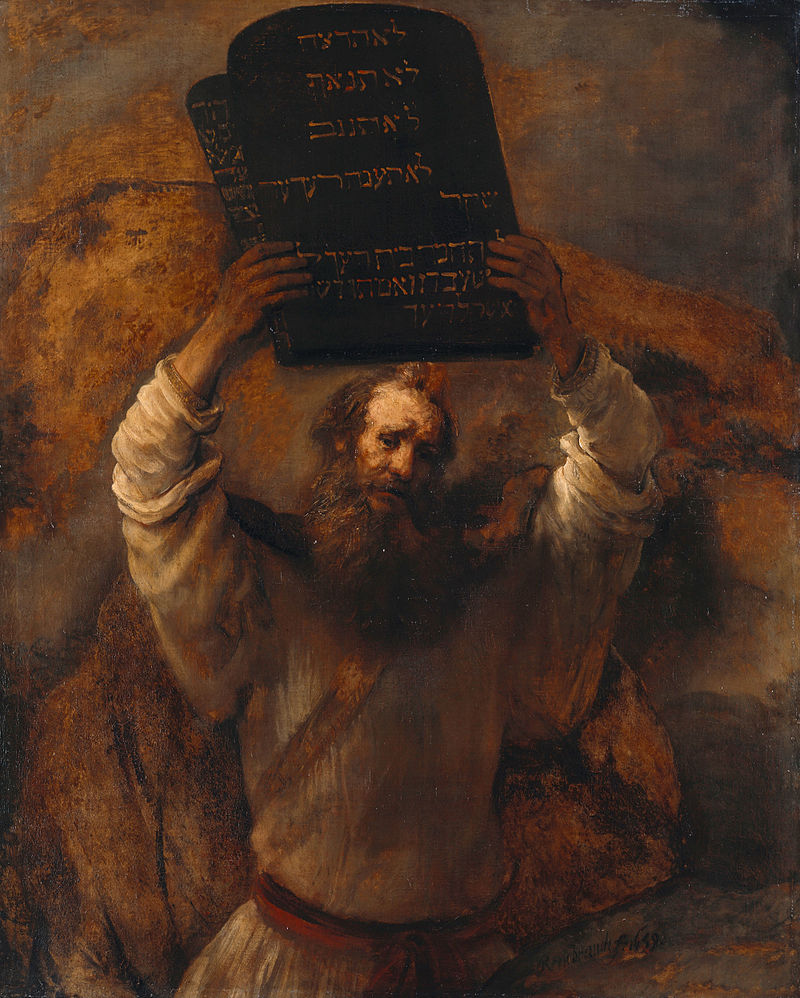
Deuteronomy 5: The Ten Commandments Revisited

Rembrandt, Moses with the Ten Commandments

Rembrandt, Moses with the Ten Commandments

Deuteronomy 5: 1-21 The Ten Commandments Revisited

Moses convened all Israel, and said to them: Hear, O Israel, the statutes and ordinances that I am addressing to you today; you shall learn them and observe them diligently. 2 The LORD our God made a covenant with us at Horeb. 3 Not with our ancestors did the LORD make this covenant, but with us, who are all of us here alive today. 4 The LORD spoke with you face to face at the mountain, out of the fire. 5 (At that time I was standing between the LORD and you to declare to you the words of the LORD; for you were afraid because of the fire and did not go up the mountain.) And he said:

 6 I am the LORD your God, who brought you out of the land of Egypt, out of the house of slavery; 7 you shall have no other gods before me.

 8 You shall not make for yourself an idol, whether in the form of anything that is in heaven above, or that is on the earth beneath, or that is in the water under the earth. 9 You shall not bow down to them or worship them; for I the LORD your God am a jealous God, punishing children for the iniquity of parents, to the third and fourth generation of those who reject me, 10 but showing steadfast love to the thousandth generation of those who love me and keep my commandments.

 11 You shall not make wrongful use of the name of the LORD your God, for the LORD will not acquit anyone who misuses his name.

 12 Observe the sabbath day and keep it holy, as the LORD your God commanded you. 13 Six days you shall labor and do all your work. 14 But the seventh day is a sabbath to the LORD your God; you shall not do any work– you, or your son or your daughter, or your male or female slave, or your ox or your donkey, or any of your livestock, or the resident alien in your towns, so that your male and female slave may rest as well as you. 15 Remember that you were a slave in the land of Egypt, and the LORD your God brought you out from there with a mighty hand and an outstretched arm; therefore the LORD your God commanded you to keep the sabbath day.

 16 Honor your father and your mother, as the LORD your God commanded you, so that your days may be long and that it may go well with you in the land that the LORD your God is giving you.

 17 You shall not murder.

 18 Neither shall you commit adultery.

 19 Neither shall you steal.

 20 Neither shall you bear false witness against your neighbor.

 21 Neither shall you covet your neighbor’s wife. Neither shall you desire your neighbor’s house, or field, or male or female slave, or ox, or donkey, or anything that belongs to your neighbor.

As we have seen in previous chapters there is the continued collapse of time between the current generation hearing (or reading) these words and the generation that was present at Mount Horeb (Sinai) who heard the original ten words (commandments) delivered. The hearing and reading of this law is to bring the hearer/reader into the presence of the God of Israel speaking to them these words. They are brought into the story of the people who made the journey out of Egypt and who saw the events of the Exodus. They are now the generation receiving the Decalogue (ten words) and charged to live out of them. Moses has already become the mediator of God’s word and now Moses’ voice captured in these words mediates the voice of God to the people.

Martin Luther interpreted the first commandment, which Luther heard being the commandment to have no other gods, as meaning “we are to fear, love and trust God above all things.” (Luther, 1994, p. 13) and for Luther all the other commandments flow out of this one each beginning with “we are to fear and love God so that…” The relationship, or perhaps better the covenant with the LORD precedes the giving of these words and as Deuteronomy narrates the commandments it begins with another reference back to the Exodus, “I am the LORD your God, who brought you out of the land of Egypt”. It is from this narrative and this action that the LORD has the position to speak these words that constitute them as a people.

When you look at how the commandments are structured here in Deuteronomy two commandments receive significantly more words than the others, the commandment or words dealing with making idols and the commandment/words on the Sabbath. Since Deuteronomy 4 deals heavily with not making images for God I will not recover that ground here even though it is important, but the idea of a Sabbath is one that is heavily needed in our culture.

Contrary to what many people believe, the Sabbath is not primarily about worship, it is about rest. Especially with the center of worship becoming centered in the temple in Jerusalem in ancient times it would have been impossible for the people to come together at the temple every week, but the command to rest for all people: men, women, slave and free, young and old and even animals are to be able to rest on this day. Interestingly the rationale for the Sabbath shifts in Deuteronomy from in Exodus. In Exodus 20 the rationale for the Sabbath harkens back to the creation narrative where the people are to reflect the action of God resting on the seventh day. In Deuteronomy the decisive event is the Exodus and more emphasis is placed on allowing male and female slaves to rest even if they are not Hebrews and that this commandment flows out of their experience of being liberated from being slaves in the land of Egypt.

In our time we may feel there is too much going on to take a day of rest. I think churches and religious organizations of all types often fall prey to the consumeristic drive to fill every available place and time with some activity, but there is something profoundly countercultural about taking a day of rest. Of unplugging from the unending demands of the world of commerce and work and allowing our bodies and spirits to be renewed. I struggle with this personally, I am not good at sitting and resting although I know it can be healing. Sabbath is an act of resistance to a productivity and consumer based mindset where a person’s life is defined by production and acquisition. It allows not only people but the community to breathe and listen.

The commandment on honoring the father and mother has typically been explained to me as young children honoring their parents as they grow and has been used as a tool to ensure obedience, but perhaps in our culture it is time to hear perhaps the justice based way that the commandment was originally meant to be heard in. The vulnerable in any society are the young and the old and the more I read about this commandment the more I am convinced that this refers to those parents who are now older and now rely upon their children for protection. We live in a culture that values youth and does not value the elderly in the same way and unfortunately they can become looked upon as a burden to society. In the ancient and the modern world there are the elderly who die of neglect and the lack of care, but in honoring the father and mother the working generations are called to care for those who are no longer able to care for themselves.

As a pastor in the United States I sometimes hear people state that our legal system is based upon the Ten Commandments, but it is difficult to make an argument that this is correct. The commandments against murder and stealing are a part of our legal system (and every legal system I am aware of but this doesn’t necessarily flow from the ten commandments) but for example coveting is a central part of the capitalist system, and it would be hard to make an argument that our legal system prevents us from making images, worshipping other gods, violating the Sabbath, dishonoring father and mother, committing adultery or bearing false witness. I think sometimes the commandments being displayed is a way in which people create their own images that they can honor but not necessarily follow. The Ten Commandments may be a part of the resonant images of our country’s religious past but they are not an active part of the legal framework of our system of laws.

Deuteronomy 5: 22-33 Standing Between the People and God

 22 These words the LORD spoke with a loud voice to your whole assembly at the mountain, out of the fire, the cloud, and the thick darkness, and he added no more. He wrote them on two stone tablets, and gave them to me. 23 When you heard the voice out of the darkness, while the mountain was burning with fire, you approached me, all the heads of your tribes and your elders; 24 and you said, “Look, the LORD our God has shown us his glory and greatness, and we have heard his voice out of the fire. Today we have seen that God may speak to someone and the person may still live. 25 So now why should we die? For this great fire will consume us; if we hear the voice of the LORD our God any longer, we shall die. 26 For who is there of all flesh that has heard the voice of the living God speaking out of fire, as we have, and remained alive? 27 Go near, you yourself, and hear all that the LORD our God will say. Then tell us everything that the LORD our God tells you, and we will listen and do it.”

 28 The LORD heard your words when you spoke to me, and the LORD said to me: “I have heard the words of this people, which they have spoken to you; they are right in all that they have spoken. 29 If only they had such a mind as this, to fear me and to keep all my commandments always, so that it might go well with them and with their children forever! 30 Go say to them, ‘Return to your tents.’ 31 But you, stand here by me, and I will tell you all the commandments, the statutes and the ordinances, that you shall teach them, so that they may do them in the land that I am giving them to possess.” 32 You must therefore be careful to do as the LORD your God has commanded you; you shall not turn to the right or to the left. 33 You must follow exactly the path that the LORD your God has commanded you, so that you may live, and that it may go well with you, and that you may live long in the land that you are to possess.

The writer of Deuteronomy spends a lot of time emphasizing the immediacy of these words to the hearers and again links the hearers to the generation that heard God’s words at Horeb (Sinai). Even though these words are mediated by hearing and writing across generations they bear an immediacy to the God who speaks through Moses to the people. The fear and reverence of that generation at that moment are lifted up as a positive and as the book of Proverbs will say at a different time, “The fear of the LORD is the beginning of wisdom.” (Proverbs 1.7)

From the mouth of the LORD we hear this lifted up and also lamented as we, and subsequent generations of hearers and readers will know, that this does not last. As the words emphasize here, “If only they had such a mind as this, to fear me and keep my commandments always, so that it might go well with them.” Deuteronomy begins a long retelling of the story of the people of Israel as they look back at how they made this journey from being a people at the edge of the promised land to being a people looking back at this lost land from their exile in Babylon and throughout the nations. Throughout Deuteronomy, Joshua, Judges, 1&2 Samuel and 1&2 Kings we will hear a continued narrative of how the people often did not have such a mind as this. Their time in the promise land would last for generations but not forever but whether in their tent in the Exodus or their isolation in the exile or anywhere in between or beyond they are to be a people who hear these commandments and ordinances and live out of them. When these words are read in a new generation they are once again joined to the story of the people of the Exodus who were brought out of the land of Egypt, who heard the voice of the LORD at Horeb(Sinai) and entered into the promised land.

Deuteronomy 4: A Story Formed People and an Imageless God

James Tissot, Moses Sees the Promised Land from Afar

James Tissot, Moses Sees the Promised Land from Afar

Deuteronomy 4: 1-14 Living in Light of the Narrative

So now, Israel, give heed to the statutes and ordinances that I am teaching you to observe, so that you may live to enter and occupy the land that the LORD, the God of your ancestors, is giving you. 2 You must neither add anything to what I command you nor take away anything from it, but keep the commandments of the LORD your God with which I am charging you. 3 You have seen for yourselves what the LORD did with regard to the Baal of Peor– how the LORD your God destroyed from among you everyone who followed the Baal of Peor, 4 while those of you who held fast to the LORD your God are all alive today.

 5 See, just as the LORD my God has charged me, I now teach you statutes and ordinances for you to observe in the land that you are about to enter and occupy. 6 You must observe them diligently, for this will show your wisdom and discernment to the peoples, who, when they hear all these statutes, will say, “Surely this great nation is a wise and discerning people!” 7 For what other great nation has a god so near to it as the LORD our God is whenever we call to him? 8 And what other great nation has statutes and ordinances as just as this entire law that I am setting before you today?

 9 But take care and watch yourselves closely, so as neither to forget the things that your eyes have seen nor to let them slip from your mind all the days of your life; make them known to your children and your children’s children– 10 how you once stood before the LORD your God at Horeb, when the LORD said to me, “Assemble the people for me, and I will let them hear my words, so that they may learn to fear me as long as they live on the earth, and may teach their children so”; 11 you approached and stood at the foot of the mountain while the mountain was blazing up to the very heavens, shrouded in dark clouds. 12 Then the LORD spoke to you out of the fire. You heard the sound of words but saw no form; there was only a voice. 13 He declared to you his covenant, which he charged you to observe, that is, the ten commandments; and he wrote them on two stone tablets. 14 And the LORD charged me at that time to teach you statutes and ordinances for you to observe in the land that you are about to cross into and occupy.

Any speech only has a life as long as it is remembered in the memory of the people who continue to remember and tell it. For the collection of books sometimes referred to as the Deuteronomic History (Deuteronomy, Joshua, Judges, 1 & 2 Samuel, 1 & 2 Kings) one of the recurring issues is that people turn aside from these words, or a later generation does evil in the eyes of the LORD. Without memory and re-telling the narrative and the commands of the law there will always be other narratives provided in the world. This was true in Israel’s time and it is true in our postmodern digitally pluralistic world. One of the interesting movements of this section of Deuteronomy is the movement from the narrative of the previous generation to that narrative being a part of the narrative of the new generation. Just as the people are reminded of what happened when some of their people began to worship the gods of Moab, this story appears in Numbers 25, and the people are charged to remember how fierce the LORD’s jealousy was in this instance, they are charged to remember that their LORD expects fidelity throughout the generations.

In the narrative Moses takes upon himself the role as the teacher of the commandments of God one last time. In this long extended series of speeches Moses is trying to prepare this generation for a life of faithfulness. In their obedience they will be a place that the nations look to and they will stand apart from others. For the Deuteronomist the people of Israel are expected to be an example to the world around them. This is the covenant they have with the LORD, the blessing and the curse of their identity. They are to live with more access to the LORD but they also live under higher scrutiny than the nations that surround them. In the midst of the ignorance of the nations they are to know the LORD.

By hearing this story the people also now participate in it. They no longer are just those who are hearing about the event of the Ten Commandments (or ten words) being given at Horeb (or Sinai) but now they are there. Physically they were not there, that generation has passed away, that was the generation that wandered in the wilderness and never reached the promised land, but in this speech this new generation becomes an extension of the old. They cannot resort to saying they didn’t see or didn’t hear. The telling of the story from generation to generation will be a way of living that story. Even though they may not have been there to see, later generations will be gathered among those who did see and will be judged like those who did hear. One of the critical focuses of Deuteronomy is the telling of the tradition and the stories from generation to generation so that they, as a people, may live in the land. On a critical edge the Deuteronomist also sees the loss of the land through the lens of the failure of Israel to hold fast to the words and ordinances.

Deuteronomy 4: 15-31 The Imageless God

                15 Since you saw no form when the LORD spoke to you at Horeb out of the fire, take care and watch yourselves closely, 16 so that you do not act corruptly by making an idol for yourselves, in the form of any figure– the likeness of male or female, 17 the likeness of any animal that is on the earth, the likeness of any winged bird that flies in the air, 18 the likeness of anything that creeps on the ground, the likeness of any fish that is in the water under the earth. 19 And when you look up to the heavens and see the sun, the moon, and the stars, all the host of heaven, do not be led astray and bow down to them and serve them, things that the LORD your God has allotted to all the peoples everywhere under heaven. 20 But the LORD has taken you and brought you out of the iron-smelter, out of Egypt, to become a people of his very own possession, as you are now.

21 The LORD was angry with me because of you, and he vowed that I should not cross the Jordan and that I should not enter the good land that the LORD your God is giving for your possession. 22 For I am going to die in this land without crossing over the Jordan, but you are going to cross over to take possession of that good land. 23 So be careful not to forget the covenant that the LORD your God made with you, and not to make for yourselves an idol in the form of anything that the LORD your God has forbidden you. 24 For the LORD your God is a devouring fire, a jealous God.

                25 When you have had children and children’s children, and become complacent in the land, if you act corruptly by making an idol in the form of anything, thus doing what is evil in the sight of the LORD your God, and provoking him to anger, 26 I call heaven and earth to witness against you today that you will soon utterly perish from the land that you are crossing the Jordan to occupy; you will not live long on it, but will be utterly destroyed. 27 The LORD will scatter you among the peoples; only a few of you will be left among the nations where the LORD will lead you. 28 There you will serve other gods made by human hands, objects of wood and stone that neither see, nor hear, nor eat, nor smell. 29 From there you will seek the LORD your God, and you will find him if you search after him with all your heart and soul. 30 In your distress, when all these things have happened to you in time to come, you will return to the LORD your God and heed him. 31 Because the LORD your God is a merciful God, he will neither abandon you nor destroy you; he will not forget the covenant with your ancestors that he swore to them.


In a world full of images the Hebrew people had a narrative, a covenant and a law. There is a level of unknown with the God of Israel. The divine form is not to be locked down, the divine name is not to be used, there may be visual aspects to the way in which God has met the people but those representations do not represent the form of God. They were a story formed people, they had words from God and words about God but somehow to lock God into any sort of likeness was to fall into idolatry. Perhaps it is the natural inclination to see in the objects of the world the aspects of the divine and to assign the creation as the image of the creator. In our own age which has become much more visual and where digital images continually are placed before us and can tell us who we are to be and how we are to live the people of God are called again to rely more on our ears telling us specifically this narrative and this story rather than our eyes which are easily led astray to any number of images.

The God of Israel has a special relationship with God’s people, what God allows of others is not allowed to them. The nations around them will have their images and their relationships with these gods in their own ways, but Israel is to be different. They are a people who lives out of their covenant with the imageless God. They are to be separate and obedient and that obedience does not come easily. There will be many images in the world around them, other narratives they will hear, and other people whose ways they admire. Just as the creation narrative in Genesis 1 can talk about God speaking and the world coming into being, they are a speech formed people. Their lives are to be ordered by the words about God, words that can never adequately describe or tame their LORD. It is a risky strangeness to the God portrayed in Deuteronomy, a God who is never too familiar. A God who is good but also jealous for God’s people, a God who desires to bless but is willing to curse, a merciful God who is willing to destroy. It is the God of Exodus and exile who sees the people through their faithfulness and unfaithfulness, and while human beings may be formed in the image of God they cannot claim to capture the image of God.

We live in an age where image is everything. If we are truly in a post-literate society where people no longer pay attention to written and spoken text but instead are swept up in the unending stream of digital images that portray reality then perhaps this is one of the central challenges for Judaism, Christianity and Islam. Christianity has wrestled with the prohibition of images since its beginnings and the iconoclastic controversy seems to present itself each time Christianity has to re-imagine itself in a new age and time. The wisdom of the ancient church was that if God could present Godself in the person of Jesus, as Christians believe, then these images could be used to help tell the story of the God who met us in this way. Yet the images were to be connected with the narrative. With time and distance there is always the danger of the image becoming isolated from the story, for example the loss of the Jewish nature of Jesus’ identity for hundreds of years, but there the danger that the story becomes lost as well.

Deuteronomy 4: 32-40 The Uniqueness of the Relationship

                32 For ask now about former ages, long before your own, ever since the day that God created human beings on the earth; ask from one end of heaven to the other: has anything so great as this ever happened or has its like ever been heard of? 33 Has any people ever heard the voice of a god speaking out of a fire, as you have heard, and lived? 34 Or has any god ever attempted to go and take a nation for himself from the midst of another nation, by trials, by signs and wonders, by war, by a mighty hand and an outstretched arm, and by terrifying displays of power, as the LORD your God did for you in Egypt before your very eyes? 35 To you it was shown so that you would acknowledge that the LORD is God; there is no other besides him. 36 From heaven he made you hear his voice to discipline you. On earth he showed you his great fire, while you heard his words coming out of the fire. 37 And because he loved your ancestors, he chose their descendants after them. He brought you out of Egypt with his own presence, by his great power, 38 driving out before you nations greater and mightier than yourselves, to bring you in, giving you their land for a possession, as it is still today. 39 So acknowledge today and take to heart that the LORD is God in heaven above and on the earth beneath; there is no other. 40 Keep his statutes and his commandments, which I am commanding you today for your own well-being and that of your descendants after you, so that you may long remain in the land that the LORD your God is giving you for all time.

In the speech Moses is portrayed calling the people back to the uniqueness of their relationship with the LORD and more directly to the uniqueness of the LORD. Unlike most of the peoples of the ancient world who saw their gods as tied to their tribes, nations or lands the Hebrew faith is in a God who creates the whole earth and has a unique relationship with Israel. There is a diversity of views of what to think of gods of the other nations, whether they are real or not, but as Deanna Thompson insightfully states, “Deuteronomy is the first biblical book to state explicitly that “there is no other” besides the God of Israel (4:35, 39).” (Thompson, 2014, p. 47) The people are linked back to the generations that experienced God’s taking them out of Egypt, going with them through the exile, presenting them the Ten Commandments at Horeb and setting them aside as a people. In this closing of this speech Moses again calls them back to remember that their relationship with the LORD, the God of Israel is both unique and decisive. They are not to acknowledge any other God and just as their ancestors heard the words of God they are to continually go back to these statutes and commandments which make them who they are.

Deuteronomy 4: 41-49 Closing Business

                41 Then Moses set apart on the east side of the Jordan three cities 42 to which a homicide could flee, someone who unintentionally kills another person, the two not having been at enmity before; the homicide could flee to one of these cities and live: 43 Bezer in the wilderness on the tableland belonging to the Reubenites, Ramoth in Gilead belonging to the Gadites, and Golan in Bashan belonging to the Manassites.

                44 This is the law that Moses set before the Israelites. 45 These are the decrees and the statutes and ordinances that Moses spoke to the Israelites when they had come out of Egypt, 46 beyond the Jordan in the valley opposite Beth-peor, in the land of King Sihon of the Amorites, who reigned at Heshbon, whom Moses and the Israelites defeated when they came out of Egypt. 47 They occupied his land and the land of King Og of Bashan, the two kings of the Amorites on the eastern side of the Jordan: 48 from Aroer, which is on the edge of the Wadi Arnon, as far as Mount Sirion (that is, Hermon), 49 together with all the Arabah on the east side of the Jordan as far as the Sea of the Arabah, under the slopes of Pisgah.

The speech ends and we transition to the closing business before moving on to the larger speech to follow. Deuteronomy narrates the setting aside of Bezer, Ramoth and Golan as cities for refuge, also narrated in Numbers 35: 9-14 which goes back to the appeal for the sort of justice the people are to live under. They are to be a people where vengeance is not supreme and the people and the judges are to act in accordance with justice even for those at the margin. In the event of a homicide there are places of refuge where the accused can go to and seek refuge until the evidence can be heard. The simplicity of an eye for an eye and a tooth for a tooth was never to be the way of the Jewish people. They were to be a people of justice and of God’s law.

Finally we hear the preparation for what is to come and a brief narration of what was before. The decrees and statutes find their authority in the God who has rescued them from Egypt, journeyed with them through the exile and in the eyes of the people who were before Moses had led them into the land they currently occupied past giants and walled cities. In what is to come the people are to listen, to hear and to obey these final words that Moses will speak to them prior to their journey across the Jordan under Joshua and their residence in the Promised Land.


Deuteronomy 3: Visions of a Future Land

James Tissot, Moses Sees the Promised Land from Afar

James Tissot, Moses Sees the Promised Land from Afar

Deuteronomy 3: 1-17 Preparing the Way for the Conflict across the River

When we headed up the road to Bashan, King Og of Bashan came out against us, he and all his people, for battle at Edrei. 2 The LORD said to me, “Do not fear him, for I have handed him over to you, along with his people and his land. Do to him as you did to King Sihon of the Amorites, who reigned in Heshbon.” 3 So the LORD our God also handed over to us King Og of Bashan and all his people. We struck him down until not a single survivor was left. 4 At that time we captured all his towns; there was no citadel that we did not take from them– sixty towns, the whole region of Argob, the kingdom of Og in Bashan. 5 All these were fortress towns with high walls, double gates, and bars, besides a great many villages. 6 And we utterly destroyed them, as we had done to King Sihon of Heshbon, in each city utterly destroying men, women, and children. 7 But all the livestock and the plunder of the towns we kept as spoil for ourselves.

 8 So at that time we took from the two kings of the Amorites the land beyond the Jordan, from the Wadi Arnon to Mount Hermon 9 (the Sidonians call Hermon Sirion, while the Amorites call it Senir),10 all the towns of the tableland, the whole of Gilead, and all of Bashan, as far as Salecah and Edrei, towns of Og’s kingdom in Bashan. 11 (Now only King Og of Bashan was left of the remnant of the Rephaim. In fact his bed, an iron bed, can still be seen in Rabbah of the Ammonites. By the common cubit it is nine cubits long and four cubits wide.) 12 As for the land that we took possession of at that time, I gave to the Reubenites and Gadites the territory north of Aroer, that is on the edge of the Wadi Arnon, as well as half the hill country of Gilead with its towns, 13 and I gave to the half-tribe of Manasseh the rest of Gilead and all of Bashan, Og’s kingdom. (The whole region of Argob: all that portion of Bashan used to be called a land of Rephaim; 14 Jair the Manassite acquired the whole region of Argob as far as the border of the Geshurites and the Maacathites, and he named them– that is, Bashan– after himself, Havvoth-jair, as it is to this day.) 15 To Machir I gave Gilead. 16 And to the Reubenites and the Gadites I gave the territory from Gilead as far as the Wadi Arnon, with the middle of the wadi as a boundary, and up to the Jabbok, the wadi being boundary of the Ammonites; 17 the Arabah also, with the Jordan and its banks, from Chinnereth down to the sea of the Arabah, the Dead Sea, with the lower slopes of Pisgah on the east.

At the end of the previous chapter I spent a lot of time talking about the command of the LORD to the people of Israel to wipe out the people and take possession of the land of King Sihon. In chapter three we see the completion of this theme with the people now taking possession of the land of King Og of Bashan and the occupation of the land of the Amorites and the elimination of the people and the threat of these two kings.  There are some differences in this and the previous narrative, where King Sihon was offered terms of peace which, by God’s hardening of the king’s heart, King Sihon and his people refuse the terms of peace which are never offered to King Og as he and his people draw up battle lines against these Israelite invaders. There is a tension in Deuteronomy between the way that the people of Moab and the descendent of Esau are treated and the manner in which the Amorites will be, between the people who are to be the neighbor and those who are to be the enemy. Within Deuteronomy things that may evoke question are given definitive answer, the Ammonites are not the enemy but the Amorites are and for the Deuteronomist what is important is the obedience of the people. It is obedience that is the life and death issue for the people of Deuteronomy to understand. It is obedience that will separate them from their ancestors who failed to enter the Promised Land and who died in their sojourn in the desert. They are called to hear and obey the LORD and those the LORD is speaking through.  If we put aside for a moment the trouble that this passage may cause modern followers of the LORD for its practice of genocide, at least within the text, and look at what is happening to the people who are being prepared to cross the Jordan, who after a lost generation are preparing to take possession of the Promised Land. The things that caused the previous generation to turn away, the well fortified cities and the presence of people bigger and stronger than themselves are now proving to be insignificant obstacles as they quickly overcome the ‘giant king’ Og and the fortresses with high walls and double gates. The doubts and fears of the past are being overcome through the demonstration of the power of the people in the present.  The close relationship between God’s action of handing over Og and his lands is paired with the reality that there are real armies and fights that the people engage in, ‘we struck him down, we did not leave a single survivor, and we captured all his towns.’  As the people in the story follow they are seeing the concrete ways in which the LORD is working through them in this fight. As they stand at the edge of the Promised Land experiencing the first spoils of the conflict to come, they will find that they have experienced the LORD’s power precisely in the midst of their own perceived lack of strength. They can see in their own triumph the triumph of the LORD. And that in their own obedience they can see the blessing as the previous generation bore the curse of disobedience.

Deuteronomy 3: 18-22 the First Portion of the Land

 18 At that time, I charged you as follows: “Although the LORD your God has given you this land to occupy, all your troops shall cross over armed as the vanguard of your Israelite kin. 19 Only your wives, your children, and your livestock– I know that you have much livestock– shall stay behind in the towns that I have given to you. 20 When the LORD gives rest to your kindred, as to you, and they too have occupied the land that the LORD your God is giving them beyond the Jordan, then each of you may return to the property that I have given to you.” 21 And I charged Joshua as well at that time, saying: “Your own eyes have seen everything that the LORD your God has done to these two kings; so the LORD will do to all the kingdoms into which you are about to cross. 22 Do not fear them, for it is the LORD your God who fights for you.”

This portion receives a longer telling in Numbers 32, where the tribes of Reuben, Dan and the half tribe of Manasseh receive their inheritance on the eastern side of the Jordan River. The story alludes to what is explicit in the narrative in Numbers, that the people of Reuben and Dan raised more cattle which require plains with larger amounts of feed than the sheep that many of the other tribes predominantly raise. It is true that different types of livestock require different types of property which is why Bandera, Texas where my family lives in the hill country is more frequently used for raising goats and sheep while the vast areas of plains in Texas typically are used for cattle. It is interesting that there is no reason given why the half tribe of Manasseh (the two half tribes of Joseph’s sons which were both large were known by the son of Joseph’s name rather than the other tribes bearing the names of Joseph’s eleven brothers) is also given possession on the east side of the Jordan, but the primary concern of this and it’s parallel in Numbers is that the tribes of Reuben, Gad and Manasseh now that they have their land will not feel compelled to fight on behalf of the other ten and a half tribes.  The agreement is set that the warriors of these two and a half tribes are to be the vanguard, the troops at the front of the fight once the people are ready to cross the Jordan under Joshua and carry on the fight to take possession of the Promised Land. The people are to see the way the LORD has acted in their own time as well as the stories they have from their parent’s generation to see the way the LORD has provided for them up to this point and will continue to provide for them as the go forward to take possession of the land.

Deuteronomy 3: 23-29 Glimpses of the Promised Land

 23 At that time, too, I entreated the LORD, saying: 24 “O Lord GOD, you have only begun to show your servant your greatness and your might; what god in heaven or on earth can perform deeds and mighty acts like yours! 25 Let me cross over to see the good land beyond the Jordan, that good hill country and the Lebanon.” 26 But the LORD was angry with me on your account and would not heed me. The LORD said to me, “Enough from you! Never speak to me of this matter again! 27 Go up to the top of Pisgah and look around you to the west, to the north, to the south, and to the east. Look well, for you shall not cross over this Jordan. 28 But charge Joshua, and encourage and strengthen him, because it is he who shall cross over at the head of this people and who shall secure their possession of the land that you will see.” 29 So we remained in the valley opposite Beth-peor.


Moses, as the leader of the people, has often stood between the people and God. There have been times throughout the story where God was ready to turn God’s back on the people and Moses would call upon God to be the God who would fulfill God’s end of the covenant even in the midst of the people’s continuing unfaithfulness. Moses enjoys a close relationship with God and has borne the weight of leadership for the people throughout this journey but will not be there to cross the Jordan. Moses again appeals to God, knowing God’s verdict from earlier in Deuteronomy (Deuteronomy 1.37) that Moses will not enter the land and yet as Moses has done before he calls upon God to change God’s mind. This time the LORD will not change course, Moses will not enter the land and Moses is commanded not to pray about this again but is, in concession, given a preview of the land. Climbing to the top of Pisgah, Moses is able to look out and see from a high point the lands that the people will enter. This is a part of the transition of leadership and power from Moses to Joshua. Moses is the one who has stood between the people and God, who led them out of slavery, through the wilderness and to the edge of the Promised Land but Moses is now linked with the disobedience of the previous generation. Even though Moses may not have been the one who was disobedient he is pulled down in the weight of the disobedience of the people of that generation.  Moses’ role now becomes to lift up the leadership of Joshua, to encourage and strengthen him for the conflict ahead and to pass on one final exhortation to the people so that they may know how to live as the people of God in a new day. Moses bears the cost of the disobedience of the previous generation and now he must charge the new generation to choose the blessings of obedience and not the curse of disobedience. Blessing and curses, life and death, prosperity and famine lie in the choices the people must make in his absence. Until now he has been their leader, their judge, their advocate and the one who could stand between them and the LORD. Now the people must take on these promises and the possibilities of new life for themselves.

Deuteronomy 2: The Warrior God

 Deuteronomy 2: 1-25 ‘Here There Once Were Giants’

(After you has stayed at Kadesh as many days as you did) we journeyed back into the wilderness, in the direction of the Red Sea, as the LORD had told me and skirted Mount Seir for many days. 2 Then the LORD said to me: 3 “You have been skirting this hill country long enough. Head north, 4 and charge the people as follows: You are about to pass through the territory of your kindred, the descendants of Esau, who live in Seir. They will be afraid of you, so, be very careful 5 not to engage in battle with them, for I will not give you even so much as a foot’s length of their land, since I have given Mount Seir to Esau as a possession. 6 You shall purchase food from them for money, so that you may eat; and you shall also buy water from them for money, so that you may drink. 7 Surely the LORD your God has blessed you in all your undertakings; he knows your going through this great wilderness. These forty years the LORD your God has been with you; you have lacked nothing.” 8 So we passed by our kin, the descendants of Esau who live in Seir, leaving behind the route of the Arabah, and leaving behind Elath and Ezion-geber.

When we had headed out along the route of the wilderness of Moab, 9 the LORD said to me: “Do not harass Moab or engage them in battle, for I will not give you any of its land as a possession, since I have given Ar as a possession to the descendants of Lot.” 10 (The Emim– a large and numerous people, as tall as the Anakim– had formerly inhabited it. 11 Like the Anakim, they are usually reckoned as Rephaim, though the Moabites call them Emim. 12 Moreover, the Horim had formerly inhabited Seir, but the descendants of Esau dispossessed them, destroying them and settling in their place, as Israel has done in the land that the LORD gave them as a possession.) 13 “Now then, proceed to cross over the Wadi Zered.”

So we crossed over the Wadi Zered. 14 And the length of time we had traveled from Kadesh-barnea until we crossed the Wadi Zered was thirty-eight years, until the entire generation of warriors had perished from the camp, as the LORD had sworn concerning them. 15 Indeed, the LORD’s own hand was against them, to root them out from the camp, until all had perished.

16 Just as soon as all the warriors had died off from among the people, 17 the LORD spoke to me, saying, 18 “Today you are going to cross the boundary of Moab at Ar. 19 When you approach the frontier of the Ammonites, do not harass them or engage them in battle, for I will not give the land of the Ammonites to you as a possession, because I have given it to the descendants of Lot.” 20 (It also is usually reckoned as a land of Rephaim. Rephaim formerly inhabited it, though the Ammonites call them Zamzummim, 21 a strong and numerous people, as tall as the Anakim. But the LORD destroyed them from before the Ammonites so that they could dispossess them and settle in their place. 22 He did the same for the descendants of Esau, who live in Seir, by destroying the Horim before them so that they could dispossess them and settle in their place even to this day.23 As for the Avvim, who had lived in settlements in the vicinity of Gaza, the Caphtorim, who came from Caphtor, destroyed them and settled in their place.) 24 “Proceed on your journey and cross the Wadi Arnon. See, I have handed over to you King Sihon the Amorite of Heshbon, and his land. Begin to take possession by engaging him in battle. 25 This day I will begin to put the dread and fear of you upon the peoples everywhere under heaven; when they hear report of you, they will tremble and be in anguish because of you.”

Sometimes when people ask me, “What does the bible say about this?” they assume that the Bible only speaks with one voice or has one answer and as a pastor I have to be sensitive to the situation the person is asking from how I answer the question. If the person is at a safe place where they can deal with the dialogue and variety of perspectives that emerge from the sixty six books collected together to form the Bible that many Christians use (Catholics and Orthodox would also include some additional books like Baruch, Wisdom of Solomon, 1&2 Maccabees and others as a part of their cannon) and I typically can do this in a way that allows the person to enter the questions of the people of God and their interaction with God. There are times of trauma and crisis where a person needs an immediate and certain answer to hold on to. Whether Deuteronomy emerges from its narrative context, where Moses is addressing the people of Israel prior to entering Israel, or as many scholars believe the trauma of the Babylonian exile, where all the things that once defined them have been taken away, it speaks from this need of an immediate and certain answer. For the author of Deuteronomy there are some bedrock truths that they want their readers in a situation of crisis to understand: God has been faithful, God is powerful and will act on their behalf and their previous defeats prior to entering the promised land were due to the unfaithfulness of their ancestors. There is strength and there is danger to this level of certainty and I will deal with the danger and the need for the broader perspective of scripture in the second half of this chapter.

Map Showing the Kingdoms of Israel and Judah in the 9th Century BCE

Map Showing the Kingdoms of Israel and Judah in the 9th Century BCE

The narrative that Deuteronomy leads us into has the people journeying peacefully through the lands of Seir, Moab and the Ammonites. Rather than approaching from the south as was done in chapter one the people move through these lands peacefully to approach from the east. There are a few really interesting things that the narrative highlights and the first is that there are other people who have land that has been given to them by the LORD. The descendants of Lot, who are distant kin according to Genesis; Esau, who are closer kin according to Genesis, both have land that has been entrusted to their heirs and even though these descendants of Lot and Esau presumably do not know the LORD, the LORD has enabled them to overcome whatever prevented them from coming into possession of the land. A new player is also introduced into the narrative, the Caphtorim who come from Caphtor, who are not mentioned in Genesis as having any link with the Hebrew people, instead they will become the Philistines who will factor into the later story of Israel, but as the prophet Amos will later state they too have a place given by the LORD:

                Are you not like the Ethiopians to me, O people of Israel? Says the LORD.
                Did I not bring Israel up from the land of Egypt, and the Philistines from Caphtor
                And the Arameans from Kir? Amos 9:7

And in the midst of the fear the people on this journey must be facing, Moses in the narrative reassures them over and over again that the LORD is not merely their tribal God but something much more. The LORD was able to bring them out of Egypt and settle all of these people because their LORD is a God above all gods.

The other side of this is that the narrative also lets us know that Israel is not the only people that the LORD is concerned with. As Walter Brueggemann says, “there are other communities on the horizon of YHWH’s specific beneficence. Israel’s entitlement gives it no permit to disrupt the entitlement of another people by YHWH.” (Brueggemann, 2001, p. 35f) This beneficence may or may not have been well received, but in the narrative the people journey onward peacefully through these lands. For the time being the most important thing is not their approval or disapproval but their obedience.

In the midst of this journey they have been provided with everything they have needed. They have the resources to pay for food and water for this part of their journey. They were able to barter for what they would need because, as throughout their sojourn in the wilderness, the LORD had provided for them. Another aspect of the LORD’s control in this narrative is the disposition of the people towards Israel. They are afraid and it is the LORD that has made them afraid but it is a fear that allows them to pass through the land without resistance rather than a fear that resorts to fighting and conflict. They walk through the lands of these former giant slayers and the giant slayers are afraid of them.

In Deuteronomy 1 their ancestor’s confidence failed when there were rumors of giants in the land.

The people are stronger and taller than we; the cities are large and fortified up to heaven! We actually saw there the offspring of the Anakim!” Deuteronomy 1. 28

The route prior to entering the conflict in the land leads them through the lands that were once possessed by related groups of giant people who were numerous but are no more. There were once giants here but the LORD worked with these other peoples to drive them out and if the LORD protected them, how much more will he protect the people who have this specific covenant with the God who took them out of Egypt, through the wilderness and now again to the precipice of the promised land. The narrative has done everything it can to build confidence and trust among the people as they prepare for the conflict ahead.


Deuteronomy 2: 26-37 The Defeat Of King Sihon And The Slaughter Of The People Of The Land

26 So I sent messengers from the wilderness of Kedemoth to King Sihon of Heshbon with the following terms of peace: 27 “If you let me pass through your land, I will travel only along the road; I will turn aside neither to the right nor to the left. 28 You shall sell me food for money, so that I may eat, and supply me water for money, so that I may drink. Only allow me to pass through on foot– 29 just as the descendants of Esau who live in Seir have done for me and likewise the Moabites who live in Ar– until I cross the Jordan into the land that the LORD our God is giving us.” 30 But King Sihon of Heshbon was not willing to let us pass through, for the LORD your God had hardened his spirit and made his heart defiant in order to hand him over to you, as he has now done.

31 The LORD said to me, “See, I have begun to give Sihon and his land over to you. Begin now to take possession of his land.” 32 So when Sihon came out against us, he and all his people for battle at Jahaz, 33 the LORD our God gave him over to us; and we struck him down, along with his offspring and all his people. 34 At that time we captured all his towns, and in each town we utterly destroyed men, women, and children. We left not a single survivor. 35 Only the livestock we kept as spoil for ourselves, as well as the plunder of the towns that we had captured. 36 From Aroer on the edge of the Wadi Arnon (including the town that is in the wadi itself) as far as Gilead, there was no citadel too high for us. The LORD our God gave everything to us. 37 You did not encroach, however, on the land of the Ammonites, avoiding the whole upper region of the Wadi Jabbok as well as the towns of the hill country, just as the LORD our God had charged.

One of the earliest heresies the early Christian church has to deal with was the followers of Marcion (more on Marcion and some of the early heresies of the church here) who could not reconcile the warrior God presented here and in many other places throughout the scriptures with the God he had come to know in Jesus Christ. Marcion approached the scriptures from a Greek perspective and wanted everything to line up systematically and give us easy answers. There can be great strength in a unified vision and a common cause but we also know all too well the dangers of such absolutism. This is a passage that will offend and I think should offend us and make us ask questions and go back to the scriptures and the dialogue they present and many other passages as we discern what God’s calling is for us at any given time. There are many places in the Old Testament where God seems to call for genocide and this is one. There are also many times where Christians have felt justified in their attempts to wipe out another people or persecute them because of a different religion or a different culture. I wrestled with this question much earlier when I was going through the book of Esther here.

We have the scriptures we have and as uncomfortable as this passage may be it is a part of our scriptures and our stories. I would rather wrestle with what is uncomfortable than ignore it. The image of the warrior God can be a great source of strength for people who are oppressed. Luther’s ‘A Mighty Fortress’ comes out of this picture of God and it is not a coincidence that the narrative that many of the preachers of the civil rights movement went back to was the people of Israel being led by the warrior God out of Egypt and to the promised land. I served for five years as a soldier prior to beginning my training for ministry and we live in a different time but the conflicts in Iraq and Afghanistan opened our eyes again to the challenge of close warfare. In contrast with the conflict in 1991 where it was a maneuver war fought primarily with airpower and artillery and armored vehicles firing at long range, in both Iraq and Afghanistan this long term conflict involved infantry and non-uniformed combatants in close quarters with urban populations. This is a type of conflict that quickly becomes ugly and distasteful, there is no glory in this type of war and many of the technological advantages become neutralized. I think if nothing else these conflicts have reminded us that war is an ugly, brutal and costly thing in lives and longer term psychological damage. The experiences of the Holocaust, Bosnia, and Rwanda have reminded us of what genocide looks like. We come to passages like this where the people strike down men, women and children leaving no survivors and it makes us wonder why, and that is a question we cannot answer satisfactorily.

I also worry about inscribing our values on the lives and times of ancient peoples. As I have told my congregation many times, “we are offended by the violence of ISIS when they behead people, but we need to understand that in the ancient world beheading was an honorable death. We should be horrified by it now, but it also reflects where our world has come.” The ancient world was a brutal place and the scriptures are a part of that world and will reflect that world. The God of Israel is a loving God but not a controllable one. Perhaps a line from the chronicles of Narnia fits here, when Lucy is wondering about Aslan she asks if he is safe, and the response is ‘Safe! He is a lion, of course he is not safe, but he is good.’ And perhaps that may be all the resolution we can come to as we approach the LORD as presented throughout the Exodus narrative. The LORD is good and passionate and hears the people but they never mistake the LORD is safe and perhaps as we go through the narrative we need this side of the LORD’s presence which complements our too easy accommodation to a God who is safe and doesn’t intervene in our world.

Approaching the scriptures is not easy. To hold together the God who hardened the heart of King Sihon , like Pharoah, and prevented peace here with what St. Paul labels God as the God of peace (Romans 15.33) is challenging and some would say impossible. Others will need to come up with systems to contain what God is like, but the God of scriptures always challenges any easy answers. This is a part of the mystery of faith and the journey of faith that we make with God. There will be times where we understand and times where we don’t but as a part of the people of this story and the story of the cross I pray for the wisdom to pray for both the people of Israel and the people of Sihon, to love my neighbor and my enemy. This is one of the many images of God that I have come to know, but for me it is not the dominant one.

Deuteronomy 1: Retelling The Story For A New Time

Moses Speaks To His People at Moab, Charles Mosley, 1747

Moses Speaks To His People at Moab, Charles Mosley, 1747

Deuteronomy 1: 1-8 Retelling the Story

These are the words that Moses spoke to all Israel beyond the Jordan– in the wilderness, on the plain opposite Suph, between Paran and Tophel, Laban, Hazeroth, and Di-zahab. 2 (By the way of Mount Seir it takes eleven days to reach Kadesh-barnea from Horeb.) 3 In the fortieth year, on the first day of the eleventh month, Moses spoke to the Israelites just as the LORD had commanded him to speak to them. 4 This was after he had defeated King Sihon of the Amorites, who reigned in Heshbon, and King Og of Bashan, who reigned in Ashtaroth and in Edrei. 5 Beyond the Jordan in the land of Moab, Moses undertook to expound this law as follows:  

6 The LORD our God spoke to us at Horeb, saying, “You have stayed long enough at this mountain. 7 Resume your journey, and go into the hill country of the Amorites as well as into the neighboring regions– the Arabah, the hill country, the Shephelah, the Negeb, and the seacoast– the land of the Canaanites and the Lebanon, as far as the great river, the river Euphrates. 8 See, I have set the land before you; go in and take possession of the land that I swore to your ancestors, to Abraham, to Isaac, and to Jacob, to give to them and to their descendants after them.”

I was sitting with some of my colleagues earlier this week when someone asked, “Why do you write on things that can be gloomy or less interesting, you spent over a year going through Jeremiah and now you are going to do Deuteronomy. You are about to get married, why not write on something like Song of Solomon.”  And my answer was simply I think there is wisdom in going back to these books that as Christians we don’t spend a lot of time in, that rarely appear, for example, in the Revised Common Lectionary, and that those who do spend time with them do it from a moralistic perspective and may be selectively choosing parts that fit their idea of what is important. I also think there is a need for understanding the God of covenant which is the background for the stories of the gospels and the New Testament as a whole. As a person who understands God primarily as a gracious and loving God I also need to be able to wrestle with the multiple pictures of God that are painted by the numerous authors of scripture. I think it is also important to walk with the God who is present in these stories because it is too easy for us as modern people to reduce God to ideas, God is love or God is the unmoved mover, or God is omnipotent, omnipresent, all knowing, etc. I think without continually going back to the narratives that we have we run the risk of falling quickly into H. Richard Niebuhr’s statements about American Christianity, “A God without wrath brought men without sin into a kingdom without judgment through the ministrations of Christ without a cross.” (Niebuhr, 1988, p. 193) I could easily write on the gospels or Paul’s letters but I also spend time here because it is a part of scripture I don’t know well and I trust that although it may not be the easiest place to engage the story of God, it remains important.

Also for our Jewish ancestors Deuteronomy is at the very heart of their understanding of God, one of the five books of the Torah, and in many ways a distillation of the books of Exodus, Leviticus and Numbers. It is a book which contains the central Jewish command, the Shema, which we will see in chapter 6. Going into the book of Deuteronomy requires me to step into another perspective and another time, and perhaps I like the Psalmist can learn to meditate on this ‘second law’ and find delight. As Psalm 1 states “but their delight is in the law of the LORD, and on his law they meditate day and night.” (Psalm 1.2) The word Deuteronomy comes from a mistranslation and the name literally means second law, and it is a second telling of the story and a highlighting of certain key portions of the law. The narrator of Deuteronomy places these words in the mouth of Moses as the people is almost ready to finally enter the promised land after their generation long sojourn in the wilderness. It is the end of Moses journey and the passing of the torch from Moses who led them out of Egypt to Joshua and the new generation who will move into the promise land.

Deuteronomy is not a neutral retelling of history, nor is any of scripture, but it is told in a way to make certain things clear. It is a book that talks about the faithful covenant God who has journeyed with the people from Egypt and will continue to journey with the people. It expounds and interprets history through the lens of God’s covenant faithfulness. Deuteronomy begins by telling the story of God and interpreting the people’s identity in light of that story. Deuteronomy narrates Israel’s identity at this crucial moment as they stand at the transition between sojourners and residents of the promised land, a generation ago they understood themselves as slaves in Egypt and that identity does not easily pass away, but now they are the chosen people called to live in a covenant with the God of Abraham and Isaac and Jacob. It is an identity that they have failed to live into in the past and it is an identity that they will not easily shoulder in the future but for Deuteronomy their lives and future are at stake as they place the people there in the valley hearing Moses tell about their past so that they may live into their present identity.


Deuteronomy 1: 9-18

 9 At that time I said to you, “I am unable by myself to bear you. 10 The LORD your God has multiplied you, so that today you are as numerous as the stars of heaven. 11 May the LORD, the God of your ancestors, increase you a thousand times more and bless you, as he has promised you! 12 But how can I bear the heavy burden of your disputes all by myself? 13 Choose for each of your tribes individuals who are wise, discerning, and reputable to be your leaders.” 14 You answered me, “The plan you have proposed is a good one.” 15 So I took the leaders of your tribes, wise and reputable individuals, and installed them as leaders over you, commanders of thousands, commanders of hundreds, commanders of fifties, commanders of tens, and officials, throughout your tribes. 16 I charged your judges at that time: “Give the members of your community a fair hearing, and judge rightly between one person and another, whether citizen or resident alien. 17 You must not be partial in judging: hear out the small and the great alike; you shall not be intimidated by anyone, for the judgment is God’s. Any case that is too hard for you, bring to me, and I will hear it.” 18 So I charged you at that time with all the things that you should do.


Moses is characterized as the type of leader who takes everything on his shoulders and the people follow, but this type of leadership not only burns out the leader dealing with every issue that comes up but it also prevents the people from taking ownership for their own calling. Now in the ancient world where most people were not literate and relied on kings, priests, and judges to be not only the interpreters but the readers of the law it was crucial to have people entrusted to this. This may refer back to both Exodus 18 and Numbers 11 which refer to two separate events, but the character of Moses in the retelling is interesting. In Exodus 18 it is Jethro, Moses’ father-in-law, who sees Moses spending all his time adjudicating minor manners and says to him, “What you are doing is not good. You will surely wear yourself out, both you and these people with you. For the task is too heavy for you and you cannot do it alone.”(Exodus 11.18) and so it is at his father-in-laws urging that Moses appoints judges. In Numbers 11 the people are complaining and Moses reaches his breaking point saying, “Why have you treated your servant so badly?…I am not able to carry all this people alone, for they are too heavy for me.” (Numbers 11.11, 14) Now it is Moses who appeals to God from exhaustion, frustration and in desperation looking for assistance and God provides a portion of the spirit that is on Moses and give it to these seventy elders. In Deuteronomy Moses is the wise and trusted leader and Moses comes up with the idea and the people respond, “the plan you have proposed is a good one.”  The story perhaps begins with the appointing of judges because of the critical nature having good judges will play in the story as it goes forward. Living justly requires a set of good and competent judges and a strong and impartial legal system which cares for the poor and the rich, the citizen and the immigrant is critical to living out their identity as the people of God.

Moses by Victorvictori, permission granted by author through WikiCommons

Moses by Victorvictori, permission granted by author through WikiCommons


Deuteronomy 1: 19-33

 19 Then, just as the LORD our God had ordered us, we set out from Horeb and went through all that great and terrible wilderness that you saw, on the way to the hill country of the Amorites, until we reached Kadesh-barnea. 20 I said to you, “You have reached the hill country of the Amorites, which the LORD our God is giving us. 21 See, the LORD your God has given the land to you; go up, take possession, as the LORD, the God of your ancestors, has promised you; do not fear or be dismayed.”

 22 All of you came to me and said, “Let us send men ahead of us to explore the land for us and bring back a report to us regarding the route by which we should go up and the cities we will come to.” 23 The plan seemed good to me, and I selected twelve of you, one from each tribe. 24 They set out and went up into the hill country, and when they reached the Valley of Eshcol they spied it out 25 and gathered some of the land’s produce, which they brought down to us. They brought back a report to us, and said, “It is a good land that the LORD our God is giving us.”

 26 But you were unwilling to go up. You rebelled against the command of the LORD your God; 27 you grumbled in your tents and said, “It is because the LORD hates us that he has brought us out of the land of Egypt, to hand us over to the Amorites to destroy us. 28 Where are we headed? Our kindred have made our hearts melt by reporting, ‘The people are stronger and taller than we; the cities are large and fortified up to heaven! We actually saw there the offspring of the Anakim!'” 29 I said to you, “Have no dread or fear of them. 30 The LORD your God, who goes before you, is the one who will fight for you, just as he did for you in Egypt before your very eyes, 31 and in the wilderness, where you saw how the LORD your God carried you, just as one carries a child, all the way that you traveled until you reached this place. 32 But in spite of this, you have no trust in the LORD your God, 33 who goes before you on the way to seek out a place for you to camp, in fire by night, and in the cloud by day, to show you the route you should take.”


There is no identity without knowing one’s story. The book of Deuteronomy narrates again the story of the people at the edge of the promised land a generation ago in order to construct a different identity in this new generation. They are the children of those who did not trust the LORD at this crucial moment in the story and they have the opportunity to act differently than their ancestors. They are the children of the people who God, “who carried you, just as one carries a child” but still had not learned to trust in the God who journeyed with them. Perhaps learning to trust in the LORD who we don’t always see is one of the hardest things to learn, and even though I think Luther is correct to interpret the first commandment, “We are to fear, love and trust God above all things” (Luther, 1994) It is more difficult to live that ideal out in the realities of life and conflict. Moses can see and interpret reality to the people, that the LORD has given them possession of the land and that it is a good and prosperous land but people will always see the giants and the walled cities.

One thing I noticed about this is that there is a changed dynamic. In the previous section Moses made the suggestion about the judges and the people felt it was a good idea, but here the people make the suggestion of exploring the land and Moses felt the plan sounded good. Perhaps, without reading too much into this, this is one of the dangers that leaders face. Knowing when to listen to the people they lead and knowing when to stick with their own plan. The time of scouting out the land allows many of the doubts to return. The murmurs of the journey through the wilderness return. The people continue to misunderstand who the LORD is and the way they are to relate to this God who has led them or their journey. The people see the LORD’s absence while Moses sees the LORD’s presence and continually calls the people to trust in the LORD who has been present throughout the journey.


Deuteronomy 1: 34-45

 34 When the LORD heard your words, he was wrathful and swore: 35 “Not one of these– not one of this evil generation– shall see the good land that I swore to give to your ancestors, 36 except Caleb son of Jephunneh. He shall see it, and to him and to his descendants I will give the land on which he set foot, because of his complete fidelity to the LORD.” 37 Even with me the LORD was angry on your account, saying, “You also shall not enter there. 38 Joshua son of Nun, your assistant, shall enter there; encourage him, for he is the one who will secure Israel’s possession of it. 39 And as for your little ones, who you thought would become booty, your children, who today do not yet know right from wrong, they shall enter there; to them I will give it, and they shall take possession of it. 40 But as for you, journey back into the wilderness, in the direction of the Red Sea.”

 41 You answered me, “We have sinned against the LORD! We are ready to go up and fight, just as the LORD our God commanded us.” So all of you strapped on your battle gear, and thought it easy to go up into the hill country. 42 The LORD said to me, “Say to them, ‘Do not go up and do not fight, for I am not in the midst of you; otherwise you will be defeated by your enemies.'” 43 Although I told you, you would not listen. You rebelled against the command of the LORD and presumptuously went up into the hill country. 44 The Amorites who lived in that hill country then came out against you and chased you as bees do. They beat you down in Seir as far as Hormah. 45 When you returned and wept before the LORD, the LORD would neither heed your voice nor pay you any attention.

 46 After you had stayed at Kadesh as many days as you did,


Can we learn from our past or are we somehow destined to repeat it? One of the things that the prophets of Israel will do over and over again is to take these central stories, like the story of the exodus and recast them to be heard again in their day. The will use the stories of the past to tell the people of their time the cost of their disobedience to their covenant with God. The God of the Bible does get angry, does show emotions, is become wounded by the disobedience of the chosen people. This time when Israel refuses to hear the word of the LORD leads to the LORD being unwilling to hear them. This is one of those times where the people missed their window of opportunity, and the LORD through Moses (even in the midst of God’s anger) tells Moses to warn the people not to go up, but the people strap on their equipment and proceed to walk into their own defeat.

This disobedience has consequences not only for the people but for Moses. The narrative places the blame for Moses’ inability to reach the promised land at the feet of the people. Their disobedience not only brings anger on themselves but on Moses, and even though Moses has stood in the gap between the people and God, now Moses finds himself caught between the people and the LORD.

One of things this makes me ponder is the God who refuses to hear. We often act as if God hears every prayer regardless of how we interact with the world God has made, and there may be some truth in this, but there is also truth in the view of the Deuteronomist where our actions and our lives matter to God. The LORD presented by Deuteronomy does care about the lives of the people who are supposed to represent God in the world. Yet there is a hope, it is not an immediate or cheap hope. God will not stay angry forever, there will be a time when God listens to the people again. It may be a generation later when the sons and daughters who grow up in the wilderness now are adults ready to enter the promise land but ultimately, for Deuteronomy, God will uphold God’s part of the covenant but not on a human timeline.

Perhaps in a later time, when all the books scholars like to label the Deuteronomic History (Deuteronomy, Joshua, Judges, 1&2 Samuel and 1&2 Kings) are brought together the people are looking back on their history trying to make sense of their world. They are trying to bring order to the chaos of living in the midst of the exile in Babylon. As they look back over their story they find meaning in who they are called to be and how they are called to live. Even without the land or the temple or a king they are still the people of the covenant and perhaps in this time of disobedience where a generation is lost in the wilderness they can find hope in their own lost generation in exile.