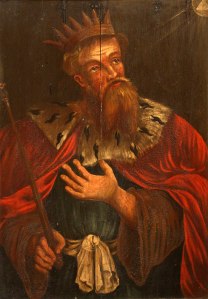
2 Kings 18: 1-8
1 In the third year of King Hoshea son of Elah of Israel, Hezekiah son of King Ahaz of Judah began to reign. 2 He was twenty-five years old when he began to reign; he reigned twenty-nine years in Jerusalem. His mother’s name was Abi daughter of Zechariah. 3 He did what was right in the sight of the LORD, just as his ancestor David had done. 4 He removed the high places, broke down the pillars, and cut down the sacred pole. He broke in pieces the bronze serpent that Moses had made, for until those days the people of Israel had made offerings to it; it was called Nehushtan. 5 He relied on the LORD, the God of Israel, so that there was no one like him among all the kings of Judah after him or among those who were before him. 6 For he held fast to the LORD; he did not depart from following him but kept the commandments that the LORD had commanded Moses. 7 The LORD was with him; wherever he went, he prospered. He rebelled against the king of Assyria and would not serve him. 8 He attacked the Philistines as far as Gaza and its territory, from watchtower to fortified city.
With the northern kingdom of Samaria (Israel) scattered by the Assyrians the remainder of the book of kings focuses on the kings in Jerusalem. Ultimately over the final eight chapters of 2 Kings it will focus on the two paradigmatically good kings, Hezekiah (chapters 18-20) and Josiah (chapters 22-23), in contrast to the kings ‘who do evil in the sight of the LORD. Hezekiah and Josiah are the only kings who are compared to their father David in faithfulness, and Hezekiah ‘held fast’ to the LORD in contrast to Solomon who in his later years ‘held fast’[1] to his foreign wives. (1 Kings 11:2) Hezekiah is viewed as a king who is faithful to God and whose faithfulness ensures that Jerusalem does not suffer the same fate as Samaria. 2 Chronicles 29-32 and Isaiah 36-39 also relate the events of Hezekiah’s reign in a very positive light.
The narrators of 2 Kings and 2 Chronicles view the faithfulness of Hezekiah in his consolidation of worship in the temple in Jerusalem and the elimination of the long-established high places and sacred poles. The high places have failed to be eliminated by previous kings and to the narrator of 2 Kings that has provided a qualification of the faithfulness of any previous king, but now Hezekiah is viewed as an example of the type of king that the LORD expects. Even Nehushtan[2], the bronze serpent on a pole mentioned in Numbers 21, is destroyed to prevent the misuse of this object from the time of Moses. The faithfulness of Hezekiah is also rewarded with success as he both rebels against Assyria and expands his territory into the land of the Philistines. We will explore the impact of this rebellion against Assyria at the end of chapter eighteen and through chapter nineteen, but this introduction to the reign of Hezekiah’s twenty-nine year reign ends on a high note.
2 Kings 18: 9-12
9 In the fourth year of King Hezekiah, which was the seventh year of King Hoshea son of Elah of Israel, King Shalmaneser of Assyria came up against Samaria, besieged it, 10 and at the end of three years took it. In the sixth year of Hezekiah, which was the ninth year of King Hoshea of Israel, Samaria was taken. 11 The king of Assyria carried the Israelites away to Assyria and settled them in Halah, on the Habor, the river of Gozan, and in the cities of the Medes, 12 because they did not obey the voice of the LORD their God but transgressed his covenant—all that Moses the servant of the LORD had commanded; they neither listened nor obeyed.
This brief reminder of the Assyrian conquest of Samaria places the disaster of the northern kingdom in its place between the fourth and sixth year of Hezekiah. Most commentaries will note a struggle with the chronology here and in the following section since Samaria is destroyed in 722/721 BCE and in the following section Sennacherib (705-681 BCE) attacks in the fourteenth year of Hezekiah (believed to be 701 BCE). Ultimately this is a relatively minor instance of numbers not aligning and I do not want to detract from the basic contrast between the kings of the Israelites in the north who did not obey the voice of the LORD their God and Hezekiah who was faithful.
2 Kings 18:13-37
13 In the fourteenth year of King Hezekiah, King Sennacherib of Assyria came up against all the fortified cities of Judah and captured them. 14 King Hezekiah of Judah sent to the king of Assyria at Lachish, saying, “I have done wrong; withdraw from me; whatever you impose on me I will bear.” The king of Assyria demanded of King Hezekiah of Judah three hundred talents of silver and thirty talents of gold. 15 Hezekiah gave him all the silver that was found in the house of the Lord and in the treasuries of the king’s house. 16 At that time Hezekiah stripped the gold from the doors of the temple of the Lord and from the doorposts that King Hezekiah of Judah had overlaid and gave it to the king of Assyria. 17 The king of Assyria sent the Tartan, the Rabsaris, and the Rabshakeh with a great army from Lachish to King Hezekiah at Jerusalem. They went up and came to Jerusalem. When they arrived, they came and stood by the conduit of the upper pool, which is on the highway to the fuller’s field. 18 When they called for the king, there came out to them Eliakim son of Hilkiah, who was in charge of the palace, and Shebnah the secretary, and Joah son of Asaph, the recorder.
19 The Rabshakeh said to them, “Say to Hezekiah: Thus says the great king, the king of Assyria: On what do you base this reliance of yours? 20 Do you think that mere words are strategy and power for war? On whom do you now rely, that you have rebelled against me? 21 See, you are relying now on Egypt, that broken reed of a staff, which will pierce the hand of anyone who leans on it. Such is Pharaoh king of Egypt to all who rely on him. 22 But if you say to me, ‘We rely on the Lord our God,’ is it not he whose high places and altars Hezekiah has removed, saying to Judah and to Jerusalem, ‘You shall worship before this altar in Jerusalem’? 23 Come now, make a wager with my master the king of Assyria: I will give you two thousand horses, if you are able on your part to set riders on them. 24 How then can you repulse a single captain among the least of my master’s servants when you rely on Egypt for chariots and for horsemen? 25 Moreover, is it without the LORD that I have come up against this place to destroy it? The LORD said to me, ‘Go up against this land, and destroy it.’ ”
26 Then Eliakim son of Hilkiah, Shebnah, and Joah said to the Rabshakeh, “Please speak to your servants in the Aramaic language, for we understand it; do not speak to us in the language of Judah within the hearing of the people who are on the wall.” 27 But the Rabshakeh said to them, “Has my master sent me to speak these words to your master and to you and not to the people sitting on the wall, who are doomed with you to eat their own dung and to drink their own urine?”
28 Then the Rabshakeh stood and called out in a loud voice in the language of Judah, “Hear the word of the great king, the king of Assyria: 29 Thus says the king: Do not let Hezekiah deceive you, for he will not be able to deliver you out of my hand. 30 Do not let Hezekiah make you rely on the LORD by saying, ‘The LORD will surely deliver us, and this city will not be given into the hand of the king of Assyria.’ 31 Do not listen to Hezekiah, for thus says the king of Assyria: Make your peace with me and come out to me; then every one of you will eat from your own vine and your own fig tree and drink water from your own cistern, 32 until I come and take you away to a land like your own land, a land of grain and wine, a land of bread and vineyards, a land of olive oil and honey, that you may live and not die. Do not listen to Hezekiah when he misleads you by saying, ‘The LORD will deliver us.’ 33 Has any of the gods of the nations ever delivered its land out of the hand of the king of Assyria? 34 Where are the gods of Hamath and Arpad? Where are the gods of Sepharvaim, Hena, and Ivvah? Have they delivered Samaria out of my hand? 35 Who among all the gods of the countries have delivered their countries out of my hand, that the LORD should deliver Jerusalem out of my hand?”
36 But the people were silent and answered him not a word, for the king’s command was, “Do not answer him.” 37 Then Eliakim son of Hilkiah, who was in charge of the palace, and Shebna the secretary, and Joah son of Asaph, the recorder, came to Hezekiah with their clothes torn and told him the words of the Rabshakeh.
This critical moment in the story of Zion is related here and in Isaiah 36. For both 2 Kings and Isaiah the implication of this story is clear, that God protected the city. The faithfulness of the people under Hezekiah leads God to intervene on behalf of the city and the people and Jerusalem, unlike Samaria, will be spared. In a David and Goliath type of moment the small kingdom of Judah resists the seemingly irresistible empire of Assyria.
Alex Israel gives a good summary of the events preceding Assyria’s actions against King Hezekiah and Jerusalem:
The death of an emperor always presented an opportunity for revolt, but the circumstances of Sargon’s death, widely seen as a bad omen for Assyria, exacerbated the unrest. Rebellion broke out at both extremities of the sprawling empire. East of Assyria, in Babylonia, Merodach-baladan (known in Kings as Berodach-baladan) crowned himself as ruler. In the West, Judah allied itself with Philistia and Egypt in rejecting Assyrian power. Since Kings records that Berodach visited Hezekiah in Jerusalem (II Kings 20: 12-13), it is probable that the resistance efforts in the East and the West were coordinated. Israel 289
During the roughly two decades since the destruction of Samaria we know that Hezekiah has been active both in attempting to strengthen the defenses of Jerusalem and has ensured that the city has an adequate water supply by cutting tunnels to carry the waters of the Gihon spring to the Siloam Pool. (Cogan, 1988, p. 221) The Philistine cities Hezekiah attacked in verse eight may have been those loyal to Assyria to secure this Philistine-Egyptian-Judah alliance on the western side of Assyria. Yet, when Assyria under Sennacherib attempts to regain control of the portions of its empire in rebellion it overwhelms the fortified cities of Judah and stands at the gates of Jerusalem where this challenge is issued.
King Hezekiah does attempt to appease the Assyrian king by submitting to a tribute of three hundred talents of silver and thirty talents of gold[3] and Hezekiah empties the treasuries and strips the gold from the temple doorposts, yet the empire is not appeased and the troops of Assyria continue from the conquered city of Lachish to Jerusalem.
The Tartan, the Rabsaris, and the Rabshakeh are three officials of Sennacherib. Tartan is the viceroy who had the authority to act on behalf of Sennacherib, Rabsaris is literally the “chief eunuch”, and Rabshakeh is the “chief cupbearer.” Rabshakeh is the speaker for the emissaries of Sennacherib to the representatives of King Hezekiah, Eliakim the steward of the palace, Shebnah the secretary and Joah the recorder. Rabshakeh speaks both to these representatives but also to the population watching from the walls to weaken the resolve of the defenders and to have people defect from Hezekiah. At the heart of Rabshakeh’s challenge is on what the people and Hezekiah can trust.[4]
Rabshakeh indicates that Egypt is not trustworthy and that any trust placed in their action to deliver will only wound the one who hoped in this weak and unreliable ally. Then Rabshakeh indicates that the people should not trust in the LORD since, in Rabshakeh’s interpretation, the people have at Hezekiah’s insistence removed the very sites that honored the LORD. Then the Rab-shakeh indicates that the presence of the Assyrian army is because the LORD has sent it, an argument that is echoed in Isaiah 10: 5-11. Finally, the people should not trust in Hezekiah to deliver them or when Hezekiah says to ‘trust in the LORD.’ Despite the efforts of Hezekiah to fortify the city, the Rab-shakeh mocks his ineffectual army which could not field two thousand mounted men if Assyria provided the horses. Rabshakeh also states that the gods of the other nations have not prevented Assyria from conquering them, and even if the LORD had not sent Assyria the God of Israel is powerless to prevent the destruction that the army of Assyria portends.
This crisis for the narrator of 2 Kings and Isaiah is more than a military and humanitarian crisis, it is a crisis of trust. Is the God of Israel trustworthy and is Hezekiah, God’s faithful king, trustworthy or does might make right. Can the emissaries of Sennacherib mock God and Jerusalem with impunity or will God intervene on their behalf. The actions of King Hezekiah and the Prophet Isaiah in the following chapter will give a model of faithfulness for future generations and God’s response will prove God’s trustworthiness.
[1] In both cases the Hebrew word dabaq is used for these kings holding fast to either God or their foreign wives.
[2] Nehustan name suggests both the material nehoset, “bronze” and the image nahas, “serpent. (Cogan, 1988, p. 217)
[3] Assyrian records indicate eight hundred talents of silver and thirty talents of gold. (Cogan, 1988, p. 229)
[4] The Hebrew batahta (trust) and derivative forms which are translated security/reliance permeate Rab-shakeh’s speech.
 Sign of the Rose
Pingback: 2 Kings 20 Hezekiah’s Healing and the Babylonian Envoys | Sign of the Rose
Pingback: 2 Kings 25 The End of the First Temple Era in Jerusalem | Sign of the Rose
Pingback: 2 Kings | Sign of the Rose
Pingback: Psalm 125 A Place Where Righteousness Can Flourish | Sign of the Rose