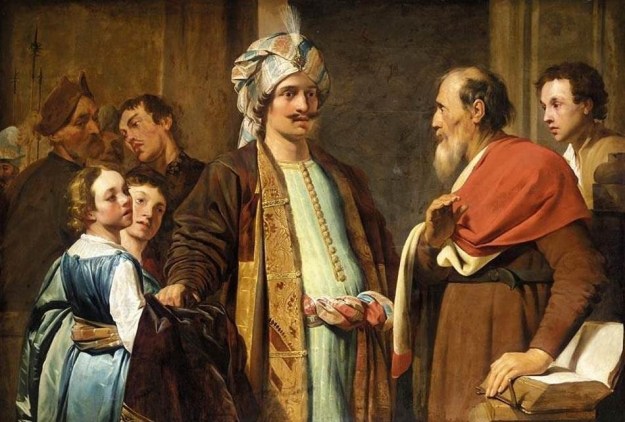
2 Kings 5: 1-19a
1 Naaman, commander of the army of the king of Aram, was a great man and in high favor with his master because by him the Lord had given victory to Aram. The man, though a mighty warrior, suffered from a skin disease. 2 Now the Arameans on one of their raids had taken a young girl captive from the land of Israel, and she served Naaman’s wife. 3 She said to her mistress, “If only my lord were with the prophet who is in Samaria! He would cure him of his skin disease.” 4 So Naaman went in and told his lord just what the girl from the land of Israel had said. 5 And the king of Aram said, “Go, then, and I will send along a letter to the king of Israel.”
He went, taking with him ten talents of silver, six thousand shekels of gold, and ten sets of garments. 6 He brought the letter to the king of Israel, which read, “When this letter reaches you, know that I have sent to you my servant Naaman, that you may cure him of his skin disease.” 7 When the king of Israel read the letter, he tore his clothes and said, “Am I God, to give death or life, that this man sends word to me to cure a man of his skin disease? Just look and see how he is trying to pick a quarrel with me.”
8 But when Elisha the man of God heard that the king of Israel had torn his clothes, he sent a message to the king, “Why have you torn your clothes? Let him come to me, that he may learn that there is a prophet in Israel.” 9 So Naaman came with his horses and chariots and halted at the entrance of Elisha’s house. 10 Elisha sent a messenger to him, saying, “Go, wash in the Jordan seven times, and your flesh shall be restored, and you shall be clean.” 11 But Naaman became angry and went away, saying, “I thought that for me he would surely come out and stand and call on the name of the LORD his God and would wave his hand over the spot and cure the skin disease! 12 Are not Abana and Pharpar, the rivers of Damascus, better than all the waters of Israel? Could I not wash in them and be clean?” He turned and went away in a rage. 13 But his servants approached and said to him, “Father, if the prophet had commanded you to do something difficult, would you not have done it? How much more, when all he said to you was, ‘Wash, and be clean’?” 14 So he went down and immersed himself seven times in the Jordan, according to the word of the man of God; his flesh was restored like the flesh of a young boy, and he was clean.
15 Then he returned to the man of God, he and all his company; he came and stood before him and said, “Now I know that there is no God in all the earth except in Israel; please accept a present from your servant.” 16 But he said, “As the LORD lives, whom I serve, I will accept nothing!” He urged him to accept, but he refused. 17 Then Naaman said, “If not, please let two mule loads of earth be given to your servant, for your servant will no longer offer burnt offering or sacrifice to any god except the Lord. 18 But may the LORD pardon your servant on one count: when my master goes into the house of Rimmon to worship there, leaning on my arm, and I bow down in the house of Rimmon, when I do bow down in the house of Rimmon, may the LORD pardon your servant on this one count.” 19 He said to him, “Go in peace.”
The healing of Naaman, along with Elijah’s ascent in the whirlwind, are probably the two best-known and most frequently used stories from 2 Kings in the life of the church. This story, along with Elijah’s provision of meal and oil for the widow of Zarephath, is utilized in Luke 4:27 as an explanation for the expansiveness of Jesus’ ministry, but it is also paired with Jesus’ healing of lepers in the gospels. Naaman is both the victorious mighty warrior who occupies a privileged position with the king of Aram and has servants and slaves along with the access to considerable wealth and power, but in Israel he is also a Gentile, an unclean one, and an oppressor. The story illustrates the fundamental differences between the world envisioned by the king of Aram and Naaman at the beginning of the story and the prophet Elisha when he enters in the middle of the story.
The position of Naaman, in the view of 2 Kings, is a result of the LORD the God of Israel granting him victory leading the Arameans. On the one hand this provides an explanation for the defeat of Israel by a foreign power, the defeat is a judgment on the unfaithfulness of Samaria. On the other hand, it makes the mighty warrior subject, unknowingly at the beginning of the story, to the LORD the God of Israel. Even a captive young woman from Israel knows what this mighty warrior cannot, that the hope for healing resides in Samaria. This young woman who is a captive and the mighty man who is a leader of armies may be on opposite sides of the power differential but in the story they are linked. Captured slaves often have an unfavorable view of their masters, yet in Naaman throughout the story we see that this mighty man is both respected enough by his servants for them to speak truthfully and compassionately to him and Naaman as their master listens. The commander of warriors who can deliver victories depends upon the knowledge willingly shared by a captured young woman residing in his household.
The skin disease which has been traditionally translated as leprosy is probably not what we today categorize as leprosy (or Hansen’s disease) but it was something that ancient cultures took very seriously. Leviticus 13-14 deals with the priestly role in the diagnosis, the social implications for a person diagnosed with this skin disorder and the method that they can also be reintegrated into the community once they are healed. The seriousness of the disease can be demonstrated by the incredible amount of wealth (ten talents of silver, six thousand shekels of gold, and ten sets of garments)[1] which the king of Aram sends to the king of Israel to bring about the healing of his favored commander.
In the ancient world there was no concept of separation of religious and state powers. For most ancient kings, even in Israel, there are religious figures including prophets in the royal court. The prophet Nathan was involved in the court of king David, and earlier in the Omri dynasty we saw the conflict between the prophets who spoke favorably to king Ahab and Micaiah who was a faithful prophet of the LORD but not in royal favor. As Alex Israel notes about the contrasting views of prophets between the kings of Aram and Israel:
The king of Aram was incapable of imagining a scenario in which the prophet would not be fundamentally subordinate to the king, and so he sought the prophet by means of the latter. By contrast, the king of Israel couldn’t conceive a situation in which the prophet would be responsive to his control, and so he failed to entertain the prospect of appealing to Elisha! (Israel, 2019, p. 98)
The king of Aram views the king of Israel as his subordinate who he can command, but Elisha does not answer to the king of Israel. Yet, Elisha does hear of the king’s distress and instructs him to send Naaman to him.
Naaman has probably encountered other healers and prophets in Damascus who attempted to heal his skin disease, and he has ideas of how that process should look for a person of his station. As a person of high status, he anticipated personal attention from the prophet. His status as a mighty warrior and commander of the armies of Aram have allowed him to be a person who is able to fulfill their request, but now he finds that this status means nothing before the prophet, and he is reduced to a “supplicant who comes to the healer as a leper.” (Brueggemann, 2000, p. 334) Yet, as previously we saw with the young woman from Israel, Naaman is a master who his servants are willing to speak to in an honest and compassionate way. Once Naaman has completed his complaint about the command delivered by an emissary to wash in the Jordan, his servants are able to convince him that the prophet has not asked a hard thing, and it is in Naaman’s interest to attempt this novel cure.
The washing in the Jordan results in Naaman’s skin becoming like a young boy. The description of Naaman’s skin utilizing the masculine form of the words used to describe the young girl at the beginning of the story now link the two together. In some way Naaman is now like this enslaved young woman even though they occupy vastly different places in the social hierarchy. Both stand in a place of dependency before God and Naaman has not only learned that there is a prophet in Samaria, but that there is no God in all the earth except in Israel.
After the healing Naaman stands, with all his company before the prophet Elisha. Naaman attempts to offer payment, but Elisha swears that he will take no payment.[2] Naaman then makes two requests when payment continues to be refused. First Naaman requests to take two mule loads of earth. Naaman likely believes that the God of Israel is tied to the land of Israel and bringing the earth will allow him to build an altar or worship space where he can access this God whom he has discovered. Secondly, he requests that in his state functions that God would not hold it against him when he escorts his master into the worship space of Rimmon, the god of Damascus. Elisha does not judge Naaman for these requests and instructs him to depart in shalom.
2 Kings 5: 19b-27
But when Naaman had gone from him a short distance, 20 Gehazi, the servant of Elisha the man of God, thought, “My master has let that Aramean Naaman off too lightly by not accepting from him what he offered. As the LORD lives, I will run after him and get something from him.” 21 So Gehazi went after Naaman. When Naaman saw someone running after him, he jumped down from the chariot to meet him and said, “Is everything all right?” 22 He replied, “Yes, but my master has sent me to say, ‘Two members of a company of prophets have just come to me from the hill country of Ephraim; please give them a talent of silver and two changes of clothing.’ ” 23 Naaman said, “Please accept two talents.” He urged him and tied up two talents of silver in two bags, with two changes of clothing, and gave them to two of his servants, who carried them in front of Gehazi. 24 When he came to the citadel, he took the bags from them and stored them inside; he dismissed the men, and they left.
25 He went in and stood before his master, and Elisha said to him, “Where have you been, Gehazi?” He answered, “Your servant has not gone anywhere at all.” 26 But he said to him, “Did I not go with you in spirit when someone left his chariot to meet you? Is this a time to accept silver and to accept clothing, olive orchards and vineyards, sheep and oxen, and male and female slaves? 27 Therefore the skin disease of Naaman shall cling to you and to your descendants forever.” So he left his presence diseased, as white as snow.
The stories of the previous chapter seem to indicate that the company of prophets (or sons of the prophets) continually struggle with poverty and this may inform Gehazi’s action contrary to his master Elisha. As Choon-Leong Seow remarks, “the faithfulness of Naaman’s slave girl at the beginning of the story stands in stark contrast to the treachery of Elisha’s servant at the end of the chapter.” (NIB III:192) While Elisha swore an oath (“as the LORD lives”) that he would accept no gift (literally blessing) from Naaman his servant Gehazi swears an oath that he will take something from this Gentile. Gehazi runs after Naaman’s party and Naaman, after dismounting his chariot asks, “Is all shalom?” Gehazi gives a reason for wanting a blessing/payment from Naaman, which Naaman is eager to grant giving double the initial request. For Naaman this is far less than the ten talents of silver he was willing to pay as payment for healing, but the roughly one hundred fifty pounds of silver with two sets of garments[3] which two of Naaman’s servants carry back to the citadel would be an incredible amount of wealth among the company of prophets. Yet, Gehazi’s secret is known by Elisha and the Hebrew indicates that Elisha’s heart went with Gehazi (NRSV ‘spirit’). Silver and clothing, land and livestock, servants and slaves for the company of the prophets is not where their security comes from. Gehazi has trusted in the same things that the king of Aram and Naaman trusted, and Elisha indicates that now Naaman’s skin disease will cling to Gehazi and his descendants.
The healing of Naaman does not end the conflict between Aram and Samaria which will continue in the narrative of the next two chapters. It is also not the end of Gehazi’s role in the story who will reappear in chapter eight. It is possible that the healing of Naaman is brought forward in the story to be a part of an Elisha cycle of miracles which reaches its peak with the thwarting of the king of Aram’s invasion of Israel. The king of Israel’s inability to heal his servant did not provide the provocation for a continued war, but ultimately the healing of Naaman did not end the conflict between Samaria and Damascus.
[1] The NIV notes that 10 shekels of silver is about 750 lbs (340 kg) of silver and 6,000 shekels of gold is about 150 lbs (70 kg).
[2] Numbers 22:18 and Daniel 5:17 are both times where two very different prophets (Balaam and Daniel) indicate that gold will not be acceptable to earn favor or as payment for a servant of the LORD.
[3] Garments in the ancient world are also expensive and an indicator of wealth.
 Sign of the Rose
Pingback: 2 Kings 6: 1-23 Floating Iron and Opened Eyes | Sign of the Rose
Pingback: 2 Kings 6:24-7:20 The Siege and Deliverance of Samaria | Sign of the Rose
Pingback: 2 Kings 8 Transitioning from Prophetic Time to a Major Transition in Royal Time | Sign of the Rose
Pingback: 2 Kings | Sign of the Rose