2 Kings 1
1 After the death of Ahab, Moab rebelled against Israel. 2 Ahaziah had fallen through the lattice in his upper chamber in Samaria, and lay injured; so he sent messengers, telling them, “Go, inquire of Baal-zebub, the god of Ekron, whether I shall recover from this injury.” 3 But the angel of the LORD said to Elijah the Tishbite, “Get up, go to meet the messengers of the king of Samaria, and say to them, ‘Is it because there is no God in Israel that you are going to inquire of Baal-zebub, the god of Ekron?’ 4 Now therefore thus says the LORD, ‘You shall not leave the bed to which you have gone, but you shall surely die.'” So Elijah went.
5 The messengers returned to the king, who said to them, “Why have you returned?” 6 They answered him, “There came a man to meet us, who said to us, ‘Go back to the king who sent you, and say to him: Thus says the LORD: Is it because there is no God in Israel that you are sending to inquire of Baal-zebub, the god of Ekron? Therefore you shall not leave the bed to which you have gone, but shall surely die.'” 7 He said to them, “What sort of man was he who came to meet you and told you these things?” 8 They answered him, “A hairy man, with a leather belt around his waist.” He said, “It is Elijah the Tishbite.”
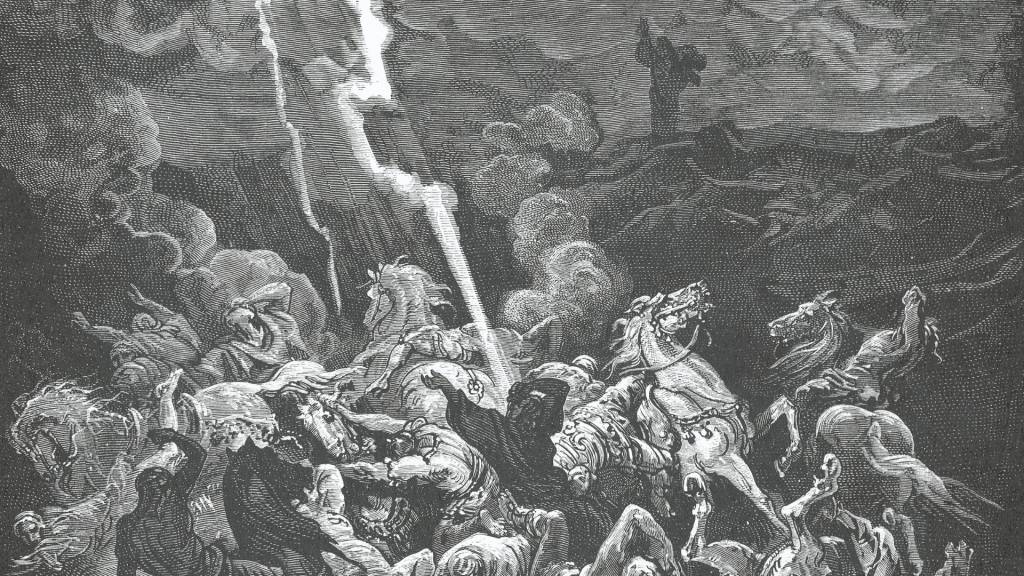
9 Then the king sent to him a captain of fifty with his fifty men. He went up to Elijah, who was sitting on the top of a hill, and said to him, “O man of God, the king says, ‘Come down.'” 10 But Elijah answered the captain of fifty, “If I am a man of God, let fire come down from heaven and consume you and your fifty.” Then fire came down from heaven, and consumed him and his fifty.
11 Again the king sent to him another captain of fifty with his fifty. He went up and said to him, “O man of God, this is the king’s order: Come down quickly!” 12 But Elijah answered them, “If I am a man of God, let fire come down from heaven and consume you and your fifty.” Then the fire of God came down from heaven and consumed him and his fifty.
13 Again the king sent the captain of a third fifty with his fifty. So the third captain of fifty went up, and came and fell on his knees before Elijah, and entreated him, “O man of God, please let my life, and the life of these fifty servants of yours, be precious in your sight. 14 Look, fire came down from heaven and consumed the two former captains of fifty men with their fifties; but now let my life be precious in your sight.” 15 Then the angel of the LORD said to Elijah, “Go down with him; do not be afraid of him.” So he set out and went down with him to the king, 16 and said to him, “Thus says the LORD: Because you have sent messengers to inquire of Baal-zebub, the god of Ekron,– is it because there is no God in Israel to inquire of his word?– therefore you shall not leave the bed to which you have gone, but you shall surely die.”
17 So he died according to the word of the LORD that Elijah had spoken. His brother, Jehoram succeeded him as king in the second year of King Jehoram son of Jehoshaphat of Judah, because Ahaziah had no son. 18 Now the rest of the acts of Ahaziah that he did, are they not written in the Book of the Annals of the Kings of Israel?
This final prophetic episode in the Elijah cycle prior to the ascension of Elijah in the following chapter occurs during the year long reign of Ahaziah.[1] The division between 1 Kings and 2 Kings splits the comments on the brief reign of Ahaziah between the final three verses of 1 Kings and the initial chapter of 2 Kings. Ahaziah’s insignificant reign cut short by his injury and offense against God are contrasted with the significant prophet Elijah’s final action. The Book of Kings could easily have been the Book of Prophets, since for most of the book the kings are often secondary characters to the prophets.
Ahaziah fell from his upper chamber to the lower floor and is injured by the fall and confined to his bed. Yet, Ahaziah’s response to his injury is what dominates his portion of the story. Instead of appealing to the LORD, whether through a prophet or through the temple in Jerusalem he sends messengers to Ekron to appeal to the priests of prophets of Baal-zebub. There has been an ongoing animosity between the leaders in Samaria and Jerusalem, and the Omri dynasty has also been hostile to Elijah and other prophets of the LORD so on the one hand the action of Ahaziah to appeal to a foreign god, even a god of the once hostile Philistines, is not out of character for the Omri dynasty. Yet it is an audacious slight of the LORD the God of Israel, one that will have fatal consequences for this insignificant king.
Baal-zebub, the title for the god of Ekron would be the lord of the flies, and this is likely an intended insult of Baal-zebul the lord of the house. This is reflected title Beelzebul in the New Testament when Jesus is accused of being in lead with the lord of demons.[2] This minor spelling change turns the master of the house into the master of something considered a pest and nuisance in the ancient world. It is possible that ‘zebub’ is a local ‘baal’[3] and there is some debate over the rendering of ‘zebub’ as ‘fly’, but the Bible does frequently use insults for the other ‘gods’ that the people of Israel and the surrounding country follow.
Hebrew loves wordplay and it helps to know that the word for messenger (malakh) and angel (malakim) are closely related. Ahaziah sends messengers and the messenger of the LORD comes to Elijah to intercept these messengers of the king. Elijah’s message from the messenger (angel) of God speaks directly to the king’s messengers, “Is it because there is no God in Israel that you (plural) are going to inquire of Baal-zebub, the god of Ekron?” But when the king’s messengers return to the king they now point the blame on the king, “Is it because there is no God in Israel that you (singular) are sending to inquire of Baal-zebub, the god of Ekron?” The sentence declared on the king is terminal by the LORD. As Brueggemann states:
The particular phrase, “surely die,” is repeated three times by the prophet (1:4, 6, 16). While the phrase looks commonplace in the English translation, it is in fact a quite severe, absolute, and formal pronouncement of a death penalty from which there is no escape or reprieve. (Brueggemann, 2000, p. 284)
From the description of the man who intercepted the prophets, a hairy man with a leather belt around his waist, the king realizes that it is the longtime foe of the Omri dynasty, the prophet Elijah. Elijah’s successor Elisha we will learn in 2:23 is bald and so there is a drastic difference in the appearance of the hairy man and the man ridiculed for being bald. The description of Elijah will also be paralleled, although in an inexact manner, by the appearance of John the Baptist at the beginning of the gospels.[4] Elijah and Elisha will be different in appearance and as we transition to the Elisha cycle it will be worthwhile to compare the ministries of these two prophets.
The king views Elijah as a threat and sends three separate leaders and soldiers to bring Elijah down from the mountain.[5] The king desires to bring Elijah down by force but only manages to cause Elijah to bring down the fire of God upon his forces.[6] The first commander of fifty goes up the mountain to approach Elijah and orders the man of God to come down, yet Elijah demonstrates that the forces of the king are no match for the power of God as the first group of fifty is consumed. The second leader goes up to Elijah, but he may not go up the mountain. There may be some hint in the story that this second commander keeps his distance, but his words indicate that now the king orders Elijah to come down. The second group of fifty meets the same fate as the first. The final commander comes and kneels before the prophet and asks the prophet to show grace[7] for his life and the lives of his men. This final commander also indicates that he is Elijah’s servant instead of the king’s. The messenger (angel) of the LORD lets Elijah know it is safe to go with this commander to deliver the message directly to the king.
For the narrative of 2 Kings, King Ahaziah dies because of the declaration of the LORD not the injuries the king receives falling through the lattice. Throughout the Elijah cycle the people under the Omri dynasty have had divided loyalties. Elijah is an uncompromising in his zeal for the LORD the God of Israel and although the Omri will continue beyond the time of Elijah, it is quickly coming to end. Ahaziah in the narrative of the Book of Kings will be one more king whose brief reign in Samaria will be defined by his disobedience to the LORD the God of Israel.
[1] 1 Kings 22:51 notes that Ahaziah ruled for two years. He came to power in the seventeenth year of Jehoshaphat of Judah and died in his eighteenth year, but his total reign was less than twelve months long. (Cogan, 1988, p. 21)
[2] Matthew 10:25; 12: 24,27; Mark 3:22; Luke: 11: 15, 18, 19.
[3] Baal is a general title for lord, and there were multiple ‘Baals’ worshipped regionally throughout Canaan.
[4] John is wearing camel’s hair as clothing rather than being described as hairy, although he does have the leather belt around his waist.
[5] Choon-Leong Seow notes that the same word har is used here as a Mount Carmel and the NIV and NRSV translation of this as ‘hill’ obscures the linkage to the previous story (1 Kings 18). (NIB III:173)
[6] Once again there is a Hebrew wordplay between the word for ‘man’ (‘is) and the word for fire (‘es). NIB III: 173.
[7] NRSV entreat. The Hebrew hanan means “to show grace’. (Brueggemann, 2000, p. 286)
 Sign of the Rose
Pingback: 2 Kings 20 Hezekiah’s Healing and the Babylonian Envoys | Sign of the Rose
Pingback: 2 Kings | Sign of the Rose