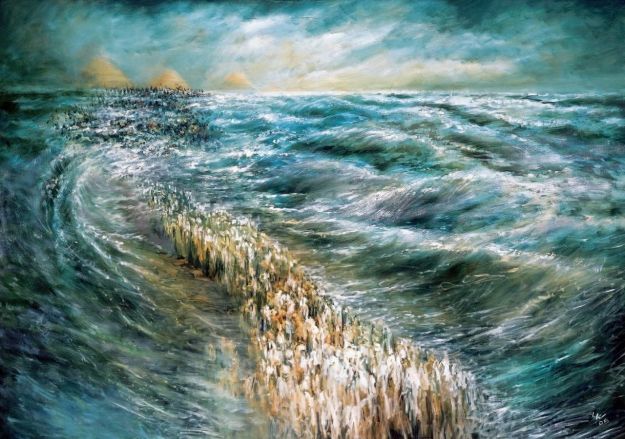
Psalm 114
1 When Israel went out from Egypt, the house of Jacob from a people of strange language,
2 Judah became God’s sanctuary, Israel his dominion.
3 The sea looked and fled; Jordan turned back.
4 The mountains skipped like rams, the hills like lambs.
5 Why is it, O sea, that you flee? O Jordan, that you turn back?
6 O mountains, that you skip like rams? O hills, like lambs?
7 Tremble, O earth, at the presence of the Lord, at the presence of the God of Jacob,
8 who turns the rock into a pool of water, the flint into a spring of water.
This second “Egyptian Hallel” psalm[1] praises the power of the LORD the God of Israel’s being. Throughout this short poem the nations, the waters, and the land all respond and tremble at the LORD’s presence. Nowhere in the poem does God act, except indirectly in the final verse. The background of the poem is the exodus narrative and the creation narrative. The LORD is the God of creation with power over the waters and the mountains, but also the God of the exodus who brought the people out of Egypt and into the promised land.
The poem is built on parallel expressions: Israel/house of Jacob; Judah/Israel; sea/Jordan; mountains/hills; and rock/flint. Each line doubles the reaction using these parallel expressions and intensifies the effect of the poem’s praise. The people’s experience of the power of the LORD goes back to the experience of God taking the people out of Egypt and making them into a sanctuary (Hebrew qados– devoted, set apart) (Nancy deClaisse-Walford, 2014, p. 851) and dominion. The exodus narrative is the obvious reference alluded to throughout the poem and yet in poetic function the event becomes transformed to the creation’s reaction to the presence of the LORD among God’s people.
The opening verse informed the reader of the poem that the reference was the exodus and now in verse three the poet uses a set of parallels to bracket the biblical narrative of the exodus event. The sea which looks and flees from God references the crossing of the Red Sea in Exodus 14 while the crossing of the Jordan once it has turned back references the end of the journey in Joshua 3. The sea and river become things that flee[2] from the LORD’s presence among the people of Israel. The God who exercised control over the deep in creation is now feared by these waters which bracket the story of the exodus.
The mountains and hills, unmoving and permanent, now become like rams and lambs in their rapid motion. Psalm 29 used a similar image of Lebanon and Sirion fleeing before the LORD, even using the same term ‘skip’ although in that psalm the metaphor is a calf and a wild ox. Habakuk also utilizes a similar image of the hills and mountains being shattered and sinking at the appearance of the LORD.[3] This reaction of both the waters and the immovable rock of mountains and hills is caused by the presence of the LORD. The earth models the proper response by trembling.[4] Creation itself models that “The fear of the LORD is the beginning of wisdom” (Psalm 111:10).
Although it should be clear throughout the poem that the people, the waters and the mountains are all responding to the God of Jacob, God is mentioned explicitly for the first time in verse seven.[5] The poem concludes by bringing the imagery of rock and water together with an allusion to God’s provision of water via Moses striking the rock at Rephidim in Exodus 17:1-7. The God who moved over the depths in creation and formed the seas, the rivers, the rocks, hills and mountains becomes known to God’s people who come to know God’s impact on the world as God brings them out of Egypt, providing water in the wilderness, and passing them through the waters of the Jordan into the promised land. The people and the earth tremble before the fearful presence of the LORD in their midst.
[1] Psalm 113-118 are often called the Egyptian Hallel psalms because they are recited on the Passover meal on the eighth day of Passover. They are the psalms used to celebrate God’s actions to take their ancestors out of Egypt.
[2] Psalm 77:16 uses a similar imagery.
[3] Habakkuk 3:6.
[4] Psalm 97:4 also has the earth trembling in reaction to the LORD’s lightning.
[5] In the NRSV in verse 2 God is mentioned in verse 2 when Judah became God’s sanctuary, but the Hebrew is simply Judah became his sanctuary (the third person singular pronoun is attached to qados the word for sanctuary.
 Sign of the Rose
Pingback: The Book of Psalms 1-120 | Sign of the Rose