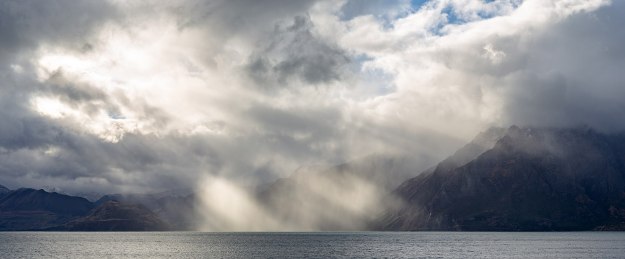
Psalm 104
1Bless the LORD, O my soul. O LORD my God, you are very great. You are clothed with honor and majesty,
2wrapped in light as with a garment. You stretch out the heavens like a tent,
3you set the beams of your chambers on the waters, you make the clouds your chariot, you ride on the wings of the wind,
4you make the winds your messengers, fire and flame your ministers.
5You set the earth on its foundations, so that it shall never be shaken.
6You cover it with the deep as with a garment; the waters stood above the mountains.
7At your rebuke they flee; at the sound of your thunder they take to flight.
8They rose up to the mountains, ran down to the valleys to the place that you appointed for them.
9You set a boundary that they may not pass, so that they might not again cover the earth.
10You make springs gush forth in the valleys; they flow between the hills,
11giving drink to every wild animal; the wild asses quench their thirst.
12By the streams the birds of the air have their habitation; they sing among the branches.
13From your lofty abode you water the mountains; the earth is satisfied with the fruit of your work.
14You cause the grass to grow for the cattle, and plants for people to use, to bring forth food from the earth,
15and wine to gladden the human heart, oil to make the face shine, and bread to strengthen the human heart.
16The trees of the LORD are watered abundantly, the cedars of Lebanon that he planted.
17In them the birds build their nests; the stork has its home in the fir trees.
18The high mountains are for the wild goats; the rocks are a refuge for the coneys.
19You have made the moon to mark the seasons; the sun knows its time for setting.
20You make darkness, and it is night, when all the animals of the forest come creeping out.
21The young lions roar for their prey, seeking their food from God.
22When the sun rises, they withdraw and lie down in their dens.
23People go out to their work and to their labor until the evening.
24O LORD, how manifold are your works! In wisdom you have made them all; the earth is full of your creatures.
25Yonder is the sea, great and wide, creeping things innumerable are there, living things both small and great.
26There go the ships, and Leviathan that you formed to sport in it.
27These all look to you to give them their food in due season;
28when you give to them, they gather it up; when you open your hand, they are filled with good things.
29When you hide your face, they are dismayed; when you take away their breath, they die
and return to their dust.
30When you send forth your spirit, they are created; and you renew the face of the ground.
31May the glory of the LORD endure forever; may the LORD rejoice in his works —
32who looks on the earth and it trembles, who touches the mountains and they smoke.
33I will sing to the LORD as long as I live; I will sing praise to my God while I have being.
34May my meditation be pleasing to him, for I rejoice in the LORD.
35Let sinners be consumed from the earth, and let the wicked be no more. Bless the LORD, O my soul. Praise the LORD!
This psalm and its predecessor are linked by their common opening and closing, “Bless the LORD, O my soul (nephesh).” The pairing of these psalms reminds me of a table prayer that I taught my children as they were growing up, “God is great, God is good, and we thank God for our food.” As Rolf A. Jacobson can state,
Whereas the central theological witness of Psalm 103 is that God is good (that is, the Lord is a God of hesed), the driving witness of Psalm 104 is that God is great. (Nancy deClaisse-Walford, 2014, p. 774)
This psalm looks in doxological wonder at the beauty, majesty, and order of God’s creation and exuberantly pours out praise at the greatness of the God who created the heavens and the earth. Like earlier psalms that marveled in the intricate connections and scale of creation, the psalmist joins their voice as a humble offering amidst the chorus of creation.
When modern people talk of creation our typical mode of thought is scientific and explanatory. The debate between creationists who try to limit God’s creation to the seven days of Genesis 1 and evolutionists arguing for a natural evolution of the universe are both framed by the language of modernity, a language which would be foreign to the scriptures. The biblical way of approaching the creation is the language of poetry and praise, wonder and curiosity. The entire direction of both the biblical narratives of creation in Genesis 1-2 and the places where the bible poetically wonders at the creation is oriented on giving praise, honor, glory, and majesty to the God of creation. This poem shares the characteristic joyfulness of the faithful ones throughout the scriptures reflecting on God’s own joy at the good creation.
Both Psalm 104 and the Genesis narratives utilize and subvert the mythological language found in the creation myths throughout the Middle East. While the Lord’s chambers are established upon the waters, an image of chaos throughout the Middle Eastern mythologies, both Genesis and the Psalms have the LORD bringing order out of chaos in a non-violent manner. Light and heavens, waters and wind, fires and flames, clouds and earth all become ordered to form the dominion of God and all the elements are brought together to build and serve the order of God. The waters rise up like a garment and though they can cover the mountains they flee at God’s rebuke and are bound and contained. The chaotic waters that threatened to flood the earth become the lifegiving seas and waters which provide for the plants of the earth and the animals of the field.
The psalmist delight’s in “God’s superabundant liberality”[1] and imagines God looking with delight upon the majestic creation. The lens of the psalmist begins his reflection on the works[2] of God’s hands with agricultural images that would likely be closest to their daily experience. God causes grass to grow for cattle, and plants that people harvest that bring forth the food that people eat. God is great and God is good, and they thank God for the food that God provides. God provide for the necessities of life but also for the joyous things: wine to gladden the human heart, oil for the human face, and bread to strengthen the heart.[3] Yet, the reflection on the works of God do not end with the immediate benefits for human society. God provides for the trees and the birds that live in them, wild goats and rabbits. There is a time for everything, daytime and nighttime for humanity and the creatures of the forest, days marked by the sun and seasons marked by the moon. The lion, the representative great beast of the forest, humanity works in the city and fields, and Leviathan the great beast of the sea all joins in the noise of creation calling out to God. Leviathan, the great chaos monster that was a threat to the gods in other societies, is now merely a plaything of the LORD. The great lion of the forest and the dragon of the sea have been tamed by the creating LORD upon whom both depend. Lion, humanity, and Leviathan all know that God is great, and God is good, and it is the LORD who they thank for the food that God provides in due season.
Yet, the creation is dependent upon God’s continual attention and sustainment. Hebrew thought has no conception of the modern image of a god who created the universe as a clockmaker creates a clock, winds it up and then departs. The creation remains dependent upon God’s face being turned towards it and God’s breath[4] residing within and animating the creature. Humanity and all creation are completely dependent upon the continued provision of the LORD which animates the creatures and renews the face of the ground. The face of the ground looks up in adoration at the face of the LORD which provides for it. The earth trembles at the attention of the LORD and the touch of God’s finger upon the mountain causes them to smoke.
The psalmist sings his song amid the majesty of creation as an offering to the LORD. The penultimate line where the psalmist asks for “sinners to be consumed from the earth, and let the wicked be not more” may seem like a discordant note to end the psalm with, but within the ordered world of creation and God’s justice and righteousness there is no space for those who undermine the order of creation. Hebrew wisdom does separate good from evil, righteous from sinners, wise from foolish, and the faithful from the wicked. Yet, the LORD is both good and great, providing life, food, and joy for all of creation, and the psalmists humble meditation tries to with their humble offering of praise to bring a little joy to the creator. Their whole life[5] is involved with blessing and praising the good and great God of creation.
Cecil Alexander’s joyous song “All Things Bright and Beautiful” echoes the emotion and orientation of this psalm:
All things bright and beautiful, all creatures great and small, all things wise and wonderful, the Lord God made them all.
And in the final verse of this song, after reflecting on creation from the smallness of flowers to the majesty of the mountains, Cecil Alexander’s words come back to the human standing amid the wonders of God’s works:
God gave us eyes to see them, and lips that we might tell how great is God Almighty, who has made all things well.
Or in the words of the psalmist, Bless the LORD, O my soul (nephesh). Praise the LORD. May our eyes, lips, and entire being continually live in wonder at the greatness of the creation that God’s hands formed, at the faithfulness of God continuing to look upon the face of the earth and sending forth the ruach (wind, spirit, breath) which continues to animate and sustain the creation and to respond in praise.
[1] John Calvin’s term. (Bellinger, 2014, p. 446)
[2] Works, Hebrew ‘asa, is an important concept in the poem which is sometimes translated make (s)/made (v. 4, 19, 24b) and other times as works (v. 13, 31). (NIB VI: 1096)
[3] Worth noting that the heart in Hebrew is not the instrument of emotion but of will and decision.
[4] This is the Hebrew ruach which can also mean spirit or wind. All creation in both Genesis 1 and Psalm 104 is dependent upon the ruach which originates in God. English translates ruach as breath and spirit in successive verses obscuring this connection.
[5] Hebrew nephesh is not simple the Greek concept of soul but encompasses all of life.
 Sign of the Rose
Pingback: Psalm 105 Give Thanks to the Faithful God of Our Story | Sign of the Rose
Pingback: The Book of Psalms 1-120 | Sign of the Rose