Ezekiel 47: 1-12 The Renewing Waters from the Temple
1Then he brought me back to the entrance of the temple; there, water was flowing from below the threshold of the temple toward the east (for the temple faced east); and the water was flowing down from below the south end of the threshold of the temple, south of the altar. 2Then he brought me out by way of the north gate, and led me around on the outside to the outer gate that faces toward the east; and the water was coming out on the south side.
3Going on eastward with a cord in his hand, the man measured one thousand cubits, and then led me through the water; and it was ankle- deep. 4Again he measured one thousand, and led me through the water; and it was knee-deep. Again he measured one thousand, and led me through the water; and it was up to the waist. 5Again he measured one thousand, and it was a river that I could not cross, for the water had risen; it was deep enough to swim in, a river that could not be crossed. 6He said to me, “Mortal, have you seen this?”
Then he led me back along the bank of the river. 7As I came back, I saw on the bank of the river a great many trees on the one side and on the other. 8He said to me, “This water flows toward the eastern region and goes down into the Arabah; and when it enters the sea, the sea of stagnant waters, the water will become fresh. 9Wherever the river goes, every living creature that swarms will live, and there will be very many fish, once these waters reach there. It will become fresh; and everything will live where the river goes. 10People will stand fishing beside the sea from En-gedi to En-eglaim; it will be a place for the spreading of nets; its fish will be of a great many kinds, like the fish of the Great Sea. 11But its swamps and marshes will not become fresh; they are to be left for salt. 12On the banks, on both sides of the river, there will grow all kinds of trees for food. Their leaves will not wither nor their fruit fail, but they will bear fresh fruit every month, because the water for them flows from the sanctuary. Their fruit will be for food, and their leaves for healing.
Ezekiel’s vision of a renewed society starts with the temple, but then from the temple it flows out to a renewed land and people. This vision of a life-giving stream that flows from the temple may originate in the imagery of the Garden of Eden in Genesis 2:10-14 where a river flows from through the garden providing life for both the flora and fauna of creation. This imagery is picked up in Psalm 46:4 and centered in Zion when that poet writes: “There is a river whose streams make glad the city of God, the holy habitation of the Most High.” This vision of Ezekiel adopts this stream flowing out of Zion and fixes its source as the holy habitation of the Most High, specifically the threshold of the temple becomes the source of this bubbling spring of renewing waters which bring life to dead waters and desiccated lands. A renewed temple where God’s presence dwells is the source of life for the renewed land.
This image of comfort is one of the portions of Ezekiel that would have the greatest reach in later years, but for a people who had been through the destruction of their home and their hope was a potent vision. As Daniel Block can state:
This marvelous picture of renewal would have stirred the heart of any true Israelite, especially one who had lived through the desolation of Judah and spent many years in exile. (Block, 1998, p. 690)
The people of Judah and Israel have no reason to believe that they can be recreated as a people unless the LORD acts in new and creative ways. Here Ezekiel joins with Jeremiah, Isaiah, and other prophets in viewing a land recreated by the God of Israel. This impossible stream which in the span of a little more than a mile and a quarter moves from a trickling flow bubbling up from the foundation to a stream too deep to wade across defies everything that water should be able to do, and yet this impossible stream can only occur within the world made possible by their God.
Daniel Block is correct from a logical point of view that everything about this stream is unrealistic: streams do not grow from a bubbling source to water too deep to cross without tributaries, nor do they come from temple thresholds or flow uphill. Freshwater when it encounters water that is too salty for life becomes fouled rather than renewing the larger body of water. (Block, 1998, pp. 700-701) Yet, the impossibility of this stream is part of the imaginative power of this image, for this is the image of a God who is doing a new thing and making streams of water to flow in the desert.[1] These miraculous waters which bubble up from the temple threshold and rapidly accumulate depth and volume as they proceed away from their source bringing vegetation to the wastelands and renewing the waters of the Dead Sea can only be an act of the creating God. The path from the temple to the Arabah would require the waters to pass over or through the Mount of Olives and a series of valleys and mountain ranges. Perhaps Ezekiel imagines a scene like Zechariah 14: 4 where the Mount of Olives is split in two which would allow the river to proceed through that space, but that is not explicit in this brief image.
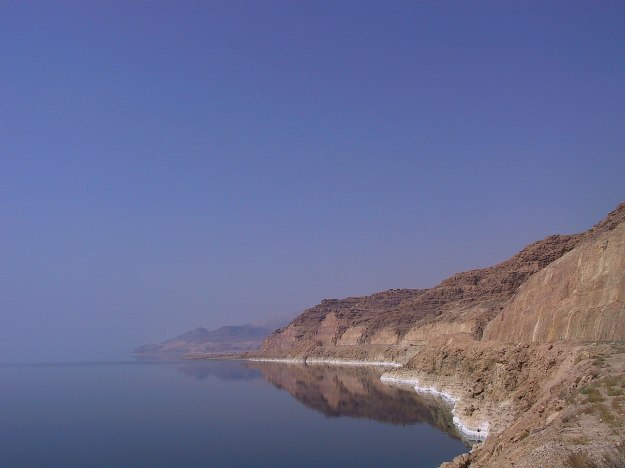
The Dead Sea is the lowest land elevation on earth and its salinity is nine and a half times higher than the ocean. These waters are unable to support life and although salt is a valuable commodity in the ancient world, this place is known for its absence of life. The vision shows the image of the sea and surrounding land revitalized to be a place where fishermen gather food, and the land becomes fruitful. Yet, the marshes[2] still provide valuable salt that can be harvested by the people for preservation, seasoning, and sale.[3] The geographical markers of En-gedi and En-eglaim[4] form a “topographical merismus” (Block, 1998, p. 695) indicating the eastern and western borders of the area and indicating that the entire region is renewed.
This section of Ezekiel resonates with Genesis and the Psalms, but this vision of Ezekiel will have echoes in several other portions of scripture. Among the prophets both Joel 3:18 and Zechariah 14:8 will make a passing reference to water flowing out of the temple or Jerusalem and may be influenced by Ezekiel. In John’s gospel, Jesus will paraphrase scripture saying that, “Out of the believer’s heart shall flow rivers of living water.”[5] It is likely that with John’s imagery that utilizes Jesus as the temple that here Jesus may envision the community of faith as the new temple which these living waters flow out of and may be alluding to Ezekiel 47. The most direct New Testament reference is Revelation 22:1-2 where the water of life flows out of the New Jerusalem and develops Ezekiel’s imagery of trees that continually bear fruit and whose leaves are medicinal. One significant difference between Ezekiel’s and Revelation’s imagery is that in Revelation the living waters, fruit and healing leaves are for the healing of the nations but in Ezekiel there is no indication of any transformation outside of Israel. (NIB VI:1599) Ezekiel’s vision of a renewed temple, a renewed land, and a renewed people emerging out of the devastation of the exile was probably as amazing as this impossible stream that he narrates. Yet, this image of this stream of living water which may have originated in the Garden of Eden will flow through the scriptures to the ultimate chapter of Revelation as God work of healing and renewal reaches its culmination.
Ezekiel 47: 13-23 The Boundaries of the Land
13Thus says the Lord GOD: These are the boundaries by which you shall divide the land for inheritance among the twelve tribes of Israel. Joseph shall have two portions. 14You shall divide it equally; I swore to give it to your ancestors, and this land shall fall to you as your inheritance.
15This shall be the boundary of the land: On the north side, from the Great Sea by way of Hethlon to Lebo-hamath, and on to Zedad, 16Berothah, Sibraim (which lies between the border of Damascus and the border of Hamath), as far as Hazer-hatticon, which is on the border of Hauran. 17So the boundary shall run from the sea to Hazar-enon, which is north of the border of Damascus, with the border of Hamath to the north. This shall be the north side.
18On the east side, between Hauran and Damascus; along the Jordan between Gilead and the land of Israel; to the eastern sea and as far as Tamar. This shall be the east side.
19On the south side, it shall run from Tamar as far as the waters of Meribath-kadesh, from there along the Wadi of Egypt to the Great Sea. This shall be the south side.
20On the west side, the Great Sea shall be the boundary to a point opposite Lebo-hamath. This shall be the west side.
21So you shall divide this land among you according to the tribes of Israel. 22You shall allot it as an inheritance for yourselves and for the aliens who reside among you and have begotten children among you. They shall be to you as citizens of Israel; with you they shall be allotted an inheritance among the tribes of Israel. 23In whatever tribe aliens reside, there you shall assign them their inheritance, says the Lord GOD.
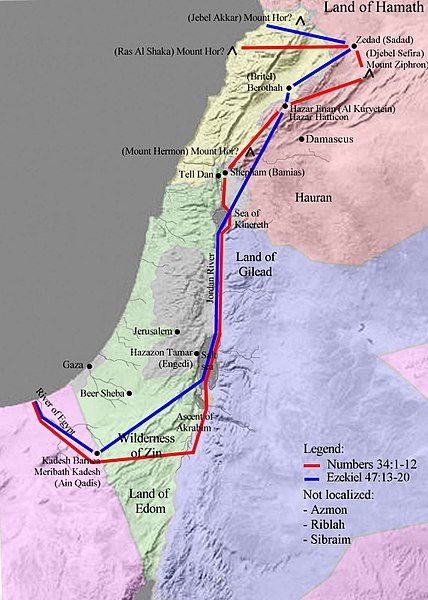
For most readers this section describing the territory of the renewed Israel is a place where a picture is worth one thousand words. Yet, there is an important caveat that any pictorial representation of Ezekiel’s map of Israel is an educated guess because many of the place, especially along the northern border cannot be identified with any certainty. Ezekiel does generally follow the Mosaic description of the land in Numbers 34: 3-12, even though the order of describing the boundaries is different (SWNE in Numbers, NESW in Ezekiel). Like Numbers, Ezekiel excludes the Transjordanian originally occupied by Gad, Reuben and one half of the tribe of Manasseh and the holy land stops at the Jordan. (Block, 1998, p. 716) The northern boundary of Lebo-hamath[6] to the southern boundary of the Wadi of Egypt is the northern and southern border of Solomon’s Kingdom (1 Kings 8:65) and this recreated land for the people recreates Israel at its peak.
The reconstruction of the land and people of Israel is as incredible as the stream that flows from the temple, crosses mountains, swells in depth, and renews the Arabah. At this point Northern Israel, sometimes called Samaria or Ephraim, has been scattered throughout the former Assyrian empire for two and a half centuries and has been separated from Judah for almost four centuries by the time the first remnants of Judah return to Jerusalem in the time of Cyrus the Great. Even Judah has been brought in exile to Babylon with some portions of the population fleeing to Egypt and others likely scattered across the empire. The recreation of Israel is not a creation ex nihlo[7] but it is a resurrection of a people long imagined as a dead stump, leaderless and lost.
The loss and dispersal of the people may be the reason that there is a space for the gerim, the “resident aliens” to be incorporated into the people and the tribes. Leviticus 19: 33-34 prohibits the resident alien from being oppressed and the people are commanded to treat these aliens like they treat themselves in remembrance of their time as aliens in Egypt. We don’t know how these people were treated throughout the history of Israel, but even Ezekiel seems to have viewed them through the lens of Leviticus 19. In Ezekiel 14:7 these aliens are held to the same standard as the people of Judah in relation to idol worship and in Ezekiel 22 they are listed with the vulnerable members of society: the widows and orphans, the poor and needy who are exploited by the residents and leaders of the bloody city.[8] As Daniel Block remarks, Ezekiel takes the fringe territories of Numbers 35: 13-15 and replaces them with a fringe people. (Block, 1998, p. 717) With the loss of connection between the tribes and the loss of population due to both war and scattering, these aliens now become citizens owning land in the tribes that are now their tribe and whose inheritance they share. They become grafted onto the vine of Israel and are a new growth among the recreated people.
[1] Isaiah 43:19.
[2] Daniel Block indicates this likely refers to the Lashon, a peninsula jutting into the sea from the eastern shore that has shallow waters that are not deep enough for fish to live in. (Block, 1998, p. 695)
[3] Preservation was the primary usage for salt in a world prior to refrigeration. Meats and fishes were packed in salt to prevent their spoilage. Salt was a heavily traded commodity in the ancient world and was so essential that our word ‘salary’ evolved from the Roman soldier’s allowance to buy salt.
[4] The location of En-eglaim is less certain, (NIB VI:1596) but most scholars believe Ezekiel intends to indicate opposite ends of the region of the Dead Sea.
[5] John 7:38.
[6] Jeroboam II also restores this border for Northern Israel in 2 Kings 14:25, yet this is during the divided kingdom but Lebo-hamath seem to be the northern edge of the territory Israel manages to secure during its history.
[7] Creation from nothing.
[8] Ezekiel 22:7, 29.
 Sign of the Rose
Pingback: Revelation 22 Amen. Come, Lord Jesus | Sign of the Rose