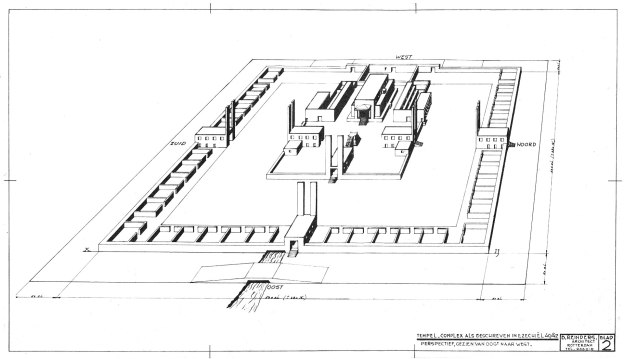

Ezekiel 42:1-14
1 Then he led me out into the outer court, toward the north, and he brought me to the chambers that were opposite the temple yard and opposite the building on the north. 2 The length of the building that was on the north side was one hundred cubits, and the width fifty cubits. 3 Across the twenty cubits that belonged to the inner court, and facing the pavement that belonged to the outer court, the chambers rose gallery by gallery in three stories. 4 In front of the chambers was a passage on the inner side, ten cubits wide and one hundred cubits deep, and its entrances were on the north. 5 Now the upper chambers were narrower, for the galleries took more away from them than from the lower and middle chambers in the building. 6 For they were in three stories, and they had no pillars like the pillars of the outer court; for this reason the upper chambers were set back from the ground more than the lower and the middle ones. 7 There was a wall outside parallel to the chambers, toward the outer court, opposite the chambers, fifty cubits long. 8 For the chambers on the outer court were fifty cubits long, while those opposite the temple were one hundred cubits long. 9 At the foot of these chambers ran a passage that one entered from the east in order to enter them from the outer court. 10 The width of the passage was fixed by the wall of the court.
On the south also, opposite the vacant area and opposite the building, there were chambers 11 with a passage in front of them; they were similar to the chambers on the north, of the same length and width, with the same exits and arrangements and doors. 12 So the entrances of the chambers to the south were entered through the entrance at the head of the corresponding passage, from the east, along the matching wall.
13 Then he said to me, “The north chambers and the south chambers opposite the vacant area are the holy chambers, where the priests who approach the LORD shall eat the most holy offerings; there they shall deposit the most holy offerings — the grain offering, the sin offering, and the guilt offering — for the place is holy. 14 When the priests enter the holy place, they shall not go out of it into the outer court without laying there the vestments in which they minister, for these are holy; they shall put on other garments before they go near to the area open to the people.”
Holy space and holy things are important in the life of a people whose life is centered around a holy God. Holiness is an under appreciated concept in many Christians, particularly in protestant traditions. For many Christians we expect the intimacy of God drawing close to us in Christ and the Spirit without appreciating the terrifying nature of God’s power and holiness. Most of the early followers of Jesus and even the Reformers understood the mystery of God’s was, to use the words of Rudolph Otto, were both fascinating (fascinans) and terrifying (tremendum). There was a deep understanding for reformers like Martin Luther of their own unworthiness to be in the holy presence of God, but in a world where intimacy has eclipsed holiness Ezekiel’s visions of holy space and holy vestments seem strange and alien to many modern readers.
Throughout the bible there is a concern about holiness and its opposite impurity or defilement. Impurity desecrates holy places and things. The idolatrous practices in the previous temple (Ezekiel 8–10) have led to God abandoning that people and by extension this defiled people. God’s vision was for Israel to be a priestly kingdom and a holy nation (Exodus 19:6) where God’s presence could dwell among them in the temple that bore God’s name. Instead, the people, places and things became corrupted by the abominations that Ezekiel has continually protested.
The recreation of sacred space has been the focus of this and the previous two chapters, a place where God’s presence can again dwell among the people. The text is full of rarely used words and so even the translation is provisional and any visual portrayal lacks both the necessary dimensions and precision, but the complete visualization of the space is probably not the intent. As Daniel Block states:
The burden of the present account is to show that the holiness of the sacred space extends beyond the concentric design of the temple complex to the form of the auxiliary structures, and the conduct of humans within those structures. (Block, 1998, p. 568)
For the priests to work in the presence of the holy God, they must be separated from the rest of the people of Israel. These concentric rings of increasing holiness provide a buffer between the complete holiness of God, the set aside Levites and priests, the people and ultimately the nations. Even the clothing worn in the service of God is not to depart the place and risk contamination beyond the walls. The priests are to dress and eat in this holy place they inhabit before the God of the people.
In the New Testament, particularly with Jesus, holiness will be ‘contagious’ and overwhelm uncleanness and unholiness. A prime example of this is Jesus healing leper who are unclean due to their illness. Yet, throughout the law and the prophets the primary fear is the unclean coming into the presence of the holy. Many scholars use the language of uncleanness contaminating the holiness of God, but I prefer to think of it as offending or perhaps being repellant to God. That is the entire thrust of Ezekiel’s frequent highlighting of the abominations and desecrations of the people that have made all of Israel, even the holy space of the previous temple, abhorrent to the God of Israel.
Ezekiel 42: 15-20
15 When he had finished measuring the interior of the temple area, he led me out by the gate that faces east, and measured the temple area all around. 16 He measured the east side with the measuring reed, five hundred cubits by the measuring reed. 17 Then he turned and measured the north side, five hundred cubits by the measuring reed. 18 Then he turned and measured the south side, five hundred cubits by the measuring reed. 19 Then he turned to the west side and measured, five hundred cubits by the measuring reed. 20 He measured it on the four sides. It had a wall around it, five hundred cubits long and five hundred cubits wide, to make a separation between the holy and the common.
The vision of the new temple moved from the exterior walls, through the gates into the outer courtyard, through a second set of gateways into the inner courtyard and the temple itself along the “central spine of sacrality” (Block, 1998, p. 571) leading to the most holy place. Then remaining in holy space are the places and spaces for the set aside priests to do their work on behalf of the LORD without being contaminated by the people. Now as the description of this holy space is completed we are taken to the exterior of the temple structure to view the total dimensions of the space. This five hundred cubit (eight hundred sixty feet) long walls on each side structure separate the mundane exterior from the holy spaces within these walls.
The walls, which are more like the walls of a fortified city than most temples in the ancient world, could be used as a defensive structure. Yet, for Ezekiel’s purposes they are primarily to separate holy space from mundane space. The walls prevent the unholiness of the people from coming into contact with the holiness of the LORD. Ultimately these walls and gates protect the people from defiling this sacred space and lead to a perfectly ordered temple for a reordered people to assemble around. The return of the divine presence will also need a reestablished priesthood, a renewed practice of the practices of faith, and ultimately a reordered land. Yet, in a Jewish view, this holy space where the presence of God dwells among the people is a central part of this renewed people of God.
 Sign of the Rose
Pingback: Ezekiel 44 The Sealed Gate, the Levites, and the Priests | Sign of the Rose
Pingback: Ezekiel 45 Land, Justice, Sacrifices, and the Passover | Sign of the Rose