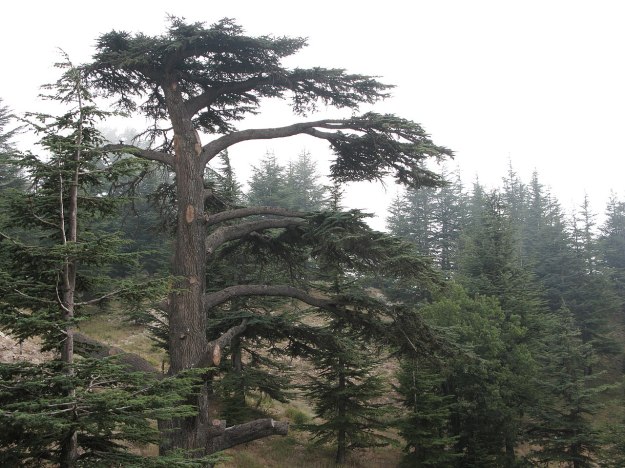
Cedar of Lebanon (Cedar of God), Lebanon By © Vyacheslav Argenberg / http://www.vascoplanet.com/, CC BY 4.0, https://commons.wikimedia.org/w/index.php?curid=92872076
Ezekiel 31
1In the eleventh year, in the third month, on the first day of the month, the word of the LORD came to me: 2Mortal, say to Pharaoh king of Egypt and to his hordes:
Whom are you like in your greatness?
3Consider Assyria, a cedar of Lebanon,
with fair branches and forest shade,
and of great height,
its top among the clouds.
4The waters nourished it,
the deep made it grow tall,
making its rivers flow
around the place it was planted,
sending forth its streams
to all the trees of the field.
5So it towered high
above all the trees of the field;
its boughs grew large
and its branches long,
from abundant water in its shoots.
6All the birds of the air
made their nests in its boughs;
under its branches all the animals of the field
gave birth to their young;
and in its shade
all great nations lived.
7It was beautiful in its greatness,
in the length of its branches;
for its roots went down
to abundant water.
8The cedars in the garden of God could not rival it,
nor the fir trees equal its boughs;
the plane trees were as nothing
compared with its branches;
no tree in the garden of God
was like it in beauty.
9I made it beautiful
with its mass of branches,
the envy of all the trees of Eden
that were in the garden of God.
10Therefore thus says the Lord GOD: Because it towered high and set its top among the clouds, and its heart was proud of its height, 11I gave it into the hand of the prince of the nations; he has dealt with it as its wickedness deserves. I have cast it out. 12Foreigners from the most terrible of the nations have cut it down and left it. On the mountains and in all the valleys its branches have fallen, and its boughs lie broken in all the watercourses of the land; and all the peoples of the earth went away from its shade and left it.
13On its fallen trunk settle
all the birds of the air,
and among its boughs lodge
all the wild animals.
14All this is in order that no trees by the waters may grow to lofty height or set their tops among the clouds, and that no trees that drink water may reach up to them in height.
For all of them are handed over to death,
to the world below;
along with all mortals,
with those who go down to the Pit.
15Thus says the Lord GOD: On the day it went down to Sheol I closed the deep over it and covered it; I restrained its rivers, and its mighty waters were checked. I clothed Lebanon in gloom for it, and all the trees of the field fainted because of it. 16I made the nations quake at the sound of its fall, when I cast it down to Sheol with those who go down to the Pit; and all the trees of Eden, the choice and best of Lebanon, all that were well watered, were consoled in the world below. 17They also went down to Sheol with it, to those killed by the sword, along with its allies, those who lived in its shade among the nations.
18Which among the trees of Eden was like you in glory and in greatness? Now you shall be brought down with the trees of Eden to the world below; you shall lie among the uncircumcised, with those who are killed by the sword. This is Pharaoh and all his horde, says the Lord GOD.
This fifth oracle against Egypt is like Ezekiel’s earlier oracle against the King of Tyre where the king is highlighted for their beauty and preeminent state among the garden of Eden.[1] Like that previous oracle the one who excels all others is brought low as they exceed their station as a creation of God. Although this oracle is directed against Pharoah and his hordes, it only mentions Pharoah or Egypt in the first and last verse, the rest of the oracle uses Assyria as an example for Egypt to heed. Assyria who was once the great empire in the north has collapsed and dragged all who allied themselves with her down to Sheol, and the same fate awaits proud Egypt in this oracle.
It is likely that Ezekiel is building upon Isaiah’s imagery in Isaiah 2:11-13 linking pride and great trees.
The haughty eyes of people shall be brought low, and the pride of everyone shall be humbled; and the LORD alone will be exalted in that day. For the LORD of hosts has a day against all that is proud and lofty, against all that is lifted up and high; against all the cedars of Lebanon, lofty and lifted up; and against all the oaks of Bashan;
Just as Daniel will probably utilize Ezekiel’s imagery in his own image in Daniel 4: 10-17 and Jesus alludes to this imagery in his parable of the mustard seed.[2] Yet, Ezekiel’s usage is the longest sustained use of this metaphor.
This oracle is dated almost two months after the previous one, June 21, 587 BCE. The city of Jerusalem is still besieged by Babylon, and it is possible that Babylon has already repulsed the Egyptian attempts to lift the siege. Egypt has been one of the significant powers in the ancient world throughout Israel’s history, and Egypt has continually exerted influence in the region around Israel. Now Egypt in this parable is told to look at a metaphor of Assyria. Assyrian was the great empire in the north prior to the emergence of the Babylonian empire. There are some translators who view Assyria’s presence here as a mistake, but thematically it makes sense to use a metaphor about Assyrian to demonstrate to Egypt that it too can fall from its great heights. Even though verses three through nine repeatedly refer to the beauty of this metaphorical tree and portray its majesty in an admirable light, like the earlier references to the King of Tyre, this is a case of prophetic satire. Although the kings of Assyria normally have the date palm as their image, the use of the cedar of Lebanon would be a well-known image of both size and strength, and a tree frequently used in royal and holy construction.
There are mythical elements in the background of this image, but they should not distract from the basic point that Pharoah and Egypt, according to the oracle, will share the same fate as Assyria. Although the waters nourished it and the deep made it grow tall, it will still fall when the prince of nations (King Nebuchadrezzar of Babylon) cuts it down. The waters and deep are the same Hebrew words used in Genesis 1:2 and this tree surpasses the trees of the garden of God (Eden) but ultimately, like the King of Tyre, its beauty, strength, and height cannot prevent its falling into the realm of the dead. The remnants of the tree fall on the mountains and valleys, just as the defeated ‘dragon’ in the next chapter will have its remains fall on the mountains, valleys, and waterways.[3] Now this great tree and all the lesser trees that inhabited the space under its branches find themselves in the Pit.
The very forces which once gave this great tree life now bury it in the depths. The rivers that flowed around it are now restrained and this once beautiful and living tree is now debris scattered upon the ground, or in other places brought down into the pit. The great tree and the empire it represents are now dead, and Egypt who is similarly a great tree is in danger from the same axe wielding prince of the nations. In the oracle Pharoah and all his armies cannot oppose God and God’s chosen instrument of vengeance King Nebuchadrezzar.
As mentioned before there are limited historical records from this period. We do know that Nebuchadrezzar does eventually turn his army to march on Egypt. Although the Babylonians have enjoyed multiple victories over Egypt, Egypt never becomes a part of the Babylonian empire. The great cedar tree which represents Egypt will stand at least for a time longer. Ezekiel interprets the actions of the king of Babylon and his forces as an extension of the will of the God of Israel. Even though Jerusalem is under siege, the LORD’s actions, in Ezekiel’s mind, are just. The LORD is not merely the God of Israel but is at work in the movement of empires to bring about the will of God.
[2] Matthew 13: 31-32, Mark 4: 30-32, Luke 13: 18-19
[3] Ezekiel 32: 5-6.
 Sign of the Rose
Pingback: Ezekiel 32 Concluding the Oracles Against Egypt | Sign of the Rose
Pingback: The Book of Ezekiel | Sign of the Rose