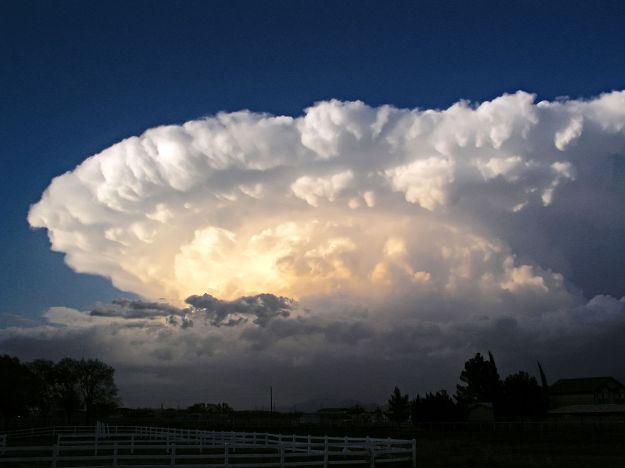
Supercell Thunderstorm over Chaparral, New Mexico on April 3, 2004
Psalm 97
1 The LORD is king! Let the earth rejoice; let the many coastlands be glad!
2 Clouds and thick darkness are all around him; righteousness and justice are the foundation of his throne.
3 Fire goes before him, and consumes his adversaries on every side.
4 His lightnings light up the world; the earth sees and trembles.
5 The mountains melt like wax before the LORD, before the Lord of all the earth.
6 The heavens proclaim his righteousness; and all the peoples behold his glory.
7 All worshipers of images are put to shame, those who make their boast in worthless idols; all gods bow down before him.
8 Zion hears and is glad, and the towns of Judah rejoice, because of your judgments, O God.
9 For you, O LORD, are most high over all the earth; you are exalted far above all gods.
10 The LORD loves those who hate evil; he guards the lives of his faithful; he rescues them from the hand of the wicked.
11 Light dawns for the righteous, and joy for the upright in heart.
12 Rejoice in the LORD, O you righteous, and give thanks to his holy name!
One of the losses of our modern, technology filled world is the patient hope of the psalmist and the prophets for the arrival of God’s kingdom. James L. Mays notes that Psalm 97 shares several key images and ideas with the portions of Isaiah most scholars attribute to Judah’s time in exile.[1] (Mays, 1994, p. 311) The psalmist’s proclamation of God’s reign causing the earth, Judah, and the righteous to rejoice were always contested claims. Israel and Judah lived in a world of multiple religious options and empires who exercised military, economic, and political might over Israel or Judah. Yet, the psalms and the prophets exhibit a persistent faith that despite the evidence to the contrary the God of Israel reigns over creation, is chief among the gods of the nations, and continues to sow joy and righteousness in the upright in heart. It is only through the eyes of faith that these poets can rejoice with the earth and the coastland because their vision has revealed to them that the LORD, the God of Israel and Judah, is king.
The vision of God in the psalms and the prophets may, as Brueggemann and Bellinger comment, retain the “remnants of a storm god.” (Brueggemann, 2014, p. 418) but as in Psalm 29 the use of the language of clouds and darkness, fire, lightning, and earthquake takes the primary language for the power of the Canaanite god Baal and now uses it to describe the power of the LORD the God of Israel. This imagery also resonates with the appearance of the LORD to the people at Mount Sinai in Exodus 19:16-19. The psalmist longs for the day for all the people to see what the eyes of faith trust: that the idols of the nations are worthless, that the kings of the earth and the gods of the nations are powerless before the LORD who is king, and that the power of the wicked over the faithful will end as God rescues them.
God’s righteousness and justice are the foundation of God’s throne, and they are also the foundation for the hopeful imagination of the psalmist. The heavens can proclaim God’s righteousness and the people of Judah can find reasons for rejoicing and gladness because of God’s judgments. Because God’s reign is based on righteousness it opens the possibility that people in Judah and beyond the borders of Judah can live as righteous ones rather than adopting the ways of the wicked. The response throughout the poem to the righteousness and justice of God is joy and gladness. The earth can rejoice, and the coastlands can be glad because the creation bears witness to the just reign of God. Zion can be glad, and the towns of Judah can rejoice because God judges with righteousness. The ones loving the LORD will hate evil[2] and God will guard their lives and sows[3] light and joy in these faithful ones of upright hearts. These righteous ones planted with light and joy in the rejoicing earth now join the earth’s joy at the celebration of God’s reign.
[1] See for example Isaiah 40: 5, 9-11; 42:17, and 52: 7-10
[2] In both the MT (Hebrew) and LXX (Greek translation) the direct translation is “The ones loving the LORD hate evil” as the NIV captures. The NRSV follows the translation of scholars who in their attempt to smooth our the translation change the subject to God, but there is no reason to make this change to the original text. (Nancy deClaisse-Walford, 2014, p. 724)
[3] Some change this word to a similar Hebrew word for ‘rise, shine’ (hence the NRSV translation) but the metaphor of sowing light fits with the imagination of the psalmist. (Nancy deClaisse-Walford, 2014, p. 724)
 Sign of the Rose
Pingback: Psalm 114 The Awesome God of the Exodus | Sign of the Rose