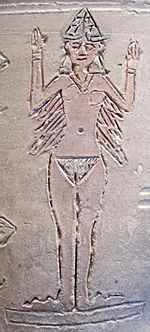
Ishtar Vase from between 1999 and 1500 BCE
Mocking the Idols: Jeremiah 10: 1-16
Hear the word that the LORD speaks to you, O house of Israel.
2 Thus says the LORD:
Do not learn the way of the nations,
or be dismayed at the signs of the heavens;
for the nations are dismayed at them.
3 For the customs of the peoples are false:
a tree from the forest is cut down,
and worked with an ax by the hands of an artisan;
4 people deck it with silver and gold;
they fasten it with hammer and nails so that it cannot move.
5 Their idols are like scarecrows in a cucumber field, and they cannot speak;
they have to be carried, for they cannot walk.
Do not be afraid of them, for they cannot do evil, nor is it in them to do good.
6 There is none like you, O LORD; you are great, and your name is great in might.
7 Who would not fear you, O King of the nations? For that is your due;
among all the wise ones of the nations and in all their kingdoms there is no one like you.
8 They are both stupid and foolish; the instruction given by idols is no better than wood!
9 Beaten silver is brought from Tarshish, and gold from Uphaz.
They are the work of the artisan and of the hands of the goldsmith;
their clothing is blue and purple; they are all the product of skilled workers.
10 But the LORD is the true God; he is the living God and the everlasting King.
At his wrath the earth quakes, and the nations cannot endure his indignation.
11 Thus shall you say to them: The gods who did not make the heavens and the earth shall perish from the earth and from under the heavens.
12 It is he who made the earth by his power,
who established the world by his wisdom,
and by his understanding stretched out the heavens.
13 When he utters his voice, there is a tumult of waters in the heavens,
and he makes the mist rise from the ends of the earth.
He makes lightnings for the rain, and he brings out the wind from his storehouses.
14 Everyone is stupid and without knowledge;
goldsmiths are all put to shame by their idols;
for their images are false, and there is no breath in them.
15 They are worthless, a work of delusion;
at the time of their punishment they shall perish.
16 Not like these is the LORD, the portion of Jacob,
for he is the one who formed all things,
and Israel is the tribe of his inheritance; the LORD of hosts is his name.
The people of Jeremiah’s time, like people in our own time, live in a world of multiple allegiances and gods and one of the central commandment of the Jewish people was not to create an image for their God. There is always the temptation to attempt to place our hopes in the things that we create, and so Jeremiah like Isaiah (see for example Isaiah 44: 9-20) has a section of mocking the idols as powerless. Yet these idols are things that are consuming the most precious resources: gold, silver, the finest clothing, the best wood, caring sculpted by an artisan and yet they are nothing. The Hebrew word hevel comes up three times in this section talking about the idols, this is a word which goes back to the name Abel (from the Cain and Abel story) which is most famously picked up in Ecclesiastes:
Vanity of Vanities,says the teacher
Vanity of Vanities! All is vanity. Ecclesiastes 1:2
The word translated vanities (hevel) is literally mist, smoke, vapor-it is something that when grasped onto vanishes within one’s grasp. Those who are trusting in these things they created are finding the objects of their trust are no more reliable than the evanescent vapor of a morning fog.
In our own time we have our own idols as well, they may not be stone, wood or metal statues but they may be individuals (athletes, politicians, actors, musicians); military might or power, security, wealth, fame, position or status or any number of other things. They may be external things we give our allegiance to or they may be things we create (or at least believe we create) with our own hands. Often they are tied up with our wealth and where our wealth is directed. And just like the people of Jeremiah’s time who invested their wealth into the creation of images of gods, we too invest our wealth where our gods are. As Walter Brueggemann can point out false economics and false religion are tied together (Brueggemann 1998, 103) or as Jesus says in the Sermon on the Mount:
For where your treasure is, there your heart will be also Matthew 6: 21.

The Leaders who Lead Astray Jeremiah 10: 17-25
17 Gather up your bundle from the ground, O you who live under siege!
18 For thus says the LORD:
I am going to sling out the inhabitants of the land at this time,
and I will bring distress on them, so that they shall feel it.
19 Woe is me because of my hurt! My wound is severe.
But I said, “Truly this is my punishment, and I must bear it.”
20 My tent is destroyed, and all my cords are broken;
my children have gone from me, and they are no more;
there is no one to spread my tent again, and to set up my curtains.
21 For the shepherds are stupid, and do not inquire of the LORD;
therefore they have not prospered, and all their flock is scattered.
22 Hear, a noise! Listen, it is coming—
a great commotion from the land of the north
to make the cities of Judah a desolation, a lair of jackals.
23 I know, O LORD, that the way of human beings is not in their control,
that mortals as they walk cannot direct their steps.
24 Correct me, O LORD, but in just measure;
not in your anger, or you will bring me to nothing.
25 Pour out your wrath on the nations that do not know you,
and on the peoples that do not call on your name;
for they have devoured Jacob;
they have devoured him and consumed him,
and have laid waste his habitation.
Who is the mourner, is it the prophet, is it Zion personified, or is it God? Any of the three, and perhaps all of the three are mourning together. The reality is that for those who are willing to listen, which seems to be few if any, they are to flee like the people of Israel fleeing at the beginning of their exodus in the wilderness. In the midst of the wounded God, wounded prophet and a wounded people we see at the center of things are the leaders who have led the flock astray. This is not the world where everyone makes their own decision on things, in fact the Davidic and priestly leadership would claim divine authorization, and yet they had not inquired of God. Rather they had probably looked out for their own interests, ensuring their own comfort, and operating much as any other nation’s leaders operated. If the leaders don’t live out the vision of God’s peace what hope do the people have.
At verse 23 we have a shift and the prophet is talking back to God, pleading both for God’s mercy and justice at the same time. Much as Psalm 6 begins with an appeal for God to act justly but not in anger:
O Lord, do not rebuke me in your anger,
Or discipline me in your wrath. Psalm 6:1
The plea is for God to calm down, to make decisions after God’s anger has dissipated which places the prophet in a precarious place (which any person who has told a person who is raging to calm down knows) and then also calls on God to pour out God’s wrath on the nations around Jerusalem. To hold them to the same standard that Jerusalem is being held to.
Being the set aside people of God is a dangerous position, God has high hopes for them. The calling is a gift and a challenge at the same time. The people have failed in their vocation and are now enduring the wrath and the grief of God. Wrath is an uncomfortable term and I probably need to spend some time talking about it, but ultimately God is not passive-God does take sides and one of the hopes that Christians have is that God will not allow injustice to continue indefinitely. Unfortunately, many times this image of God’s wrath has been used as an object of fear to prop up the unquestioned authority of the church or particular leaders, and this would not be that different from Jeremiah’s day with the temple and king.


 Sign of the Rose